Updated Date: Feb 24, 2026

Urban transportation has changed a lot in the last few years, but the biggest change came when taxi booking became a mainstream option, allowing people to book a ride in a few clicks on their mobile phones. Popular platforms like Uber and Lyft were the torchbearers of that change, transforming the mobility patterns of urban people.
Now, the next question was: comparing Uber vs. Lyft to find out which is better? If you just analyze them based on drivers’ and riders’ workflows, they would appear similar to you: both use separate apps for drivers and riders, and both provide control to business owners through a centralized platform. However, if you dive deep, you will find that there’s a difference in customer reach, price, features, revenue, etc.
To make that decision easier for you, we’ve written this blog, which will help you understand where Uber is better and where Lyft stands out based on various parameters, use cases, and scenarios, so you can pick the right one for your business.
Uber vs Lyft: An Overview
Founded in 2009, Uber is a taxi-hailing app that operates in more than 15,000 cities across 70+ countries, with major coverage in the USA. According to reports, the Uber app generated USD 27.44 billion in gross bookings, up 22%, and the delivery number reached USD 25.43 billion, up 25%. The cumulative earnings for Q4 2025 were USD 54.1 billion.
Founded in 2012, Lyft is a ride-hailing app that primarily operates in North America and four major Canadian provinces. Lyft reported USD 5.1 billion in gross bookings (up by 19% YoY), USD 1.6 billion in annual revenue, 243 million rides, and 29.2 million active users as of Q4 2025. In the last few years, Lyft has expanded its operations in Europe and upgraded its services to the premium category, but it still operates on a smaller scale than Uber.
With massive presence, worldwide reach, and operational experience, Uber is way ahead of Lyft in sales and revenue, while Lyft is a more region-specific model.
Lyft vs Uber – Average Sales Per Customer
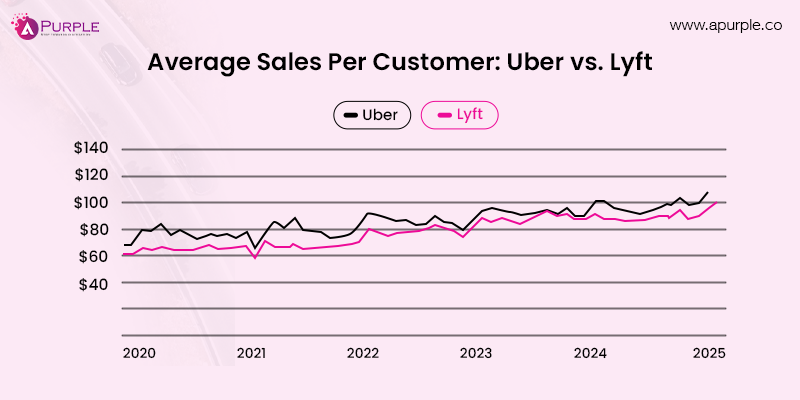
With the help of average sales per customer, you can know whether customers are willing to pay a sufficient amount for the ride-hailing platform services and how long these taxi-booking services can survive and stay relevant.
According to the chart data, Uber’s average sales per customer rose from about USD 75 in 2019 to around USD 113 by 2025, indicating that customer spending has been rising steadily over the last few years. From these numbers, you can easily say that Uber’s customer loyalty is pretty strong and their user have no hesitation in paying more per-trip and for monthly expenses.
During the same period, Lyft’s average sales per customer rose to USD 100 by the end of 2025, up from USD 65 in 2019, indicating steady sales growth. However, compared to Uber, the growth was slightly slower. One thing you can observe is that Lyft has a more conservative growth strategy, yet it maintains a strong customer retention rate, reflected in steady sales.
By doing this comparison, you will know which taxi booking services are generating the most sales and revenue per customer. Also, we have compared per-customer sales because total revenue doesn’t always translate into the application’s success. There are also a lot of factors that can be market-specific, operational, and technical that play a significant role in deciding how an application will perform.
Must-Watch Podcast For You Before Developing a Taxi Application:
Now that we know that revenue and sales per customer play a vital role in determining the success of any taxi service, let’s compare the business models of Uber and Lyft that shape those decisions.
What’s Uber’s Core Business Model?
Uber’s business model is generally focused on developing an intermediary platform that allows it to support various transportation services without directly owning any vehicles or hiring any drivers. What Uber does is run a centralized digital platform that connects drivers and customers, and all management is handled by Uber. Also, they use the infrastructure for freight, logistics, and food delivery services.
If you go deeper into Uber’s operations, you will realize that they create separate apps for drivers and riders (customers), and both user roles are supported by a centralized system for pricing, fraud detection, demand & supply, and region-based performance. What Uber’s matching algorithm does is that it doesn’t just provide you with a nearby driver or customer; it also takes into account arrival time, supply availability, driver behaviour, service quality, and more to provide you with the best available option. Here, the rider submits the request, and the driver has the right to accept or reject it based on distance, incentives, price, and the current traffic situation.
This became the widely recognized method, and now people know it as the “UberX-style” on-demand model. However, many startups are trying to replicate this business model for on-demand services to build an app like Uber without realizing how dependent it is on local density and operational scale. In the last few years, Uber has tried to build a stable revenue model by investing in services beyond taxis and signing long-term partnerships with mobility giants, making its business model more sustainable than those of other companies.
What’s Lyft’s Core Business Model?
At a high level, Uber’s business model and Lyft’s business model operate in very similar ways. Just as Uber does, Lyft also serves as a platform that connects riders and independent drivers.
In its early years, Lyft set itself apart from others with its shared rides as the main focus and community-oriented approach as the main branding. But eventually, Lyft changed its strategy and went for shorter, more frequent urban trips, thus increasing both driver utilization and unit economics.
Currently, customers (riders) can choose and book Economy, Premium, and XL ride options straight through the Lyft app. Just like Uber, Lyft is completely operated through a mobile app. Drivers who get the ride requests instantly can accept or deny them according to their availability and potential earnings.
If both platforms use a similar model, the next question is whether pricing is also similar?
The answer is “No”!
Lyft vs. Uber: Is There a Price Difference?
There are noticeable pricing differences between the Uber and Lyft taxi booking applications across particular cities, ride types, and times. The latest research on more than 2200 rides shows that the price gap between Uber and Lyft was on average 14% (~$3.50 to $4.15) for the same trips, and neither of them was always cheaper.
If you analyze the pricing of both Uber and Lyft taxi booking applications, you will find that they vary by city, ride type, and time of day. The latest research on more than 2200 rides shows that the price gap between Uber and Lyft was on average 14% (~$3.50 to $4.15) for the same trips, and neither of them was always cheaper. According to Q4 2025 reports, Uber averages $14.62 gross per ride with Comfort at $23.50, while Lyft averages $20.85 gross per ride, while premium equivalent is $22.80.
Dynamic pricing is common to both ride-hailing applications; they have base rates, per-mile (~$1-2 by city), per-minute fees, and surges. For example, Lyft in New York City fares around $1.09-$1.82 per mile, and there’s no uniformity across cities. There’s generally 7.2% YoY increase in ride chargers, which translates to an average price of $15.99, and the suburban price always depends on demand.
Generally, people understand that Uber is the more expensive option than Lyft. However, there are some cases where Lyft can charge you more than Uber does during peak demand. However, in a normal scenario, Lyft generally offers a cheaper option, but there’s not a huge difference in pricing. One major difference between Uber and Lyft is that Uber has a larger pool of drivers, so availability is better than Lyft’s.
What Is The Market Share of Uber and Lyft?
If you compare the market share of Uber and Lyft, you will find that Uber is still dominating the charts in 2026, with 74%-76% of the market share in the USA, while Lyft holds 24%-26%. The reason for Uber’s long-term dominance is its diversified business. It doesn’t rely solely on the taxi business; it has also expanded into food delivery, logistics, and freight.
On the other hand, Lyft is only focused on ridesharing so far; it’s just that it’s thinking of expanding its business into healthcare and transportation, which explains the difference in market share between the two platforms.
What Types of Services Do Uber and Lyft Provide?
When you compare the types of services offered by Uber vs Lyft, Uber provides a larger range of services than Lyft.
| Service Category | Uber | Lyft |
|---|---|---|
| Standard Ride Booking | UberX: It’s an everyday car with a limit of 4 passengers; the most affordable solo option. | Lyft Standard: Standard cars with a capacity of 4 passengers; straightforward and reliable option. |
| Large Vehicle Service | UberXL: Provides SUVs or minivans with a seating limit of 6 passengers. Also gives options for premium interiors. | Lyft XL: A Spacious vehicle for a group of 6 passengers; XXL upgradation available in selected areas. |
| Comfort Rides | Uber Comfort: New vehicles with extra legspace and top-rated drivers. | Extra Comfort: Serves roomier cars with highly rated drivers and multiple amenities. |
| Premium Rides | Uber Black: Offers professional drivers with great experiences in luxury sedans. | Lyft Black: Upscale sedans with leather seats and premium service availability. |
| Luxury Rides | Uber Lux: High-end vehicle choices for elevated journey experiences (available in key markets). | Lyft Black SUV: Luxury SUV options for up to 6 passengers, focusing on comfort as well as style. |
| Car Pooling | UberX Share: Route-matched shared rides availability, now including Route Share for fixed commuter corridors with a discount of 50% off. | Shared Rides: Pooled trips for customers with others on similar routes; this can include Wait & Save for budget shared options. |
| Food Delivery | Uber Eats: On-demand meals, groceries, and pharmacy delivery services in minutes from thousands of partners. | N/A |
| Freight Management/Logistics | Uber Freight: Full truckload and logistics services for businesses to ensure seamless transportation. | N/A |
| Scooter Rentals | Uber Green: Electric bikes and scooter services integrated for short and eco-friendly trips in 100+ cities. | Lyft Scooters and Bikes: Gives dockless e-scooters and bikes for quick urban trips, with a Community Pass discount. |
| Healthcare Transportation | Uber Health: Non-emergency rides, plus grocery/OTC delivery for patients. Additionally, it now covers flex cards and home health coordination. | Lyft Healthcare: Provides appointment rides with assisted door-to-door support, now available in 21 states. |
This comparison of different types of ride services highlights how Uber prioritizes scaling while the Lyft app prioritizes its core focus. But for drivers, how the app compensates and provides consistency matters more than the service variety. Let’s explore it in the following section.
How Are Drivers Compensated and What Benefits Do They Receive?
From the driver’s perspective, it’s essential to know the types of fares, compensation, and incentives Uber and Lyft offer. Based on that analysis, drivers can determine which platform is best for them based on cost, availability, and driving habits.
- If you talk about 2026, an Uber driver can earn up upto USD 25-30 per hour in metros like New York or Los Angeles. When you go to California, the driver can earn $24/hour. If you’re working full-time (40+ hours a week), you can earn up upto USD 800 to USD 1,000 per week and USD 41,000 to USD 52,000 per year.
- If you want to work as a Lyft driver, you can earn around $22 to $28, and in some urban pockets the rate can go upto $35. Also, one of the good things about Lyft is that they always try to give 70% of rider fares back. Lastly, if you talk about full-time earnings, they can go up to USD 35,000 to USD 45,000.
But what about other perks and benefits?
Here is a comprehensive comparison of drivers’ different perks with Uber vs. Lyft!
| Perks & Benefits for Drivers | Uber | Lyft |
|---|---|---|
| Flexibility | Drivers can set their working schedules and switch between rides/deliveries. | Drivers can set their working hours and locations for busy zones. |
| Bonus and Incentives | Opportunity to receive promotions during peak hours, Uber Pro rewards. | Drivers can have turbo bonuses (10-40%), ride challenges, and reward points for tiers. |
| Cashback on Gas | For some markets, it can be received via Uber Pro. | Based on rides, drivers get cashback on fuel. |
| Access to Wellness Perks | Limited, focus on EV health/safety tools. | Debit card for wellness perks like gym discounts. |
| Community Stories | Driver hubs in the application for important tips/updates. | Driver blog option for stories and local events. |
How Do Uber vs. Lyft Compare in User Experience?
This comparison compares Uber and Lyft across key factors, including price, compensation, and market share. However, it will still be incomplete without considering the user experience of both ride-sharing apps.
The basic ride-booking experiences of Uber and Lyft are still very similar, but both platforms have made their apps even better by supporting different strategic priorities. Uber is still integrating various services like rides, delivery of food, and local businesses into a single application, making it more convenient for frequent users.
On the other hand, Lyft is adopting a less complicated and more focused interface, which results in faster bookings and reduced friction with decision-making. Still using rider-driver identification tools to enhance pickup accuracy, the two platforms eventually came to a point where these features are considered standard expectations rather than standout differentiators.
The dedicated rider app also offers live ride tracking, instant communication with drivers, and fare estimation features. These may sound like basic functionality, but even their clones involve a thorough analysis of the Uber app development cost. The price may vary and can be higher depending on the complexity level of integrated features.
A user who picks one of the two ride-sharing apps just for the sake of the app experience may feel that there is a difficult choice. But if you weigh all the factors mentioned above, like price, service type, app experience, and market share, then the decision is made a bit easier!
What Are the Future Trends and Innovations for Uber and Lyft?
In 2026, you will see ride-hailing companies like Uber and Lyft investing heavily in the latest technologies and innovations, such as EVs, autonomous vehicles, sustainability, and eco-friendly practices.
Uber has already announced to bring driverless vehicle fleets to the San Francisco Bay Area by 2026, and for that purpose, it has already signed deals with leading autonomous companies. In addition, Uber is working on its super app strategy by integrating modules for package shipping, public transportation, ride-hailing, and food delivery into a centralized platform. Lastly, Uber is also focusing on the environment and sustainability, and for that purpose, it has invested USD 800 million in the Green Future Program to provide electric vehicles to drivers and support the global net-zero emissions goal by 2040.
On the other hand, Lyft is also focusing on deploying driverless cars by 2026 and working toward 100% electric fleet goals by 2030. For that purpose, it has launched the Green Mode initiative, which has expanded to 22 cities and 40 airports so far, allowing passengers to book electric or hybrid rides. Although Lyft is also considering building a super app to streamline operations, it is also focusing on major partnerships in healthcare transportation and has invested in bike and scooter ride services in urban areas.
Uber vs. Lyft: It’s Verdict Time!
There can’t be a one-size-fits-all approach when it comes to choosing between Uber and Lyft. It depends on a variety of factors. If you are looking for global reach, higher market share, diverse services, and exceptional operational capabilities, you should opt for Uber. Also, when it comes to higher revenue and sales per customer, Uber dominates the market.
However, these are not the only factors on which you should make informed decisions. You should also consider your business’s unique needs, personal preferences, users’ location, and more. If you talk to end users and drivers, they may prefer Uber because of its higher availability and greater earnings/incentives. But finally, it comes down to the region where you want to book a ride or become a driver, because in some regions Lyft may be a better option than Uber.
So, if you’re a startup founder interested in the taxi business and want to develop a taxi application like Uber or Lyft, connect with aPurple with your requirements.
FAQs
Uber and Lyft ride-hailing apps differ mainly in terms of drivers’ pay structure, incentives, and flexibility. Uber provides higher trip volume and great earning opportunities by accessing busy markets, while Lyft often provides simpler incentives and a more driver-friendly app experience. Drivers mostly choose an app based on local demand and personal earning goals, as the pay rates, bonuses, surge pricing, and driver support can vary city to city.
The tipping period for Lyft is 72 hours, while Uber accepts cash tips or tipping before the trip ends. Uber has more cities in the world, while Lyft’s trip receipts are clearer.
Yes, as long as they meet city requirements for insurance, background checks, and minimum ages.