Uber, the name is enough today…
Uber Technologies, Inc. is no longer just a company; it’s the kind of startup story every founder looks up to. Whenever they think about building something scalable, disruptive, and long-lasting, Uber is their role model.
Starting as an online ride-hailing solution has expanded to a multi-industry targeting ecosystem. From efficient cab booking to food delivery, freight, and healthcare, Uber’s business model has thrived by differentiating itself.
Being the best on-demand app platform, it has seamlessly scaled the business. For any budding startup, Uber’s journey shows how to build, pivot, and expand with purpose. If Uber has made it through the years, so can you. Staying consistent with driving your innovative concept is the main gateway. So, get along with this piece, starting with the basics on Uber…
Uber Company Overview
Founders: Garrett Camp & Travis Kalanick
Parent Company: Uber Technologies, Inc.
Headquarters: San Francisco, California, USA
Industry: Mobility as a Service (Ride-hailing, Delivery, Freight)
Uber App Ratings: iOS – 4.9 & Android – 4.7
Customer Base & Courier Base: 200–202 million monthly active users
Driver Base: ~10 Million globally
Daily Trips: ~40–42 million trips /orders per day
Service Locations: Serves 70+ countries & 15,000+ cities worldwide
To learn how to begin as a budding firm and adapt to the flexible market demand, you must know about;
What is the Uber Business Model?
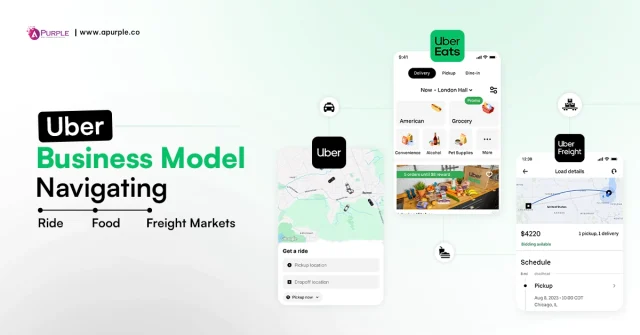
Uber’s business model is a simple, aggregator-based one, making it the bridge to connect multiple user panels. It generates revenue through commissions and an AI-based surge-pricing model. The major success driver of Uber has been its thriving brand building, vast audience base, forecasting the demand of the flexible market, and optimizing its resources. It has amplified from a mere taxi booking app to different aspects, such as;
- Uber Eats = B2C convenience play
- Uber Freight = B2B logistics optimization
- Uber Health = B2B2C healthcare infrastructure
These 3 pillars of Uber have one thing in common: their core asset, i.e., driver network + routing tech. Moreover, the major difference lies in the industry and the different monetization layers.
So, this is how Uber Technologies, Inc. evolved from a ride-hailing app to a multi-industry online space. Next, jumping into the Uber business model and services operations. It will make the picture clearer about Uber.
How Does Uber’s Business Model Work?
The Uber business model is a three-facet on-demand mobility marketplace. It has been introduced as the online taxi/cab booking solution, and now serves to deliver food, freight, and healthcare essentials. It has smartly expanded to a multi-vertical business.
Moreover, it has become popularized as a mediator business. It handles both user requests and driver requests, accepting them at the unified platform. Accordingly, it has emerged as a booming on-demand taxi application. Therefore, Uber has become a household name in diverse regions across the globe. This is extremely aligned with Uber’s marketing strategy from the very beginning.
What is the Marketing Strategy of Uber?
Uber’s business model strategy is a very clear and compelling one, with a unique value proposition in the market. The tagline “On our way” has been representing reaching on time for life’s important moments, no matter how big or small they are.
Its business model is more network-driven, but what really worked out for Uber is the emotional connection through transportation. That has stuck in the user’s mind and turned the fortune of Uber. So, it has opened a variety of opportunities and scope for Uber.
However, you know what actually led Uber to shine is the continuous adaptation. As the online taxi solution Uber has expanded into a delivery partner. Without constraining itself to just the big taxi booking app, Uber has grown rapidly. From diverse vehicle types to becoming a logistics partner, food delivery provider, it has really come a long way in the online marketplace.
Uber Ride Types & Their Strategy
Uber’s mindblowing ride type segmentation has been an attractive value proposition. You can make an app like Uber as the taxi or ride booking partner (even start with bike ride services). Anyways, moving to the type;
1. Standard & Everyday Ride Types
-
UberX –
Everyday Ride
-
UberX Share (formerly UberPool) –
Shared Ride
-
Uber Comfort –
Spacious & Premium Economy
-
UberXL –
Group Travel
2. Premium & Luxury Ride Types
-
Uber Black –
Luxury Sedan
-
Uber Black SUV –
Luxury Group Travel
3. Specialized & Accessibility Services
-
Uber WAV –
Wheelchair Accessible Vehicles
-
Uber Assist –
Extra Support Service
Uber Ride-Sharing Strategy – The Actual Mastermind
By putting thorough effort into research and analysis, Uber has segmented the ride-hailing process in the following ways;
1. Tiered Pricing
- Low-cost: UberX, Moto, Auto
- Mid-tier: Comfort, XL
- Premium: Black, Black SUV
2. Asset Optimization
- Economy rides
- Delivery Partners (Uber Eats)
3. Localization Strategy
- India → Auto, Moto
- US/EU → Comfort, Black, EV
- Healthcare → WAV, Assist
4. Future Captivating Strategy
- EV adoption (Uber Green)
- Autonomous Vehicles (Robotaxis)
Moreover, the main focus of Uber is to tap into different demographics of users. It has been moving to a high-end mobility solution. So, Uber is holistically covering the delivery, transportation, and logistics market. This is more well-versedly understood by the business model canvas of Uber below.
Uber Business Model Canvas (BMC)
Uber has been the transforming power not just in the taxi booking industry but also as a delivery and logistics solution. To make a detailed outlook on this, you will have the separate and curated business model canvas of Uber, Uber Eats, Uber Freight, and Uber Health, respectively.
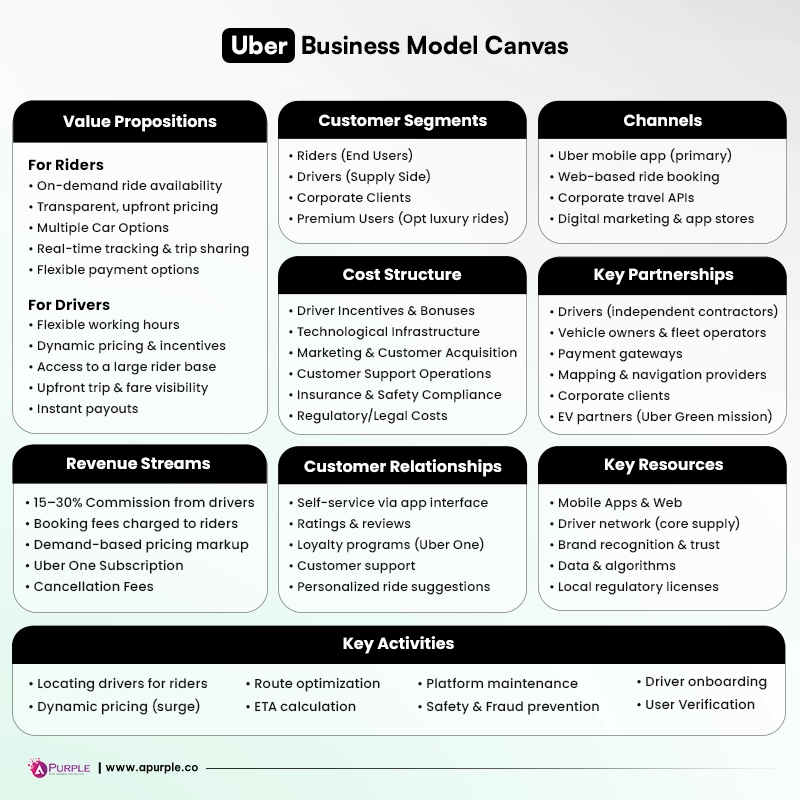
1. Uber Business Model Canvas
Uber’s core ride-hailing model connects riders and drivers through a real-time, AI-powered marketplace. It operates as per the given structure.
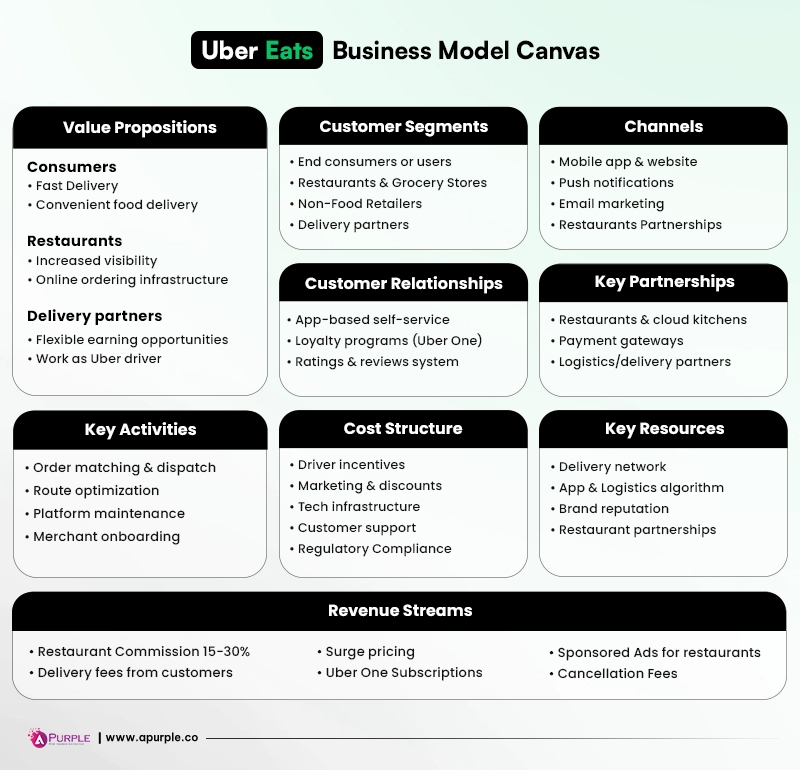
2. Uber Eats Business Model Canvas
Uber Eats extends Uber’s platform into food delivery, connecting users, restaurants, and couriers seamlessly. Check out the image info for deeper insight.
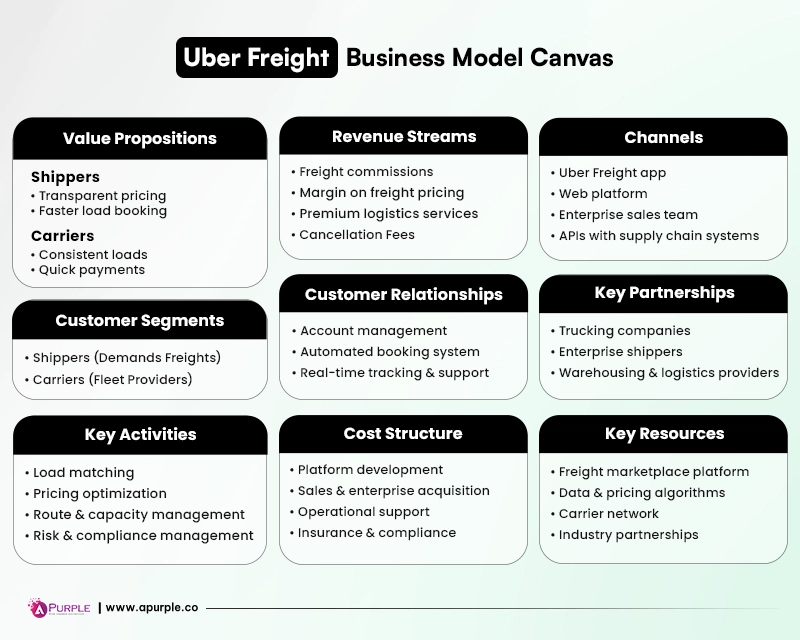
3. Uber Freight Business Model Canvas
Uber Freight digitizes the logistics industry by connecting shippers with carriers through a transparent platform. It works as follows;
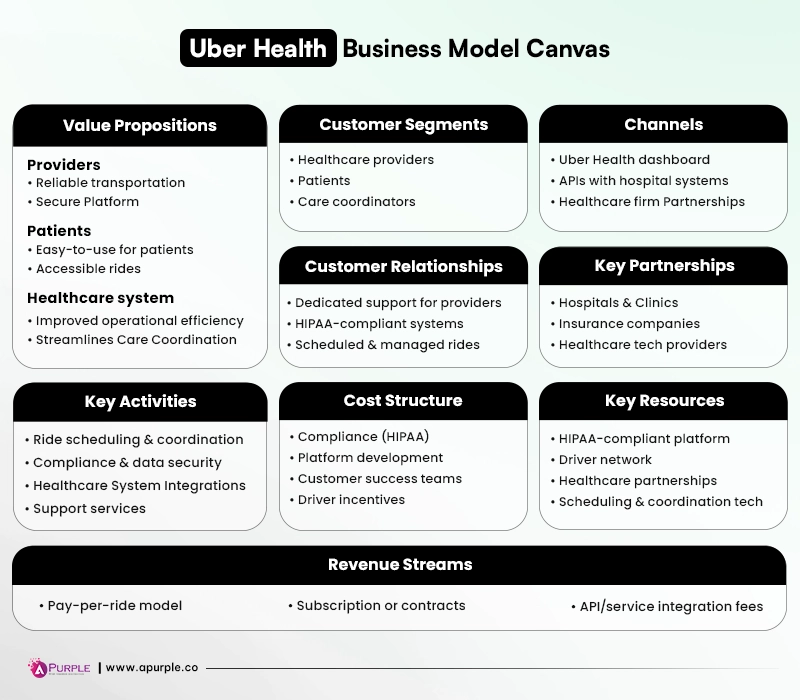
4. Uber Health Business Model Canvas
Uber Health provides non-emergency medical transportation by integrating directly with healthcare providers. See how this performs to manage the healthcare deliverables.
The major takeaway for emerging startups from Uber’s business model is multiplying the recent opportunities to your benefit. It is highly recommended to drive your unique and innovation-oriented business. The competition has upgraded, and so should your approach. Although we all have used Uber and know how it works. But you must gain clarity on the different user panels of Uber.
How Does Uber Work For Drivers?
The driver panel of Uber works as follows:
- To become a reliable driver on Uber, you must share and verify your personal information. Name, age, background check, valid driver’s license, and other information must be validated.
- With the assurance of guaranteed earnings for each accepted ride, the driver experiences better interaction.
- Drivers are notified when nearby riders request to book a taxi. It displays the current location, fare, time, and destination of the ride.
- As a result, they can accept or reject the ride based on their preferences.
- After each ride, the rider pays with cash, a credit card, or online.
How Does Uber Work for Riders?
Riders can use Uber to book taxis and bike rides in the following way.
- Users can create a rider (passenger) profile that includes their name, contact number, and location.
- When users want to get somewhere by taxi, they (riders) can mention the location and search for nearby taxis, bikes, and scooters on Uber.
- You can book the ride based on your preferred car type and fare.
- Furthermore, whichever driver accepts the rider’s location and arrives at their destination on time.
- The driver selects the rider and requests the PIN verification. As a result, the idea begins at the destination.
- When the driver drops off the riders, they pay in the predefined mode.
Now, moving to the value propositions for each stakeholder of Uber.
What are the Unique Value Propositions of Uber’s Business Model?
As you know, different panels generally engage on the platform, which are;
1. Riders
2. Drivers
Let’s dive into the value it offers to them, starting with the driver panel first…
1. Value Proposition For Drivers
Drivers are the core pillars of any business trying to execute an Uber, and they are highly valued, too.
- Earn more on each ride, supported by dynamic surge pricing, upfront fare visibility, and incentive programs like quests and bonuses to maximize earnings.
- Able to accept or reject the ride request, with upfront trip details such as estimated earnings and destination visibility before accepting.
- Choose the work timings, along with enhanced flexibility features like destination filters and preferences. It will let them control trip types and working zones.
- Able to accept payments on the go, including instant cashouts (Instant Pay), digital wallets, UPI (in India), and weekly automatic transfers.
- Access multiple earning streams such as ride-hailing, food delivery (Uber Eats), and package delivery (in select markets), increasing overall utilization and income opportunities.
2. Value Proposition For Riders
Riders are your customers, and providing them value is crucial. Some essential value propositions riders can expect are,
- X nearest algorithms in the Uber app allocate drivers in the nearby location to users for each ride request. Well, it has been enhanced with AI-based matching that considers ETA, traffic conditions, driver ratings, and route optimization.
- Proper breakdown of the fare with an accurate estimation, including upfront pricing and real-time adjustments.
- Before deciding on what type of vehicles they can choose for the rides, with expanded options including EV rides (Uber Green), Comfort, XL, and premium categories like Black.
- Ability to track their request and provide feedback, supported by real-time GPS tracking, live trip sharing, safety toolkit, and SOS emergency features.
- Ease of payments through multiple options, including UPI, wallets, cards, cash (in select regions), and split fare functionality.
- Access to booking across devices, along with web booking, third-party integrations, and the ability to book rides for others remotely.
- Access to subscription-based benefits like Uber One, offering discounted rides, priority service, and bundled perks across services.
- Enhanced safety and trust measures, including driver background checks, ride verification (PIN), and AI-based anomaly detection during trips.
Uber’s Revenue Model – How Does It Make Money?
Several revenue streams drive the Uber business model. You can leverage these streams to ensure profits for your business and drivers.
1. Commission on Each Ride
On average, you can earn 15-30% commission on each ride. Uber charges 25-40%, depending on the location and demand.
2. Surge or Dynamic Pricing
Surge pricing is the amount you charge during peak hours (which is usually higher). During peak hours, demand is high, and so is the price of rides. By introducing a dynamic pricing structure, Uber takes advantage of surge pricing through a custom algorithm. Drivers make a few extra bucks from each ride, and you earn more profit!
3. Ride Cancellation Charges
Another revenue model Uber uses is charging customers for ride cancellations. It enables fees for the customer if they cancel the ride at the moment of arrival.
4. Premium Rides
If you offer luxury rides with branded cars, charges are higher for such ride requests. Uber provides a premium service that costs around 1.5-1.8X the standard booking price. These rides have extra legroom for tall passengers, quiet rides, luggage assistance, and temperature control. Similarly, you can design premium services for customers and charge extra, maximizing your profits.
5. Advertising
With more users and drivers registering on the platform, the brand gets bigger and obviously attracts ad programs. So, Uber has leveraged its brand to its full potential and added advertisement revenue.
Explore About: Uber App Development Cost
Uber’s Recent Financial Statement
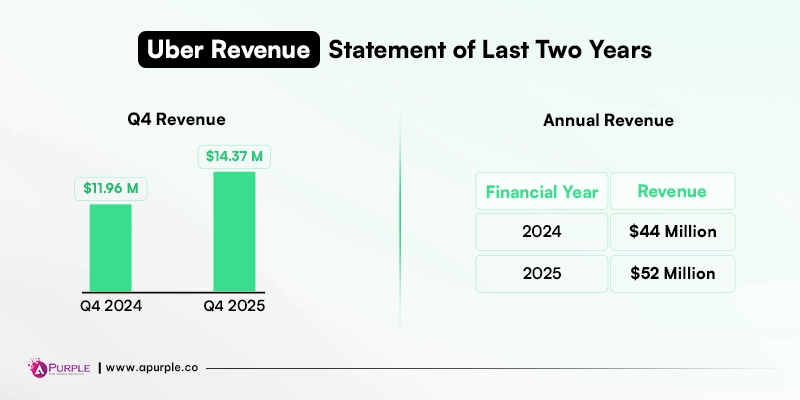
The latest revenue report of Uber shows the commitment it strives for. It has made $52 Million in 2025, way higher than $44 Million in 2024. You can see the pictorial difference between the two years.
Key Takeaways
Uber has been a revolutionary player in the ride-hailing market since its launch. With such a massive user base, Uber has become a massive brand now. But what works behind this well-oiled ride-hailing giant is a structured business model that has multiple elements.
Right from stakeholders to customer segments and revenue model, all of the elements together contribute to the success of Uber. However, collaborating all the elements, planning, execution, and conviction of Uber has made it this far.
Don’t let your dream project remain mere thoughts; now is the time to take action and make it your reality. Get FREE Startup Consulting from aPurple today!
FAQs
- Lyft
- DoorDash
- Tesla
- Ola
You can even browse through the Uber Alternatives options.