Updated Date: May 15, 2026
The wrong business model can kill a startup faster than a bad product ever will. Founders pour months into building, only to realize the way they make money simply doesn’t hold up; not because the idea was flawed. But because the foundation was wrong from day one.
So, if you’re deciding between freemium, subscription, marketplace, or other startup business models, you’re facing one of the highest-stakes decisions in your journey. The model you choose directly impacts revenue predictability, customer acquisition cost (CAC), lifetime value (LTV), and your ability to scale without burning cash.
Every successful startup: Uber, Airbnb, Spotify. They didn’t just build a great product. They built the right model around it. One that scaled revenue without scaling costs, attracted investors without burning trust, and turned early users into long-term customers. That’s the real game-changer.
In this guide, you’ll explore 15 proven startup business models, understand when to use each, and learn how to choose the right one based on your startup stage, revenue goals, and market dynamics.
What is the Startup Business Model?
- Who do you serve?
- What do you offer?
- How do you make money?
For founders, this isn’t just a theoretical framework, it directly impacts revenue predictability, cost structure, and long-term scalability. A weak model leads to poor unit economics, while a strong one enables consistent growth and investor confidence.
So, the startup business model deals with the following segments.
Value Propositions:
The problem being solved and why customers would pay for it
Target Market:
There specific customer segment the product or service is built for
Revenue Streams:
how the business earns money (i.e., subscriptions, commissions, ads, licensing, etc.)
Cost Structure:
This is what it costs to build, operate, and grow the business. You can’t take any risk for the efficiency of the business to succeed in terms of the cost investment and returns.
Why is It Important to Develop a Business Model?
Developing a business model is crucial because a startup business model works as the foundational blueprint for how a company creates, delivers, and builds value. A startup business model is not just a planning tool. It’s a critical factor that determines whether your startup can generate sustainable revenue and scale efficiently.
Without a clear model, even strong products struggle with inconsistent monetization, high burn rates, and poor investor confidence. San Francisco, USA, stands as the no. 1 city with the most investment per capita, worth USD 17,458 million. Obviously, the rise of venture founders in the city involves brainstorming about business models. Moving into the—Here’s why it matters:
- Defines Strategic Direction: Clarifies your target market, value proposition, and growth path so every decision aligns with a clear goal
- Ensures Financial Viability: Helps validate revenue streams, pricing strategy, and cost structure to avoid unsustainable burn
- Improves Competitive Positioning: Enables you to differentiate in the market through pricing, distribution, or delivery models
- Supports Risk Management: Identifies potential operational and financial risks early, allowing for faster pivots
- Attracts Investors: Demonstrates scalability, strong unit economics, and a clear path to profitability
15 Startup Business Models With High-Revenue Potential
Business models are the backbone of any successful startup. Understanding various models can help entrepreneurs make informed decisions. Here are the different business models for startups.
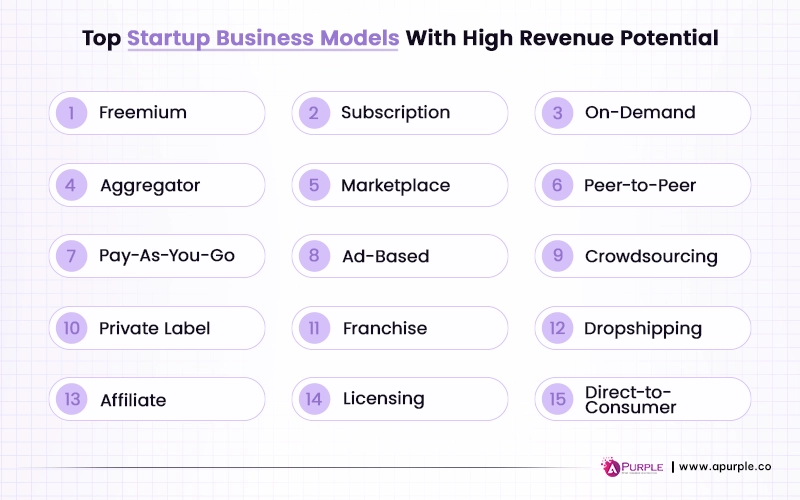
| Business Model | Best For | Revenue Predictability | Scalability | Biggest Risk | When to Choose |
|---|---|---|---|---|---|
| Freemium | Rapid user growth | Low | High | Low conversion rates | When marginal cost per user is near zero |
| Subscription | Recurring revenue | High | High | Churn risk | When delivering continuous value |
| Marketplace | Platform scaling | Medium | Very High | Chicken-and-egg problem | When you can build both supply & demand |
| On-Demand | Convenience services | Medium | High | Operational complexity | When speed is key differentiator |
| Aggregator | Fragmented markets | Medium | High | Quality control | When standardizing services |
| P2P | Community platforms | Low | High | Trust issues | When users drive supply & demand |
| Pay-As-You-Go | Usage-based services | Medium | High | Revenue variability | When usage fluctuates |
| Ad-Based | Content platforms | Low | Very High | Needs massive scale | When traffic is your strength |
| D2C | Product brands | Medium | Medium | High CAC | When brand control matters |
| Dropshipping | Quick launch | Medium | Low | Thin margins | When testing product ideas |
| Licensing | IP monetization | High | Very High | Adoption dependency | When you own proprietary tech |
1. Freemium Business Model
The freemium business model has been an advanced solution to drive the capabilities. By enhancing the user experience for real-time and instant access to the services, the freemium model makes the startup process seamless.
By attracting users with free or trial-based access, they can upgrade to the advanced features. Moreover, it becomes an easy-peasy way to enter the market with a viable idea for business. It has high production costs, tangible products, or services that require capital intensity.
Best for startups that:
Build software or digital tools where the cost of serving an extra free user is near zero.
Real-World Examples:
- Slack
- Dropbox
- Zoom
2. Subscription Business Model
The subscription-based model is quite effective for product-based startups. It works by charging the customers a recurring fee. You can offer access to products or services to users or members.
So, they can acquire the subscriptions and unlock the advantage. Such a business model brings the efficacy of attracting new users and retaining them for a longer duration to access services.
Best for startups that;
Offer ongoing value; SaaS tools, media, health, education, or curated products
Real-World Examples:
- Netflix
- Adobe
- HubSpot
3. On-Demand Business Model
On-demand business models involve providing customers with an immediate solution to their service or product needs. This strategy makes use of advanced technology to meet the customer’s needs as quickly as possible.
These businesses primarily operate through mobile apps or websites. They rely on a network of agents, dealers, and subagents. The prices in such a business model may fluctuate depending on service demand, time frame, and availability of tools and equipment. However, the on-demand business model is highly rewarding for startups to begin with.
Best for startups that:
Operate in mobility, food, healthcare, home services, or logistics with a gig-worker supply side
Real-World Examples:
- Uber
- DoorDash
- TaskRabbit
- Instacart
4. Aggregator Business Model
An aggregator business model operates as a reliable plan for third-party service solutions. It falls under the brand for a standardized experience for end users at a centralized platform.
So, this is basically a network model, partners with service providers under the unified brand, and connects to the customers seamlessly. Thus, the aggregator business is responsible for managing the customer relationship and boosting the quality aspects for the stakeholders.
Best for startups that:
Want to unify a fragmented industry (travel, hotels, food, taxis) under a single trusted platform.
Real-World Examples:
- Uber
- Airbnb
- Practo
5. Marketplace Business Model
A marketplace or two-sided platform is an attractive startup business model. It connects independent buyers and sellers, earning through listing fees, commissions, or transaction cuts as well.
You can take an innovative approach to enter the marketplace with the inventory to facilitate the exchange of products. Thus, it develops a credible bond for both sides and expands the marketplace.
Best for startups that:
Can build and balance supply and demand in a specific niche—products, services, or talent
Real-World Examples:
- Etsy
- Fiverr
- Amazon
- eBay
6. Peer-to-peer (P2P) Business Model
Individuals transact directly with each other through a shared platform; no middleman ownership of assets. For your startup business, the platform earns revenue through transaction fees or subscriptions. Moreover, the trust mechanisms (ratings, reviews, verification) are critical to the success of P2P.
Therefore, it will assist in making a real impact on the combined growth.
Best for startups that:
Develop communities or sharing economies where users are both the supply and the demand.
Real-World Examples:
- BlaBlaCar
- Lending Club
- Turo
7. Pay-As-You-Go Business Model
The customers are charged only for what they use: per minute, per GB, per API call. It lowers the barrier to entry (no upfront commitment) and scales naturally with the customer’s usage. Moreover, it’s sort of clearly common in cloud, utilities, and mobility businesses.
Best for startups that:
Offer infrastructure, cloud, communications, or any service with measurable, variable consumption
Real-World Examples:
- AWS
- Google Cloud
- Stripe
8. Ad-Based Business Model
The product is free to users; revenue comes from advertisers who pay to reach that audience. It requires massive scale to be viable; the larger and more targeted the audience, the higher the ad rates. In addition to that, the data and engagement metrics drive monetization for this robust startup business model.
Best for startups that:
Can attract large, engaged audiences—media, social platforms, news, entertainment, or search
Real-World Examples:
- Meta
- YouTube
9. Direct-to-Consumer Business Model
Brands sell directly to end customers, bypassing retailers, distributors, and wholesalers. This means full control over pricing, branding, and the customer experience. In other terms, this emphasizes bypassing mediators and selling goods directly to consumers. So, the margins are higher, but customer acquisition costs can be steep.
Best for startups that:
Make physical or digital products and want to own the customer relationship without retail dependency.
Real-World Examples:
- Warby Parker
- Casper
- boAt
10. Private Label Business Model
A private label business model for a startup is enticing. It allows them to source products from third-party manufacturers and sells them under its own brand. By skipping the R&D and manufacturing investment, you can still build brand equity. Margins depend on branding strength and sourcing efficiency.
Best for startups that:
Want to build a product brand quickly without manufacturing infrastructure, especially in e-commerce, health, and beauty.
Real-World Examples:
- Amazon Basics
- Kirkland (Costco)
11. Franchise Business Model
The franchise-based model works with licensing the brands, systems, and processes to an independently operating startup. It enables you to come up with their franchisees to pay upfront fees and continuous royalties.
Hence, there can be a capital-light way to scale both geographically and demographically. However, the concerns of quality control across franchisees are the biggest challenge to managing it.
Best for startups that:
Have a proven, replicable model in food, retail, fitness, or services, and want to scale without owning every location
Real-World Examples:
- McDonald’s
- Subway
12. Dropshipping Business Model
Dropshipping is also a startup-friendly one, which sells products online without holding inventory for themselves. When a customer orders, the supplier ships directly to the customer.
Additionally, this is a zero inventory risk, which enables starting quickly, but margins are thin. The dropshipping business model may face hard competition due to the same products and services.
Best for startups that:
Want to test e-commerce product ideas with minimal upfront capital before committing to inventory.
Real-World Examples:
- Many Shopify stores
- Oberlo-powered brands
13. Affiliate Business Model
The affiliate business model is the most revenue-driven model for startup eCommerce business ideas today. The business earns commissions by promoting other companies’ products and services.
When a referred user makes a purchase, the affiliate gets a cut. So, it’s performance-based; no sale, no cost. This model helps to scale well with content and SEO and gains audience trust smoothly.
Best for startups that:
Build content platforms, comparison sites, newsletters, or communities with an engaged niche audience.
Real-World Examples:
- NerdWallet
- Wirecutter
- MoneySuperMarket
14. Licensing Business Model
For the high-authority startups that want to create intellectual property, software, patents, technology, or content, a licensing model is best. It will let you charge others to use it via a license fee or SaaS solution.
So, the asset is built once and monetized repeatedly for acquiring its service. Thus, it is more of high margins, low marginal cost, and scalable without headcount growth. Hence, it’s a win-win, even as an AI startup idea, to enter as the future-ready solution.
Best for startups that;
Develop proprietary tech, patents, APIs, or media content that other businesses need access to.
Real-World Examples:
- Qualcomm
- Shutterstock
- Dolby
15. Crowdsourcing Business Model
Last and most impressive is the crowdsourcing business model. It has been used for the business to outsource tasks, content, or funding to a large group of people.
So, usually via an open platform, it dramatically reduces production costs and scales content or solutions without a large internal team. Therefore, community engagement is the core asset for your startup business model.
Best for startups that;
If you are making knowledge platforms, funding tools, design contests, or data labeling products that benefit from collective contributions.
Real-World Examples:
- Wikipedia
- Kickstarter
- Duolingo (translations)
Next, taking you deeper into the actual benefits and limitations of each business model. It will help you in the final decision-making to pick the ideal one. Let’s dive into it…
What are the Advantages & Disadvantages of Different Business Models?
| Business Model | Advantages | Disadvantages |
|---|---|---|
| Freemium Business Model | Attracts a large user base; low customer acquisition costs; rapid user growth | Conversion rate critical for profitability; continuous feature development |
| Subscription Business Model | Predictable revenue; ongoing customer relationships; opportunities for upselling | Requires continuous value delivery; emphasis on retention and satisfaction |
| On-Demand Business Model | Real-time service delivery; leverages the gig economy; high convenience | Pricing fluctuations, dependency on user ratings, and logistic complexities |
| Aggregator Business Model | Centralized platform; standardized customer experience; economies of scale | Relies on provider quality, competitive market, and complex logistics |
| Marketplace Business Model | Connects buyers and sellers; scalable; low inventory costs | High competition; platform management complexities |
| Peer-to-peer Business Model | Direct transactions; community-driven; scalable | Regulatory challenges; quality control issues |
| Pay-as-you-go Business Model | Flexible pricing; cost-effective; scalable | Revenue unpredictability requires continuous usage monitoring |
| Ad-based Business Model | Low-cost access to revenue; scalable | Privacy concerns; requires high user engagement |
| Direct-to-consumer Business Model | Control over branding, direct customer relationships, and scalable |
High marketing costs; logistics management |
| Private Label Business Model | Control over branding and pricing; lower production costs | Dependence on third-party manufacturers; high initial marketing costs |
| Franchise Business Model | Established brand recognition; operational support | High initial fees; ongoing royalties |
| Dropshipping Business Model | Low startup costs; no inventory management | Low-profit margins; dependency on suppliers |
| Affiliate Business Model | Minimal upfront investment; scalable | High competition; reliance on traffic and marketing strategies |
| Licensing Business Model | Steady income stream; expands market reach | Complex management; high compliance requirements |
| Crowdsourcing Business Model | Access to diverse talent and ideas, low costs | Quality control challenges require strong community management |
Start Smart & Build an Ideal Business Model for Your Startup
The correct model selection can make or kill a startup. It is critical to consider both the advantages and disadvantages to make judgments that align with company objectives. Yet, a bit of depth on the market research and competitor analysis in the industry gives clarity. For assistance in deciding the ideal model, connect with our experts!
FAQs
- Value Proposition
- Customer Segments
- Channels
- Relationships
- Revenue Streams
- Key Activities
- Cost Structure
- Key Partners
- Key Resources