Updated Date: Apr 23, 2026
If you talk to any startup founder about marketplace ideas, they will instantly get excited about the prospect of consistent revenue. However, when they see the roadmap for the marketplace app development, that excitement turns into anxiety. The reason behind that is the level of decision-making involved at every stage.
In the initial stage, startup founders need to decide on the right model. After product validation, you need to decide on the core features for the MVP that shouldn’t burn your capital or reduce the chances of any traction. If you complete these two stages, the next step is to choose the right monetization model that delivers consistent revenue for your platform.
Answering all these questions by yourself can waste a lot of time. Having worked closely with hundreds of marketplace founders over the past decade, we can help you navigate these challenges.
Based on these firsthand experiences, we have written this guide to help startup founders build a world-class marketplace application and choose a marketplace model, monetization strategy, core features for the MVP, tech stack, scalable foundation, and more.
What is Marketplace App Development and How Does it Work?
Marketplace app development is the process of building digital solutions that connect sellers or third-party vendors with buyers or customers. While buyers can search for and purchase products or services to meet their needs, sellers can register and list their offerings through this digital solution.
Unlike a typical eCommerce website, online marketplace app development requires you to develop separate modules for admins, sellers, and buyers, along with a secure payment gateway, inventory tools, and a strong search filter.
How does a Marketplace App Work?
Here is a simple step-by-step workflow of how a typical marketplace functions:
- The seller signs up in your marketplace app, completes the verification process, and uploads photos of their products/services along with pricing, availability, and fulfillment details.
- The buyer registers in the marketplace app, searches for a specific product or service, uses smart filters, finalises the purchase, adds it to the cart, and completes checkout.
- After checkout, payment is processed through a split-payment system or escrow to ensure confidentiality and security.
- Sellers analyze orders, pack products, and deliver them to customers directly or through third-party logistics services.
- Buyers receive products and provide ratings and reviews based on their experience, which helps you build credibility, improve transparency, and encourage repeat purchases.
- The marketplace will generate revenue through per-order commissions, product listing fees, subscriptions, advertising, and more.
How to Create a Marketplace App?
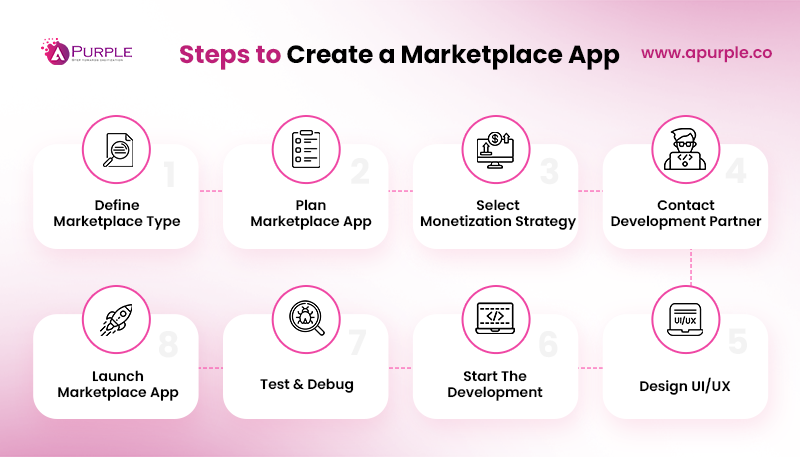
Building a marketplace in 2026 is more than just app development; it’s about laying the foundation for business growth. Here’s how you can achieve that:
- Step 1: Define Your Marketplace Type
- Step 2: Plan Your Marketplace Application
- Step 3: Select a Monetization Strategy
- Step 4: Reach Out to a Marketplace App Development Company
- Step 5: Design the UI/UX for the Marketplace App
- Step 6: Start the Development Phase
- Step 7: Test and Debug Your Application
- Step 8: Launch Your Marketplace App
Step 1: Define Your Marketplace Type
First and foremost, you need to decide on the marketplace model you want to use, as it determines your order volume, customer retention rate, and revenue stream.
Here is a list of different marketplace types that will help you to decide the best one for your business:
| Marketplace Type | Description | Popular Business Apps |
|---|---|---|
| Business-to-Business (B2B) | It is a type of marketplace that connects businesses. If you want recurring revenue and high order volume, choose this option. | Alibaba, Faire, Thomasnet |
| Business-to-Customer (B2C) | This marketplace model connects businesses to targeted customers. Here, the order volume is high, but the profit margin is low. | Amazon, Walmart, Wayfair |
| Peer-to-Peer (P2P) | It’s a marketplace model that connects one consumer with another. People use this model to buy or sell used products or services. | Airbnb, Uber, Turo |
| Vertical Marketplace | If you want to focus on a particular industry, you should choose this model. When you want to provide specialist services such as food delivery, home cleaning, or office administration, this is a good option. | StockX, Reverb, Houzz |
| Horizontal Marketplace | If you want to focus on multiple categories or industries, you can opt for this marketplace model. | eBay, Facebook Marketplace, Craigslist |
Step 2: Plan Your Marketplace Application
When startup founders think about “how to build a marketplace app,” they should not focus only on features during the planning stage. Here are key things to keep in mind while planning your marketplace solution:
| Key Aspects | Description |
|---|---|
| Define the Niche | You should specify the industry vertical or category you’re targeting and verify its demand, the strength of its problem-solving, and its scalability potential. |
| Validate Market Demand | You should conduct in-depth surveys, analyze the latest industry trends, and test as early as possible to confirm user demand before investing in full-fledged development. |
| Know Your Audience | You should know who your ideal buyers and sellers are, what their pain points are, and what their typical user behavior is. |
| Analyze Your Competitors | You must study your competitors and know their feature gaps, pricing model, and user complaints. |
| Define Value Proposition | State what makes your marketplace different from others in terms of user experience, pricing tactics, niche focus, or tech innovations. |
| Plan Revenue Model | You should decide in advance how your marketplace will earn money from various sources, such as commissions, subscriptions, ads, and product listing fees. |
| Decide Core Features | List down the core features with which you can release version 1.0, such as user onboarding, product listing, secure payments, search filters, ratings, and admin control. |
| Define User Journey | Draw out the complete buyer and seller journey, right from sign-up to checkout, to ensure higher engagement across the platform. |
Step 3: Select a Monetization Strategy
Knowing when to monetize your business and selecting the right strategy are key to success. Your monetization must align with startup business models and your potential customers’ willingness to pay.
Here are the various monetization strategies you should consider for a marketplace app:
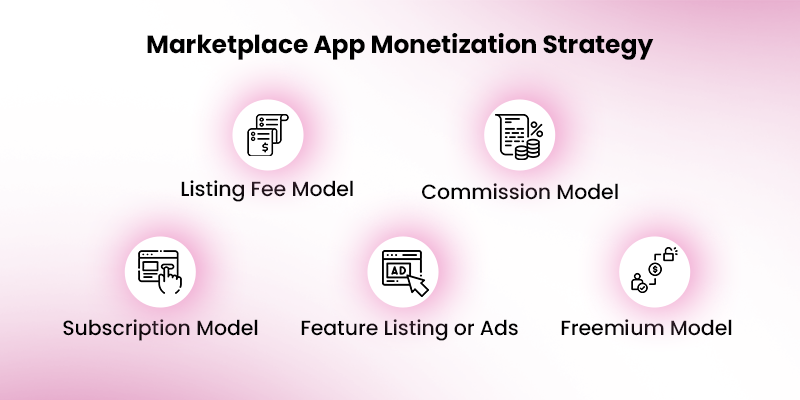
| Monetization Model | Description | Pros | Cons |
|---|---|---|---|
| Commission-Based Model | Buyers must pay a fixed fee for each successful transaction. | It’s easy to grow revenue here, given the large number of orders and transactions. | There needs to be a high volume of orders for this model to be successful. |
| Subscription Model | You can offer premium features to buyers and sellers and charge a fixed monthly/yearly fee. | You can establish recurring revenue and achieve stable cash flow. | Getting new users onboard is very hard. |
| Listing Fee Model | When a seller lists a new product or service, you charge a fixed amount. | Here, there’s little reliance on the sales cycle, which helps you generate good revenue in the initial stages. | As there’s no guarantee of conversions, it’s hard to keep sellers engaged. |
| Freemium Model | You offer basic features for free and charge for premium features. | You can attract a large user base with this model. | For this to be successful, you need to distinguish between free and premium services clearly. |
| Advertising Model | Here, you can allow brands and third-party sellers to advertise their products and charge a fee for that. | It can become an add-on revenue channel for you. | You need a high-traffic website for this to be successful. |
Step 4: Reach Out to a Marketplace App Development Company
As a startup founder, you always want to start with an MVP development to validate your marketplace assumptions before going for full-fledged development.
That’s where you need a partner experienced in service marketplace app development, as they can help you set up compliance, user roles, the payment gateway, and the customer journey from day 1.
It will also provide you with MVP development services that help you validate your concepts and enable a faster launch within your desired budget.
You should keep these things in mind while searching for a development partner:
- The company should have experience in multivendor marketplace app development.
- They should provide clear timelines and costs, and communicate transparently.
- The partner should use sprints and define a detailed roadmap for execution.
- They should have expertise in scalability and API-first design
- The firm should know the applicable compliance and regulatory requirements in advance.
- They should also provide support and maintenance plans.
Step 5: Design the UI/UX for the Marketplace App
UI/UX is the first thing that your users see in the marketplace mobile app development. That’s why here’s what you should do while designing your user experience and user interface:
- You should focus on designing an easy-to-navigate onboarding workflow.
- Always make sure you showcase pricing and platform fees in the top-right corner.
- You should create a product listing flow to guide sellers.
- Always try to provide a secure checkout by displaying trust badges.
- Establish a review and rating system to allow users to share feedback.
- You should create a direct communication channel between sellers and buyers.
Step 6: Start the Development Phase
You should opt for startup consulting services that help you make the right choices for architecture, infrastructure, tech stack, and AI integration without increasing complexity.
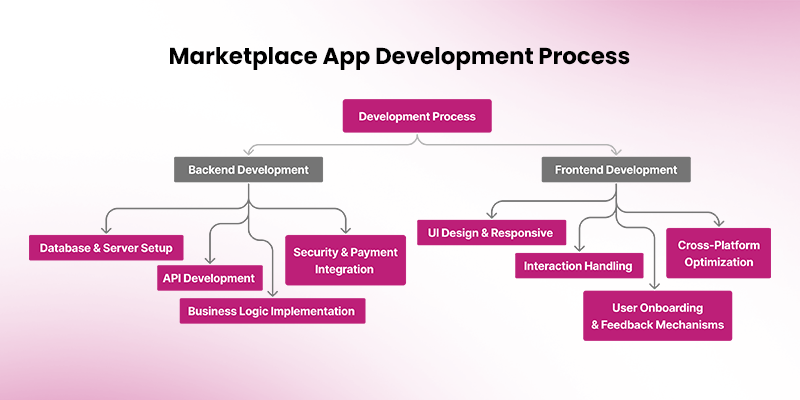
You should keep these things in mind while developing your marketplace app:
- You need to create a two-week sprint for MVP development
- You should focus on creating seller and buyer workflows
- There also needs to be a focus on creating a core transaction workflow
- You should emphasize integrating a secure payment gateway with an escrow setup
- There should be a focus on designing a scalable database
- You should always enforce role-based access control for admins, buyers, and sellers
- Try to build a performance monitoring and analytics dashboard
- You should always give importance to developing AI integrations for smart search, personalization, and fraud prevention
Step 7: Test and Debug Your Application
Rigorous testing helps you avoid mishaps during product launch. Start testing as early as possible to help you identify loopholes in your system that developers can rectify before the final launch. The testing procedures must consider both technical validation and real-user simulation.
Here’s a checklist that you should follow for testing your marketplace application:
- Functional testing for verifying the flow of user onboarding and checkout
- Load testing to know whether your marketplace app works well under varying loads
- Security testing for validating payment confidentiality and security
- Usability testing to know what is good and what’s not, directly from buyers/sellers
Step 8: Launch Your Marketplace App
Start with a single region, category, or niche, and validate your product in that market before expanding into others.
Here’s what you should do while launching your marketplace app:
- Pre-onboard verified sellers into your marketplace
- Offer early bird discounts to sellers
- Use referral programs to get more sellers on board
- Partner with various niche communities
- Monitor repeated transactions and the customer retention ratio
What are the Essential Features for On-Demand Marketplace App Development?
If you’re opting for an eCommerce marketplace app development, here is a list of features that you should have for admin, buyers, and sellers.
1. Buyer Side Features
Here is a list of features that provide buyers with a seamless user experience:
| Key Features | Descriptions |
|---|---|
| Easy Sign-Up (Email, Socials, Google) | Buyers can sign up via email, Google, or social accounts, which increases the onboarding conversion rate. |
| Advanced Search & Filters | Buyers can easily find the products or services they’re looking for. |
| AI-Powered Recommendations | With this feature, buyers receive suggestions on what to buy based on their personal preferences. |
| Real-Time Order Tracking | Buyers can track the status of their orders in real time, reducing stress and improving the user experience. |
| Secure Payments | With this feature, buyers can securely pay for their orders without compromising their privacy or confidentiality. |
| Reviews & Ratings | Buyers can provide ratings and reviews for various products they bought. |
| Smart Pricing | AI showcases competitive pricing, which speeds up buying decisions. |
| Push Notifications | With this feature, buyers receive alerts about order status and various discounts. |
2. Seller Side Features
Here is a comprehensive list of features through which sellers can manage their business efficiently:
| Key Features | Descriptions |
|---|---|
| Easy Product/Service Listing | Sellers can register and list their products or services. |
| Seller Dashboard | Your sellers can view the order status and revenue using this dashboard. |
| AI-Enabled Demand Forecasting | AI can help sellers anticipate demand for a particular product in advance, streamlining inventory. |
| Secure Payout | Your sellers can securely pay a commission fee per successful transaction to the marketplace owner. |
| Inventory Management | With this feature, sellers can manage their inventory more effectively and avoid overstocking or understocking. |
| Order Management | The sellers can track orders and check with customers about timely delivery. |
| Performance Analytics | Sellers can gain actionable insights into their business to help them engage prospects. |
3. Admin Panel Features
Here is a list of features through which the marketplace owner can gain control over proceedings and track everything:
| Key Features | Descriptions |
|---|---|
| User Management | With this feature, the marketplace owner can approve, verify, or remove buyers/sellers. |
| Commission Configuration | Your sellers can view the order status and revenue using this dashboard. |
| Commission Configuration | As a marketplace owner, you can set a commission rate with this feature. |
| AI-Enabled Fraud Monitoring | Here, AI can help you detect unusual activity and protect your marketplace from fraud. |
| Analytics Dashboard | With this feature, you can monitor your marketplace’s performance using various metrics. |
| Content Moderation | It allows you to track whether the product descriptions align with your community rules. |
| Payment Management | You can know the total payments processed, refunds given, and settlements. |
| Role-Based Access Control | With this feature, you can create various roles and assign them respective privileges. |
What is the Ideal Tech Stack for Marketplace Application Development?
You should use this technology stack if you’re planning to create a marketplace app development solution:
| Layers | Technologies |
|---|---|
| Frontend (Web & Mobile) | Next.js, React.js, Flutter, React Native, Swift, Kotlin |
| Backend | Ruby on Rails (RoR), Express.js, Node.js, Django, Spring Boot |
| Database | Firebase, DynamoDB, MongoDB, MySQL, PostgreSQL, Redis |
| Cloud & DevOps | AWS, Azure, GCP, Docker, Kubernetes |
| Payment & Authentication | PayPal, Stripe, Square, Auth0, Firebase Auth, Apple Pay |
| AI & Automation | AWS SageMaker, OpenAPI APIs, LangChain, TensorFlow, Google Vertex AI |
| Analytics & Growth | Google Analytics 4, Hotjar, PostHog, Mixpanel, Amplitude |
How Much Does It Cost to Create a Marketplace Application from Scratch?
Here’s a detailed breakdown of the marketplace app development cost according to the app complexity and how AI-assisted development can help you to bring down those numbers:
| Complexity of the App | Description | Custom Development Cost | AI-Assisted Development Cost |
|---|---|---|---|
| Lean MVP | Core user flow, basic seller/buyer listing, payment gateways, simple admin control | USD 15,000 – USD 20,000 | USD 8,000 – USD 12,000+ |
| Growth-Ready Marketplace | Intuitive UI/UX, smart search, performance analytics, role-based access, automation | USD 20,000 – USD 60,000 | USD 12,000 – USD 40,000+ |
| Multi-Region Marketplace | Large-scale integrations, personalization, compliance, and regulations | USD 60,000 – USD 100,000+ | USD 40,000 – USD 70,000+ |
What are the Common Challenges in Online Marketplace App Development?
Here are the common challenges that you may encounter while developing a world-class marketplace application:
| Key Challenges | Possible Solutions |
|---|---|
| Scalable Marketplace Architecture | You need to build a modular and cloud-native architecture with flexible APIs. It allows you to keep the marketplace stable during the growth phase and also adaptable if you expand into NFT marketplace app development. |
| Trust & Safety | From the beginning, add reviews & ratings, KYC verification, dispute resolution workflows, and AI-driven fraud detection to build user credibility. |
| Complex Payment Integration | Integrate payment gateways with escrow, split payouts, and automated tax handling to avoid any disputes. |
| User Acquisition & Retention | You should always focus on one niche at a time, optimize onboarding workflows, craft referral loops, and monitor CAC and LTV before increasing your marketing budget. |
| Logistics & Fulfillment Management | Start with a third-party logistics partner for delivery, then integrate your logistics APIs as your business grows. |
| Hiring & Development Risk | When you hire developers for marketplace app development, clearly define your project scope, deliverables, and secure IP rights before development begins. |
What are the Top Marketplace Apps Leading Worldwide?
Before you start B2B marketplace app development, you should study the top marketplace apps, their niche, key features, marketplace model, monetization strategy, etc., to know what made them successful over the years.
| Marketplace App | Marketplace Model | Niche | Key Features | Monetization Model | Revenue (Approx.) |
|---|---|---|---|---|---|
| Amazon | B2C + B2B | eCommerce | Prime ecosystem, seller analytics, AI-powered product recommendations, and dynamic pricing | Commission + Subscription + FBA fees + Ads | $717 Billion |
| Airbnb | P2P | Short-Term Rental | AI-driven search, smart pricing, fraud detection, and two-sided reviews | Service fees (guest + host) | $12.2 Billion |
| Uber | P2P | Mobility | Surge pricing, AI-enabled route optimization, real-time matching, and driver risk detection | Commission per ride | $52 Billion |
| Etsy | B2C | Handmade & Vintage | Personalized discovery, seller ad optimization, and AI-powered search | Listing fees + Commission + Ads | $2.85 Billion |
| Upwork | B2B | Freelance Services | Proposal scoring, skill recommendations, and AI-driven talent matching | Service fees + Connection credit | $788 Billion |
What are the Things to Keep in Mind for Choosing the Right Marketplace App Development Team?
Choosing the right marketplace app development team is vital to your success, as it will determine whether you can launch your MVP faster and secure a first-mover advantage.
Here are the things that you should consider when choosing your development team:
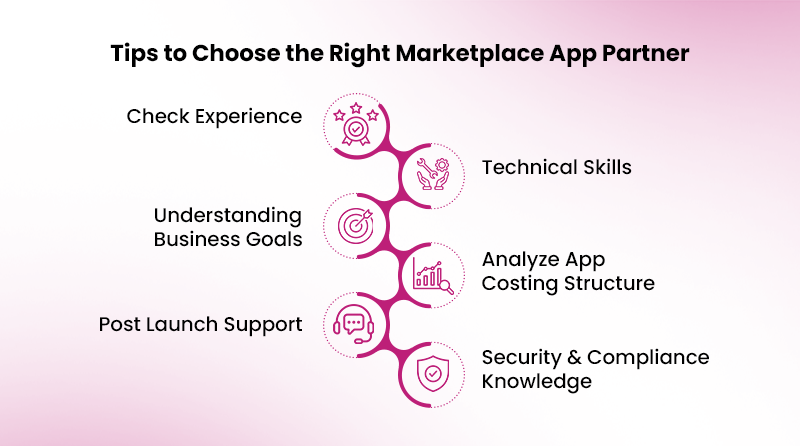
| Things To Keep In Mind | Description |
|---|---|
| Experience With Marketplace Development | Always choose a team with experience in marketplace development, as they know how to navigate various challenges with ease. |
| Technical Skills | You should check whether the team you’re choosing has deep expertise in cloud architecture, payment gateway integration, AI integration, and related areas. |
| Understanding Of Business Goals | The marketplace app development team should be able to map technology aspects with business goals and make choices that help you achieve objectives. |
| App Costing Structure | The development partner you’re looking to collaborate with should offer a transparent pricing structure and a milestone-based billing model. |
| Post Launch Support | The development team should provide support after development for activities such as new feature upgrades, performance enhancements, and maintenance. |
| Security & Compliance Knowledge | You should always assess whether your marketplace app development team has in-depth knowledge of the compliance and regulations applicable to this project. |
aPurple: Your One-Stop Destination For Marketplace App Development
Building a marketplace app in 2026 is like riding an F1 car on the Monaco track, full of twists and turns. One wrong decision here can cost you a delayed launch, increased cash burn, and investor confidence. That’s where you need a partner experienced in marketplace app development.
We at aPurple can play that role effectively, with years of experience helping startups build world-class marketplaces that have become leaders in their niche. With a founder-first vision, we help you to validate your idea, select the right marketplace model, and develop a lean MVP that gets your business started in one region before expanding globally.
We can help you choose the right tech stack, build a scalable cloud architecture, and set up a secure payment gateway. So, ready to build a marketplace solution that scales seamlessly and generates consistent revenue? Then connect with our experts to get a custom roadmap for marketplace app development.
Frequently Asked Questions
In general terms, the answer is YES! You can develop a marketplace application without extensive technical expertise, thanks to the many no-code/low-code and AI-based coding tools available on the market. However, in the initial stages, it may work as you want, but once your idea proves viable in the market and you need a scalable solution, those tools won’t help much.
That’s where aPurple can help you out. With years of experience and technical expertise, we know how to build a scalable, secure, and robust marketplace solution. We can help you set a foundation for your infrastructure and architecture that facilitates scaling and business growth. So, leave all your tech worries behind by partnering with us, and focus on your business.