Updated Date: Mar 6, 2026
In 2013, four students from Stanford University started delivering food from their own cars. To take orders, they built a simple website, and there was no investor funding. 13 years later, it became one of the most successful food delivery platforms, DoorDash, with 67% market share in the United States (Source: Backlinko) and $13.72 billion in revenue (Source: Simply Wall St) for the year 2025.
This was not pure luck; it’s a well-planned revenue model that helped DoorDash get to this point. The DoorDash business model didn’t scale well because they moved fast, but because they chose the right monetization model at every growth phase. Delivery fees, commissions, subscriptions, and advertising weren’t implemented all at once. They were added one by one as the business grew over the years.
That’s what this blog aims to help you understand. In this blog, you will get a thorough DoorDash business model analysis by understanding their revenue streams, how they improved their profit margin, and lessons you can learn from this as a startup founder to build similar apps.
What is DoorDash?
Founded in 2013, DoorDash is one of the largest online food-ordering and delivery platforms in the United States. It connects end users with local restaurants, retail shops, and grocery stores via an app or website. DoorDash uses independent contractors, called “Dashers,” to handle deliveries in the US, Canada, and Australia.
DoorDash – Company Profile
- Year of Foundation: 2013
- Founders: Tony Xu, Stanley Tang, Andy Fang, Evan Moore
- CEO: Tony Xu
- Headquarters: San Francisco, California
- Net Worth/Market Cap: $75.18 billion
- Total Valuation: $69.96 billion
- Number of Employees: 31,400
- Type of Business: Public company focused on Food Delivery, Logistics, and Grocery.
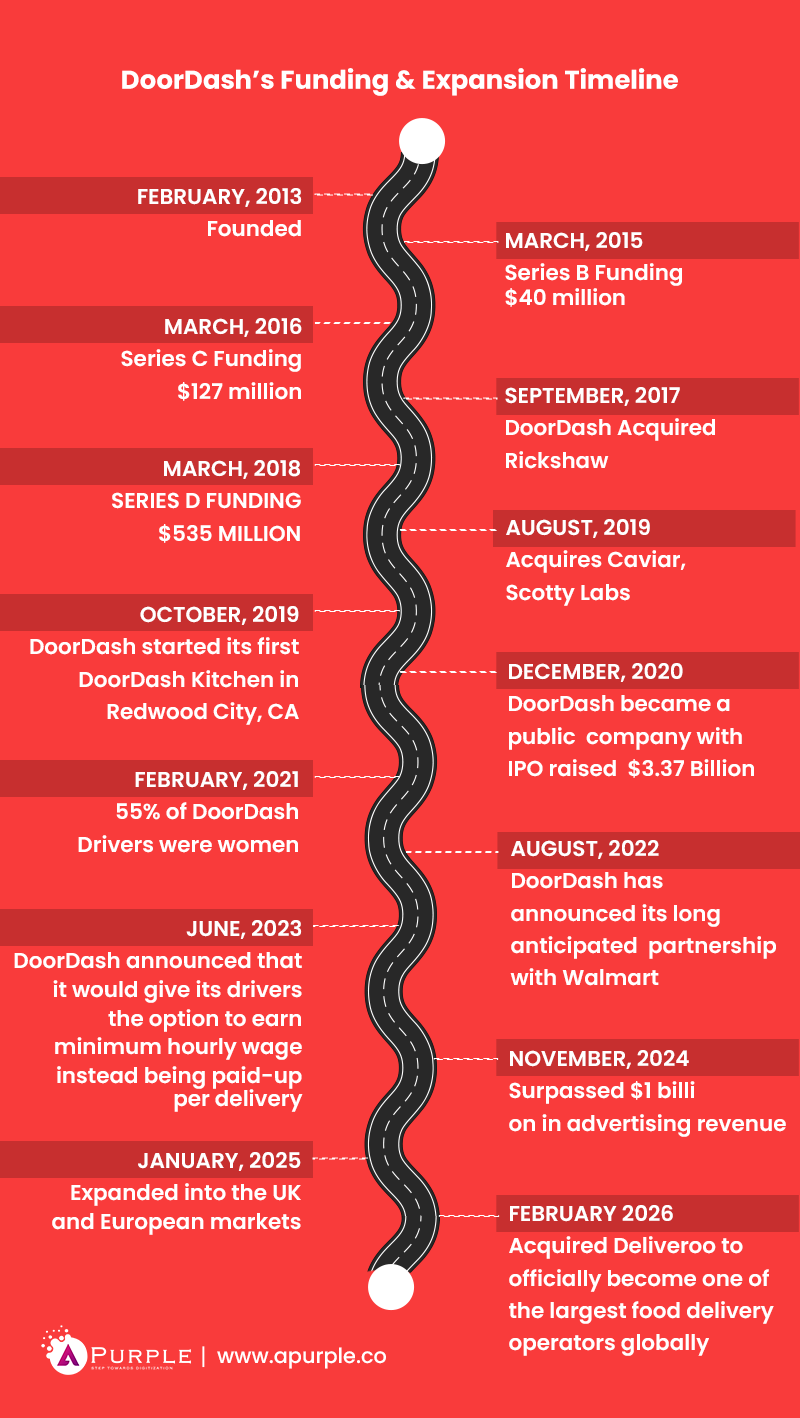
Now, let’s look at DoorDash’s history timeline to see how the platform has grown over the years and the milestones it has achieved along the way.
How does DoorDash work?
If you’re someone interested in building an online food delivery marketplace, then the DoorDash company’s business model is a good case study. However, to understand, you first need to understand its operating model.
DoorDash basically connects three user groups: customers, restaurants, and delivery partners. Now, let’s understand how DoorDash works in a step-by-step manner.
#1. Customers Open the App & Place an Order: Customers browse popular restaurants near their current location, select food items, place an order, and pay the bill. There are many restaurants available on the app, and customers can choose any nearby one or select based on their desired cuisine. Customers have multiple payment options, including credit cards, debit cards, wallets, and more.
#2. Restaurants Receive the Order: The restaurant receives the order, prepares the food, and then waits for the delivery partner to hand it over.
#3. A Dasher or Delivery Partner Is Assigned: Once the restaurant prepares the food, the application automatically finds the nearest available Dasher or delivery partner.
#4. The Customer Receives the Order: Dashers check the customer’s location and try to deliver the order as quickly as possible. Meanwhile, the customer can track their delivery in real time, reducing their stress and anxiety.
#5. The Customer Rates the Order: Customers can provide ratings and reviews for both restaurants and delivery partners through the application, which helps DoorDash improve its operations in the near future.
DoorDash Business Model Canvas
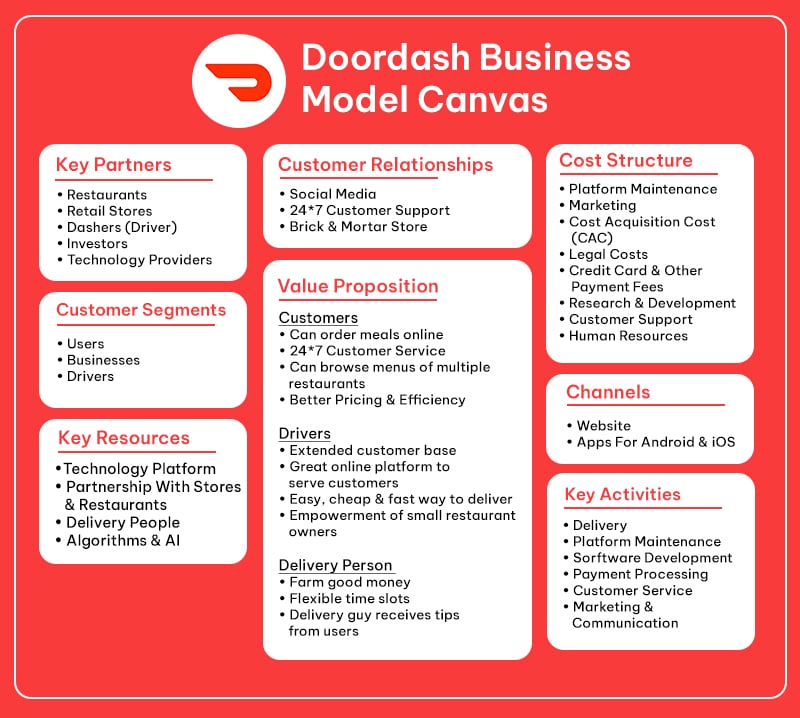
With the help of a business model canvas, you can easily know how a successful business creates, delivers, and captures value. The infographic below represents the DoorDash business model canvas. It helps you understand aspects such as the value proposition, key partners, costs, and revenue so that you can understand the strategic thinking behind the business model.
DoorDash Value Proposition
DoorDash’s business plan focuses on three user roles: customers, restaurants, and delivery partners (Dashers). Now, let’s understand how the platform provides value for each of its major user roles.
1. DoorDash’s Value Proposition For Customers
Any food delivery service’s customers want their food delivered on time and reliably. DoorDash understood that aspect, so it combined multiple restaurants, real-time delivery tracking, and an affordable subscription model for customers.
- Fast and reliable delivery across all major cities in the US
- Customers can track their delivery status in real time
- Repeat customers can opt for a DashPass subscription to eliminate delivery fees
- A wide range of products to select from, right from fast food to grocery to retail
- Users can choose the delivery date and time as per their convenience
- A facility for reordering items that lowers the cart abandonment rate
- A discount and loyalty reward program increases customer retention
- The option of ordering from multiple restaurants increases the average order value
2. DoorDash’s Value Proposition For Resturants
If you do a DoorDash business model evaluation, you will know that DoorDash treats restaurants not just as food suppliers but as a major paying partner. That’s why DoorDash helps restaurants by giving access to millions of customers, which would be a challenge, especially for new ones. The restaurant has to pay a portion of its sales to DoorDash, but in return, it can generate significant revenue without incurring customer-acquisition costs.
- Restaurants get access to DoorDash’s massive customer base
- No technology investment requirement for developing an online ordering system
- With smart data analytics, restaurants can improve their menu and pricing
- The app gives restaurants the option for sponsored placement, which increases visibility
- With Catering and DashMart, restaurants have diverse revenue streams beyond delivery
- The app gives restaurants the option of creating promo codes without any coding
- Commission structure varies according to order volume and is not a fixed cost
3. DoorDash’s Value Proposition For Delivery Partners (Dashers)
DoorDash treats delivery partners, or Dashers, as independent contractors rather than employees. It allows Dashers to work on a flexible schedule and on multiple platforms at the same time. Delivery partners don’t need to work for a fixed number of hours on DoorDash. As a result, DoorDash can minimize labor costs and manage profit margins effectively.
- Delivery partners can work according to their preferred time
- Dasher receives weekly payments, thereby increasing the retention ratio
- Delivery partners have no obligation to work for a minimum number of hours per month
- In-app navigation system helps delivery partners arrive on time
- Bonus for delivery partners for working during peak hours
- The Dasher reward program provides incentives to top performers
- Delivery partners can work on multiple platforms at the same time
DoorDash Revenue Model
From a general perspective, most people think that DoorDash delivers food on time and generates substantial revenue. Butif you dive deep into DoorDash’s business model and revenue streams, you will find that it generates revenue in multiple ways.
How Does DoorDash Make Money?
There are five major ways through which DoorDash generates revenue:
1. Delivery Fees
Delivery fees are among DoorDash’s top revenue sources.
- Whenever a customer orders through DoorDash, they need to pay $1.99 to $7.99+, depending on current demand and distance.
- In addition, DoorDash also charges service fees, i.e., 15% of the total order for general members and around 5% for DashPass members.
- Lastly, DoorDash also earns from surge pricing when demand for a particular product is very high.
2. Commission
Whenever a restaurant completes an order, it has to pay DoorDash a commission, which has been one of the platform’s more recurring revenue streams over the years.
- There are three commission tiers restaurants can choose from:
➜ Basic (15%) – the most cost-effective option
➜ Plus (25%) – restaurants get access to the most loyal customers through DashPass
➜ Premier (30%) – restaurants can maximize the number of new customers - Restaurants can also act as delivery partners if they believe the customer is nearby, and for that
- purpose, DoorDash has lowered the commission rate to 6%.
- As per the Q4 2025 results, DoorDash had a marketplace GOV of $29.7 billion and revenue of $4 billion,
- indicating strong cash flow in the last quarter.
3. Subscriptions
DashPass is DoorDash’s subscription model, where customers pay $9.99/month and get unlimited free deliveries on orders over $15. As a result, DoorDash now has 35 million customers and a strong customer retention rate of 47%.
4. SaaS Solution
Restaurants can now build their own online ordering system using DoorDash’s infrastructure. They don’t have to pay per-order commissions; they just need to pay a fixed monthly fee to use this SaaS solution. DoorDash also doesn’t need any upfront investment for this, as they’re using their existing infrastructure to create another revenue stream.
5. Advertising & Paid Listings
As DoorDash’s business grew and it built a massive user base, the application itself became the company’s biggest asset. Restaurants are now ready to pay a specific amount for sponsored placements, paid listings, and in-app advertisements, as these can increase their visibility and have become a successful revenue stream for DoorDash.
DoorDash vs UberEats vs Grubhub vs Postmates: A Comparative Analysis
As a startup founder, if you’re studying DoorDash’s business model, you should also analyze it by comparing it with other best food delivery apps to get a comparative standpoint.
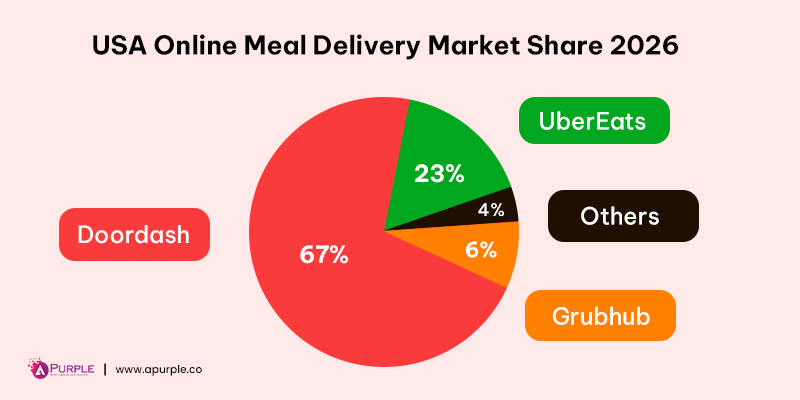
Here’s a comparison of DoorDash, UberEats, and Grubhub, which are dominating the food delivery space in recent years:
| Parameter | DoorDash | UberEats | Grubhub |
|---|---|---|---|
| Market Share | 67% | 23% | 6% |
| Commission Rate | 15-30% | 15-30% | 5-20% |
| Subscription Model | DashPass ($9.99/month) | Uber One ($9.99/month) | Grubhub+ ($9.99/month) |
| Total Subscribers | 35 million (DashPass + Wolt+ + Deliveroo Plus) | 30 million (Uber Rides + UberEats) | Comes free with Amazon Prime |
| 2025 Annual Revenue | $13.72 billion | $15 billion | $2 billion |
| Primary Revenue Streams | Commissions, delivery fees, ads, DashPass | Commissions, delivery fees, diner fees | Commissions, delivery fees, subscriptions |
| Advertising Revenue | Strong | Good | Limited |
| Logistics Model | Own Dashers (gig) | Leverages Uber driver network | Mix of own + restaurant delivery |
| Geographic Reach | Suburban + urban dominant | Urban-first | Urban-concentrated |
| Customer Retention Rate | 47% | 29% | 11% |
Wrapping Up
By reading this blog, you may have learned that DoorDash built a multimillion-dollar business by focusing on creating diverse revenue streams and adding them one by one, such as delivery fees, commissions, advertising, subscriptions, and more.
The lesson for startup founders is that if you want to build such a marketplace, don’t focus only on tech and operational workflows. You should also focus on creating diverse revenue streams because, at the end of the day, sales and revenue determine a business’s success, not the quality of its technology or features.
So, if you want to build a food delivery app similar to DoorDash, connect with aPurple. We can help you build a robust tech foundation and infrastructure to support a scalable, profitable business.
Frequently Asked Questions:
DoorDash is an on-demand, app-based food delivery platform that helps customers connect with restaurants, retail shops, and grocery stores.
Basically, customers browse for products or food items, place orders, and complete payment. The restaurant or retail shops will receive the order and pack the products or prepare the food. Lastly, the app assigns the order to a nearby delivery partner, or Dasher, who delivers it to the customer’s location.
- Suburban Strategy: DoorDash targeted Tier 2 and Tier 3 cities with areas where many families live and where delivery options are very limited.
- Three-Sided Marketplace: The company created value for customers, delivery partners (Dashers), and restaurants.
- Aggressive Marketing: The company spent $3 billion between 2019 and 2021 on marketing campaigns to capture major market share.
- Operational Efficiency: DoorDash used smart tech from day 1 to optimize delivery times. Also, they approached the business more like a logistics company than a food delivery startup.