Updated Date: Feb 20, 2026
I met a first-time founder in Austin at a recent startup conference. He received pre-seed funding nine months ago, during which he validated the idea and gained early traction with users.
The next step was MVP development, so he started searching for developers by conducting interviews, which increased confusion instead of giving clarity. Each candidate offered a different approach: one focused on complex architecture, another promised quick delivery, and the third offered the most affordable option.
After multiple conversations, he realized the problem wasn’t finding developers; it was knowing which direction to choose because he didn’t have an evaluation framework to guide that decision.
That’s why “how to hire developers for a startup” has become the most searched query among founders. Early-stage startup founders want clarity regarding:
- How can I build an MVP development team within a limited budget?
- Should I hire an in-house developer, an agency, or a freelancer?
- How can I verify developers’ technical skills before signing a contract?
- From where can I hire app developers or a development team?
- Which hiring model should I opt for in the early stages?
This guide aims to answer all your questions and provide a detailed roadmap of practical strategies drawn from our years of experience delivering world-class products for startups.
How to Hire Developers for a Startup? Step-by-Step Process
If you’re a first-time startup founder, you must be thinking about more than building just the MVP. You would aim to create a robust technical foundation that scales seamlessly as your business grows. That’s why knowing how to hire a developer for a startup is vital.
Here are the steps to hire app developers:
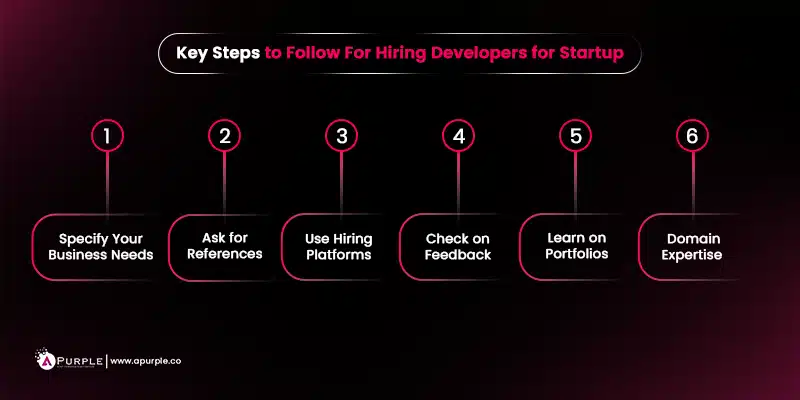
- Step 1: Specify Your Business Needs When Hiring Developers for a Startup
- Step 2: Ask for References to Find Reliable App Developers for Startups
- Step 3: Use Hiring Platforms to Hire Developers for Your Startup
- Step 4: Check Feedback and Reviews for Trustworthy Developers
- Step 5: Review Portfolios to Assess Developer Skills
- Step 6: Evaluate Domain Expertise for Industry-Specific Needs
Step 1: Specify Your Business Needs When Hiring Developers for a Startup
First things first. You need to be clear in your requirements while hiring developers for your startup. Most founders make the mistake of focusing on technology or features when selecting developers. For example, they might say, “I need someone who is an expert in AI,” or “I need a React Native developer.”
Rather than this approach, you need to focus more on business needs.
Before you hire developers, you need to clarify:
- What is the core issue you’re looking to solve with your MVP?
- What is that one core feature that can prove your product-market fit?
- What are the features that should be included in the investor demo?
- What are the features that can wait until version 2?
If these things are clear upfront, you will get a product that is closely aligned with your vision. On the other hand, a lack of clarity will result in in-scope creep.
So, always document these things before connecting with developers:
- What are the must-have and nice-to-have features for MVP?
- What is your approximate budget?
- What is your timeline for product launch?
- What compliance and regulations requirements?
- What is the long-term vision for your product?
If you can answer these questions accurately and precisely, you can avoid startup mistakes that lead to a complete rebuild within 12 months.
Pro Tip: Don’t hire for technology; always hire by keeping outcomes in mind. If a developer cannot map your business goals to a technical foundation, don’t select them.
Step 2: Ask for References to Find Reliable App Developers for Startups
If you’re not a tech expert, here’s how to find app developers – i.e., by focusing more on references than resumes of potential candidates.
The reason is that anyone can claim they have the skill to build a scalable application. However, very few developers can demonstrate their ability under pressure, and that’s where referrals matter.
You should always check these things while searching for developers:
- Ask references from startup founders related to your region and industry
- Number of projects delivered under pressure
- Ability to handle pivots midway through the project
- The kind of post-launch support they provide
You can also connect with your potential developer’s past clients and ask:
- Were they able to deliver the project on time?
- Did they cross your estimated budget?
- Were they able to handle changes to requirements?
- Was there regular communication from their end?
Pro Tip: Always talk one-on-one with the developers recommended by the startup community, and check their client testimonials before making any decision.
Step 3: Use Hiring Platforms to Hire Developers for Your Startup
After talking with multiple developers recommended by the startup community, if you’re still not satisfied, search for developers on hiring platforms. It will help you hire a developer to make an app for your business.
The most popular hiring platform comprises:
Each of these platforms has its pros and cons, and you need to evaluate them based on your business requirements. While a freelancer is a cost-effective option, there’s a significant risk of dependency: if they leave midway, your project will stall.
So, before committing to a freelancer, do the following:
- Always begin with a paid trial sprint for 2-3 weeks
- Specify your project deliverables
- Ask for weekly demos
- Ensure that your source code is stored on GitHub
- Secure your Intellectual Property (IP) rights
If you’re serious about how to hire an app developer, focus on these aspects rather than just evaluating them based on hourly rates.
Pro Tip: Never give a freelancer complete ownership of your project. Always maintain a shared repository, a well-documented process, and control over source code from day 1.
Step 4: Check Feedback and Reviews for Trustworthy Developers
Online ratings and reviews are not always perfect, but you can still find positive or negative signals by analyzing them.
Here are some best practices for hiring developers that you should follow while evaluating freelancers, agencies, or an enterprise-level firm:
- Check their reviews across various platforms and analyze their consistency
- Watch out for any complaints related to a lack of transparency
- Assess if they’re missing timelines repeatedly
- Notice if reviews mention the budget overrun
Here is a list of things that provide strong hiring signals for startup founders:
- Transparent planning of sprints
- Well-documented processes
- Defined processes to handle any problems
- In-depth reporting and regular updates about project progress
Pro Tip: Ask potential candidates to explain your product in simple language. If they can’t communicate clearly, then you shouldn’t hire them.
Step 5: Review Portfolios to Assess Developer Skills
Reviewing developers’ portfolios helps you gain clarity on how much experience and expertise they have in a particular subject and whether they can deliver on time.
Always look for these things while reviewing portfolios to know how to hire a developer for a startup:
- Live product demos
- Apps that can handle real users
- Scalable architecture decisions
- Case studies with business impact metrics
And ask them the following questions:
- Which particular challenges did you face while scaling the product?
- How did you manage the performance issues?
- If given the opportunity, would you rebuild this product differently?
Pro Tip: Always choose developers who have built products from scratch, not those who have only maintenance experience.
Step 6: Evaluate Domain Expertise for Industry-Specific Needs
When analyzing how to hire a developer for a startup, consider the industry’s specific needs. Knowing whether the potential developers have experience in that domain is paramount.
For example:
- Developing a fintech app requires an understanding of PCI-DSS and GDPR
- Building a healthcare app requires knowing HIPAA compliance
Without having domain expertise, you face these challenges:
- Slow development
- Risk of compliance
- Reactive architecture decisions
- Possibility of rebuild
Pro Tip: Always ask developers for examples from a particular industry and for how they handled scaling, security, and compliance. It will give you an idea of their expertise in a particular domain.
Where Can I Find App Developers for a Startup?
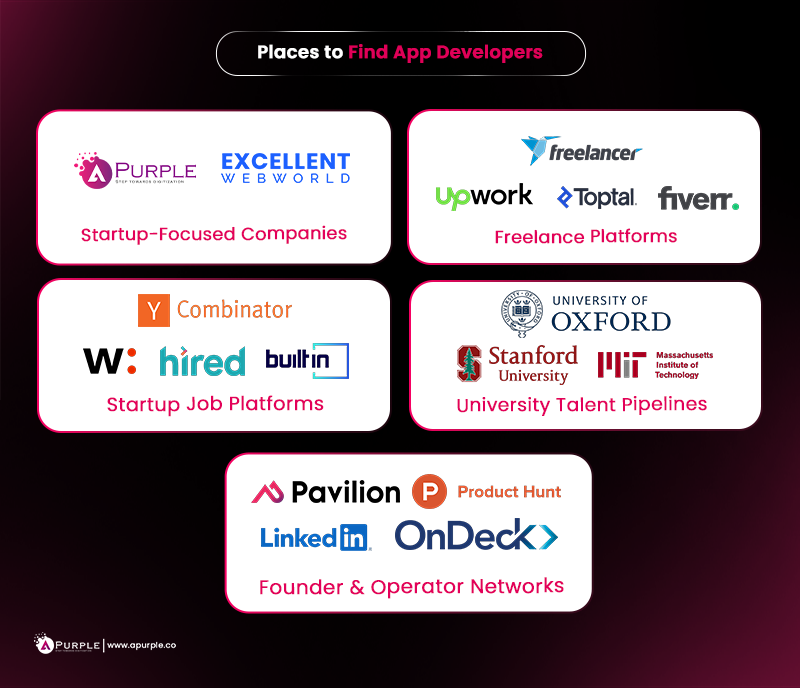
So far, you have known the process of hiring developers for a startup. However, the follow-up question is: where to find developers for a startup. Let’s find out more about the best place to hire app developers.
| Where To Find App Developers | Description | Examples |
|---|---|---|
| Startup-Focused Companies | If you lack tech knowledge, you can opt for this option. The tech partner can help you from planning through execution. | aPurple, Excellent Webworld |
| Freelance Platforms | You need to pay a small amount up front, but it requires dedicated management on your end. | Upwork, Toptal, Fiverr, Freelancer.com, PeoplePerHour |
| Startup Job Platforms | For those who want to build an in-house team and are looking for people who align well with startup culture. | Wellfound, Y Combinator Jobs, Hired, Triplebyte, Built In |
| University Talent Pipelines | The most cost-effective option you have, but it is only desirable for support and maintenance roles. | Stanford University, University of Oxford, IIT Bombay, National University of Singapore |
| Founder & Operator Networks | This option allows you to bring on board some of the big tech names who have left those organizations and wish to contribute to startup success. | LinkedIn, On Deck, Pavilion, Founders Network, Product Hunt |
What are the Proven Hiring Models for a Startup?
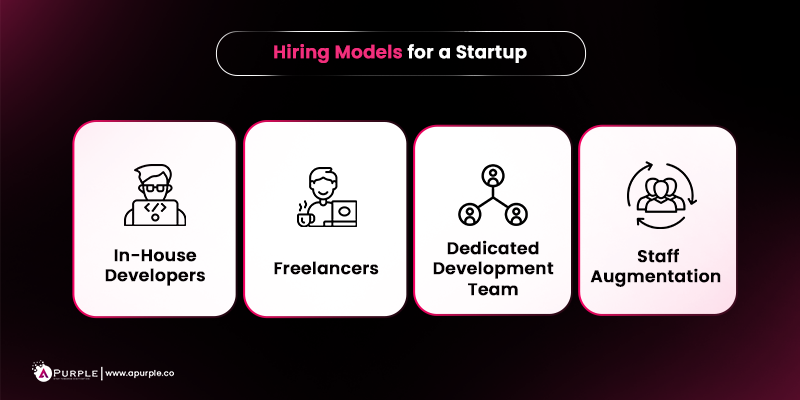
Here are some proven hiring models, along with tips for hiring app developers to help you find the best fit.
| Hiring Models | Pros | Cons | Best For |
|---|---|---|---|
| In-House Developers | Complete control, strong culture, and ownership of architecture. | The hiring cycle is very slow, and the salary you need to pay is very high. | Ideal for Series A founders who are aiming to build everything from scratch. |
| Freelancers | Fast developer onboarding, flexibility, and lower initial costs. | The chance of missing deadlines is high, accountability is very limited, and scaling is tough. | Good for founders who want to validate features before testing the product. |
| Dedicated Development Team | Predictable final cost, access to senior-level developers, and perfect execution with trustworthy software product development services. | It requires continuous monitoring on your end. | Suitable for Pre-Seed to Series A founders who want faster time-to-market while being scalable. |
| Staff Augmentation | Easy to scale, reduces hiring overhead, and provides access to subject-matter experts. | You need an internal team with experience in mobile app development services. | Ideal for founders with a CTO on board who want to focus on business decisions before launching the product. |
What are the Key Challenges While Hiring App Developers for Startups?
Here are some of the most common challenges startups face when hiring app developers. We have also provided possible solutions to these challenges.
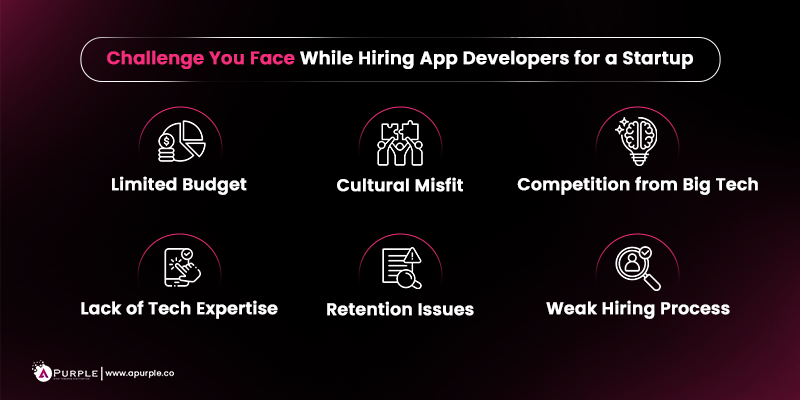
1. Limited Budget vs Quality Talent
2. Competition from Big Tech
3. Cultural Fit and Passion for the Startup
4. Lack of Technical Expertise Among Founders
5. Retention Issues
6. App Developer Hiring Process with Relevant Expertise
| Challenges | Business Impact | Possible Solutions |
|---|---|---|
| Limited Budget vs Quality Talent | Finding an app developer for a startup is challenging because budgets are limited and developer packages are very expensive. | Focus on narrowing your project scope and sign a contract with a partner that requires you to pay based on milestones achieved. |
| Competition from Big Tech & Funded Startups | Top-tier developers are attracted to big tech and funded startups because of the high salaries they offer. | Provide developers with full autonomy and some equality, and inform them about your product’s real-world impact. |
| Cultural Fit and Startup Mindset | Having a developer who doesn’t align with a startup mindset and is slow to execute can cost you first-mover advantage. | Prefer developers with experience in early-stage startups. |
| Lack of Technical Expertise Among Founders | To find an app developer, you need to assess them on technical aspects such as code quality, scalability, and architecture, which is hard for a non-tech founder. | Hire a tech expert and conduct in-depth interviews with them. |
| Retention and Dependency Risks | Developer retention in early-stage startups is challenging, and if someone leaves your project halfway through, it can cost you valuable knowledge and lead to costly rework. | Don’t give one developer total control of proceedings. Always hire multiple people and share responsibilities among them. |
| Weak App Developer Hiring Process | A lack of clarity in the app developer hiring process can lead to steep learning curves for candidates. | When looking for an app development partner, establish your hiring process early and define your requirements accordingly. |
What are the Key Factors to Consider While Hiring a Developer for a Startup?
If you’re wondering how to find a programmer to build an app, consider these factors, as they will help you to find the right developer:
| Key Factor | Description |
|---|---|
| Technical Depth vs Hype | You shouldn’t follow the buzzwords only. Hire developers based on their experience in scaling, architecture, and preventing rebuilds in the first 12 months. |
| Startup Experience | Hire developers for startups only who know MVP challenges, rapid delivery, and high-end scalability. |
| Cost Transparency | Look for developers/development teams that provide clarity on scope, timeline, and sprint costs from the first meeting. |
| Communication Clarity | Always check if developers can speak your native language or English. Otherwise, understanding the details of weekly demos and strategy meetings would be difficult. |
| Code Ownership & IP | When you hire developers for a startup, ensure you retain full control over the source code, documentation, and IP rights. |
| Scalability-First Mindset | Check whether your developers are creating an app with plans for post-MVP scaling and how they will accommodate business growth in a fully fledged product. |
How Much Does it Cost to Hire an App Developer for a Startup?
Knowing the money you need to invest in hiring an app developer for your startup is essential, as the cost you spend here will directly affect your scaling, hiring, marketing, and investor confidence. So, here’s a breakdown of the total cost according to various factors involved:
1. Cost According to the Complexity of the Project
The complexity of your startup project directly affects the cost, timeline, and delivery risk.
For example:
- If you’re an early-stage startup founder building an MVP in mobile app development for validating product-market fit, then you need to pay less with a limited number of features.
- If you’ve already validated your requirements and are moving forward with full-fledged development, including must-have and nice-to-have features, it may cost more.
| Complexity of the App | Average Cost (USD) |
|---|---|
| Basic MVP/Simple App | USD 9,000 – USD 20,000 |
| Growth Stage App (Product-Market Fit) | USD 20,000 – USD 60,000 |
| Full-Fledged App | USD 60,000 – USD 120,000+ |
Note: Price is Subject To Scope and Availability
2. Cost According to the Location of Developers
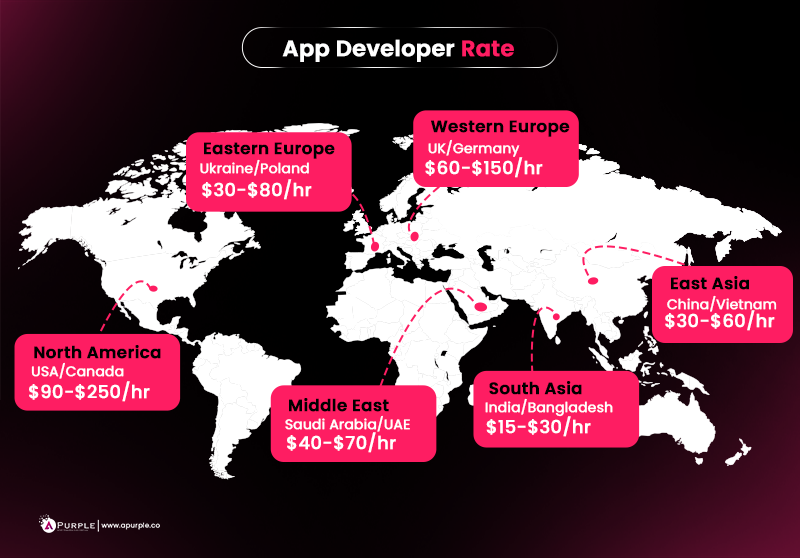
The developer’s location significantly affects the cost of app development, communication transparency, and accountability. For example, mobile app development in Saudi Arabia may cost less than for US-based developers but more than in Asian markets, due to regional demand and the maturity of the talent pool.
| Region | Country | Junior Developer | Mid-Level Developer | Senior Developer |
|---|---|---|---|---|
| North America | USA/Canada | $35-$70/hr | $70-$90/hr | $90-$140/hr |
| Western Europe | UK/Germany | $30-$50/hr | $50-$80/hr | $80-$130/hr |
| Eastern Europe | Ukraine/Poland | $20-$35/hr | $35-$50/hr | $50-$90/hr |
| South Asia | India/Bangladesh | $10-$20/hr | $20-$30/hr | $30-$40/hr |
| Middle East | Saudi Arabia/UAE | $20-$40/hr | $40-$70/hr | $70-$110/hr |
| East Asia | China/Vietnam | $15-$30/hr | $30-$45/hr | $45-$65/hr |
Note: Price is Subject To Scope and Availability
At aPurple, if you want to validate your idea and build a fast MVP, you can hire a vibe coding engineer starting at $20/hour. This is perfect for testing your concept before making a bigger investment.
If you’ve already built a prototype using AI tools and now need a scalable, production-ready app, you can hire an AI-assisted developer starting at $30/hour. They’ll upgrade your prototype into a secure, high-performance, full-fledged application.
3. Cost According to the Type of App
The type of app you choose also affects the overall development cost. Each app type or industry has different requirements, and matching them requires a developer with experience in that particular app type or domain, which affects cost calculations.
For example, SaaS apps require knowledge of subscription logic and cloud architecture. On the other hand, a fintech app needs to be compliant and secure.
| Type of App | Basic | Mid-Range | Complex |
|---|---|---|---|
| E-Commerce App | $15,000 – $35,000 | $35,000 – $80,000 | $80,000 – $150,000+ |
| Social Media App | $15,000 – $50,000 | $50,000 – $100,000 | $100,000 – $200,000+ |
| Healthcare App | $20,000 – $60,000 | $60,000 – $120,000 | $120,000 – $220,000+ |
| On-Demand Delivery App | $15,000 – $40,000 | $40,000 – $90,000 | $90,000 – $180,000+ |
| Fitness/Wellness App | $10,000 – $25,000 | $25,000 – $70,000 | $70,000 – $130,000+ |
| Education App | $8,000 – $20,000 | $20,000 – $60,000 | $60,000 – $110,000+ |
| Gaming App | $20,000 – $70,000 | $70,000 – $140,000 | $140,000 – $220,000+ |
Note: Price is Subject To Scope and Availability
Why Choose aPurple for Your Startup App Development?
Hiring developers for a startup that aligns with your vision while staying within your budget is not that easy. As a first-time founder, it’s difficult to judge scalability, code quality, and architectural decisions. So, you need a developer or a development team whose heart, soul, and DNA reflect the startup’s vision and the founder’s concerns at every point.
That’s where aPurple comes into the picture. With 10+ years of experience, 850+ projects delivered, and 18+ industries served, we know what it takes to build a world-class MVP, which validates your idea in the market within 8-12 weeks.
Here’s what you will get by partnering with aPurple:
- A comprehensive MVP roadmap with timeline, scope, and budget
- Seamless transition from AI prototype to full-fledged, scalable app
- Senior-level developers and experts who help you find product-market fit
- Scalable architecture that supports business growth and attracts investor funding
- Clear and transparent communication about project status and milestones
- Complete ownership of source code, IP rights, and documentation
Want to hire developers for your startup without compromising speed, capital, or control? Then connect with our experts and get a custom MVP development roadmap.
Frequently Asked Questions:
- Specify your business needs
- Ask for references
- Use hiring platforms
- Check feedback
- Review portfolios to assess developer skills
- Evaluate domain expertise for industry-specific needs
- Startup-focused companies like aPurple and Excellent Webworld.
- Freelance platforms such as Upwork, TopTal, Fiverr, etc.
- Startup job platforms like Wellfound, Y Combinator Jobs, Hired, etc.
- University talent pipelines such as Stanford University, MIT, and the University of Oxford.
- Founder & Operator Networks like LinkedIn, On Deck, Pavilion, etc.