Updated Date: Jan 12, 2026
How to create a restaurant app is often the first step for restaurants and food-tech startups that want to stay competitive and grow beyond third-party platforms. We can say that restaurants and mobile apps go together like pizza and toppings. If you look around, most of the restaurants are leveraging apps to reach the maximum audience. If you are a restaurant owner or a startup looking to invest in food tech, ignoring the benefits of restaurant app development can be a costly mistake.
Because a restaurant app isn’t just about online orders, it’s about building a profitable business you actually control. For tech startup founders, it creates a direct revenue channel, higher customer lifetime value, improved profit margins, lower customer acquisition cost, and more. For restaurant owners, it unlocks advantages such as higher margins, repeat orders, and direct engagement through loyalty programs and personalized discounts. Undoubtedly, building a restaurant app gives you returns that your efforts and investment really deserve.
Like every other industry, creating an app for the restaurant sector requires specific guidance based on proven experience. At aPurple, we work with food founders who want results, not theory, and who know that scaling a restaurant today requires a product-led app strategy. Harnessing that expertise, we have created a guide that helps you do efficient app development for restaurants.
What is Restaurant App Development?
Restaurant app development is the process of designing and developing a mobile or web application for restaurants. These apps serve as a bridge between restaurants and their customers, enabling operations such as online food ordering, table bookings, and payments.
Beyond the core development stages like planning, designing, coding, and testing, these restaurant apps contribute to gaining practical business benefits. They increase order rate, reduce manual tasks, and improve customer engagement. Additionally, developing a restaurant app boosts repeat sales through features like loyalty rewards, push notifications, and secure digital payments.
What are the Different Types of Restaurant Apps?
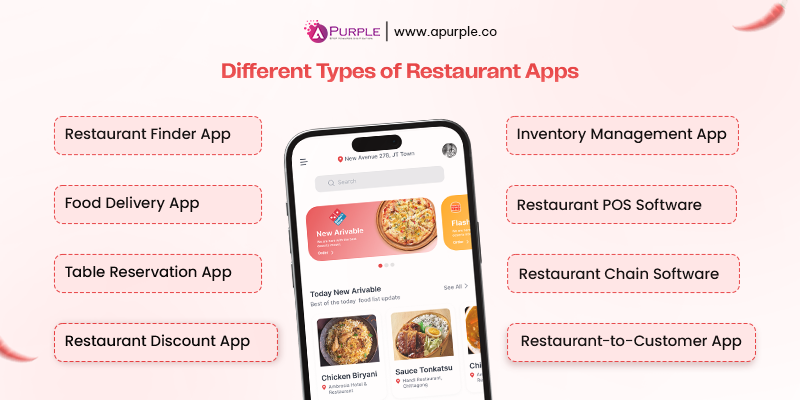
There are multiple types of restaurant apps, such as food delivery, table reservation, inventory management, and so on. Before jumping into the restaurant app development steps, let’s understand all the key types of restaurant apps with their real-world examples.
| App Type | What Is It? | Top Examples |
|---|---|---|
| Restaurant Finder App | This locator app enables users to search nearby restaurants by applying filters like ratings, location, and cuisine. | Yelp, OpenTable |
| Food Delivery / Ordering App | Food delivery app development allows ordering food from restaurants with options like browsing menus, customizing orders, delivery tracking, and online payments. | Uber Eats, DoorDash |
| Table Reservation App | These booking apps enable users to reserve tables, select time slots, and manage reservations easily. | Resy, Tock |
| Restaurant-to-Customer App | As the name suggests, this app allows restaurant businesses to connect directly with their customers and enhance engagement. | McDonald’s, Subway, Domino’s, Starbucks |
| Inventory Management App | The inventory management apps track ingredients, monitor stock, and automate supplier reorders. | Restaurant365, MarginEdge |
| Restaurant Discounts App | This restaurant app has features to provide coupons, loyalty rewards, exclusive deals, and other offers to customers. | TheFork, Eatigo |
| Restaurant Chain Software | This app connects multiple restaurant outlets under one system, allowing centralized management of menus, pricing, and other details. | MarketMan, Apicbase |
| Restaurant POS Software | A restaurant’s point of sale (POS) system handles different operations like billing, payment processing, order tracking, and reporting. | Oracle MICROS, Toast, Clover |
How to Create a Restaurant App in 9 Easy Steps [Step-by-Step Process]
Restaurant app development requires a planned strategy that meets your business goals and results in a successful digital product. The development process includes many stages, including understanding the target audience, identifying market gaps, and partnering with the right restaurant app development company. Let’s begin with the process in detail.
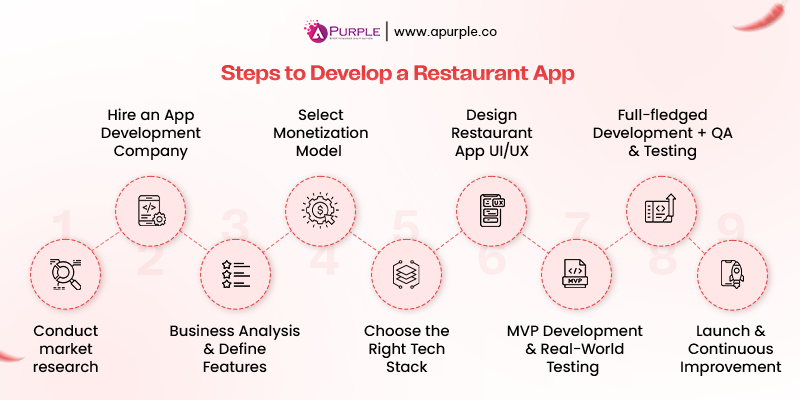
Step 1: Conduct Market Research
The first step to create an app for your restaurant is conducting in-depth market research and collecting data. Because the information you collect will help you make crucial decisions in further steps. Check the following questions to find answers for initiating restaurant app development:
- Who is my target audience?
- What kind of experience do users truly want?
- What are the current market gaps?
- What are the latest restaurant industry trends?
- What are the user’s pain points when dining or ordering online?
- What do your competitors offer?
- What’s your competitors’ marketing strategy?
Consider studying the leading restaurant apps like Uber Eats, DoorDash, and OpenTable; know how they work and what they are missing so you can take advantage of them. Answers to all these questions help you understand the restaurant industry and build an app that meets user expectations and stands out in the competitive market.
Step 2: Hire an App Development Company/strong>
Once your research is complete, the next step is to hire expert developers from a reputable restaurant app development company who can turn your restaurant app idea into a scalable solution. Their expertise and approach will directly influence your product’s success.
Make sure you are collaborating with a restaurant booking app development company that has proven years of experience in creating solutions for startups and businesses in the food and hospitality industry. While searching, do the following:
- Check years of industry experience
- Review their portfolio
- See client testimonials
- Check case studies
An experienced company will understand your concept, assist you in creating an app, guide you in selecting the tech stack, and ensure a smooth deployment.
Step 3: Business Analysis and Define Features for Restaurant App
At this stage of business analysis, the real collaboration with your hired app development team begins. Together, you analyze the primary goal of your restaurant app business and, according to that, what you need to integrate as core features.
A restaurant app caters to multiple roles, such as customers, restaurant owners, delivery partners, and admins; each needs distinct functionalities, which means different features.
Finalizing the restaurant app type and clearly outlining core features helps in planning the right architecture, prioritizing functionalities, and ensuring a smooth and user-centric experience.
Here’s the must-have features list for each role in restaurant app development.
Restaurant App Features for Customer/User
| Features | How It Works |
|---|---|
| User Registration/Login | Enables customers to sign up and access app features. |
| Menu Browsing | Let customers explore complete menus with images, ingredients, and prices. |
| Smart Search & Filters | Helps users quickly find dishes or restaurants based on cuisine, price, location, or ratings. |
| Online Ordering | Allows app users to place dine-in, takeaway, or delivery orders seamlessly. |
| Real-Time Tracking | Shows live updates to users on food preparation and delivery status. |
| In-App Payments | Allows users to pay securely through the app’s payment gateway. |
| Reviews & Ratings | Let customers share feedback to improve transparency and trust. |
| Notifications & Updates | Sends timely updates on offers, order status, and promotions. |
Restaurant App Features for Restaurant Merchant
| Features | How It Works |
|---|---|
| Restaurant Profile Management | Allows restaurants to maintain business details, timings, and information. |
| Menu & Pricing Management | Let them update dishes, images, prices, and availability. |
| Order Management | Helps staff accept, prepare, and track all incoming orders efficiently. |
| Inventory Tracking | Monitors stock levels to avoid shortages and improve planning. |
| Promotions & Discounts | Allows restaurant owners to create offers and targeted deals. |
| Analytics Dashboard | Provides insights into sales, customer trends, and top-selling items. |
Restaurant App Features for Delivery Partner
| Features | How It Works |
|---|---|
| Easy Signup & Verification | Allows riders to register and get approved to start delivering. |
| Order Acceptance & Rejection | Gives delivery partners control over which orders to take. |
| Route Optimization | Provides the fastest delivery route using GPS navigation. |
| Earnings Dashboard | Shows daily, weekly, and monthly earnings in real time. |
| Availability Updates | Let riders mark themselves online or offline instantly. |
| Delivery Status Updates | Allows partners to update pickup and delivery progress. |
| In-App Chat or Call | Gives access to direct communication with customers or restaurants. |
Restaurant App Features for Admin Panel
| Features | How It Works |
|---|---|
| User & Restaurant Management | Allows admins to manage customers, restaurants, and delivery partners. |
| Order & Delivery Control | Monitors all ongoing orders and handles all the ups and downs. |
| Menu & Category Management | Let admins oversee categories, cuisines, and menu compliance. |
| Commission & Payments Management | Tracks commissions, payouts, and transactions securely. |
| Content Management System (CMS) | Helps update banners, static pages, and app content easily. |
| Analytics & Reporting | Gives complete insights into app data such as revenue, performance, and app usage. |
| Promotions & Campaign Management | Allows admins to easily run offers, coupons, and marketing campaigns. |
| Security & Access Control | Ensures safe application usage with role-based access and activity logs. |
Step 4: Select the Most Suitable Monetization Model for a Restaurant App
After understanding the core features of a restaurant app, it’s important to finalize the method to make money. Choosing the right monetization model can determine how profitable your restaurant app becomes and how effectively it supports your business goals.
Below are some proven monetization strategies for restaurant apps that are used by most of the top food delivery apps like Uber Eats, DoorDash, and similar.
1. Commission-Based Model
The commission-based model is the most popular revenue model in the food-tech industry. For restaurants, the platform charges the partner restaurants a small commission on every successful order or reservation. That means revenue grows as order volume increases.
2. Subscription or SaaS Model
The subscription-based model offers premium benefits to the customers and restaurant merchants. By paying a fixed monthly or annual fee, customers can avail themselves of the benefits of free deliveries and exclusive discounts on every order. This will give you a consistent income from loyal customers.
3. Delivery Fee or Surge Pricing
This strategy adds flexibility to increase the delivery charges or apply surge pricing during the high-demand periods. This is a smart way to balance the demand, cover logistics costs, and maximize profit during peak hours. Ultimately, you can maintain healthy profit margins when order volume spikes.
4. Featured Listings for Restaurants
This monetization model is mostly preferred by discovery or listing-based restaurant apps, in which they sell premium visibility to restaurants. Businesses can pay for banner placements, featured listings, or top-ranking spots within the app to get visible to customers.
Step 5: Choose the Right Tech Stack
Choosing the right tech stack for your restaurant app is very important as a startup, as it saves money and reasonably determines your app’s performance and scalability.
The technology requirements of native app development and hybrid app development are clearly different. You have to build separate versions for iOS and Android in a native approach. However, cross-platform development gives you the opportunity to build a restaurant app for both Android and iOS with a single codebase.
Let’s see the most popular technologies preferred for efficient restaurant app development.
| Technology Layer | Popular Restaurant App Technologies/Tools |
|---|---|
| Frontend | React Native, Swift (iOS), Kotlin (Android) |
| Backend | Node.js, Django, Ruby on Rails |
| Database | Firebase, MongoDB, PostgreSQL, MySQL |
| APIs & Integration | Google Maps API, MapBox, PayPal/Stripe, Cloud Messaging |
| Cloud & Hosting | AWS, Google Cloud, Microsoft Azure |
| Authentication | OAuth, JWT |
| Testing Tools | Appium, Selenium, Postman, Jest |
| DevOps & Deployment | Docker, Jenkins, GitHub Actions, Kubernetes |
| Real-Time Functionality | Socket.io, Firebase Realtime Database |
| Analytics & Monitoring | Google Analytics, Firebase Analytics |
Step 6: Design an Intuitive Restaurant App UI/UX
After selecting an appropriate tech stack, it’s time to focus on creating a user-friendly interface. A well-designed restaurant app should be visually appealing and provide a seamless, intuitive experience for customers, restaurant owners, and delivery partners.
Ask your hired development partner to give a team of experienced UI/UX designers with experience in creating a restaurant app design. Make sure your design matches your brand identity and user expectations of seamless navigation.
A strong and attractive UI/UX design matters a lot in a restaurant app’s success, as it decides whether your user loves to come back to your app or not. Along with this, a pleasant UI drives user engagement and turns users into loyal customers.
Step 7: Begin MVP Development and Test With Real Audience
As an experienced startup consulting firm, we always suggest our clients to prefer MVP development before investing money and effort into a full-fledged solution.
Starting with an MVP in mobile app development will help in validating the restaurant app idea with real-world feedback. Yes, you can collect reviews and experience from multiple real users on your core features without investing much, and later upgrade it for a full-fledged restaurant solution.
So, developing a restaurant app MVP before the full-fledged solutions will help you to:
- Validate your app idea
- Minimize development cost
- Get user feedback faster
- Accelerate time to market
- Lower business risk
Once your MVP version gets positive feedback, you can move forward to developing a full-fledged restaurant app.
Step 8: Full-fledged Development + QA & App Testing
In this phase of restaurant app development, you have to start a fully-featured development of your product. With the core features integrated in the MVP development, now you can implement advanced features and functionalities in the restaurant app based on user feedback and market insight.
At this stage, make sure your development team will work on strengthening the app’s architecture, integrating core features, optimizing performance, and ensuring scalability.
As per your restaurant app complexity, you can integrate advanced features like AI chatbots, dashboards, and other tools in this phase. These cutting-edge features engage users as well as provide real value to merchants and delivery partners.
Once development is complete, it’s critical to thoroughly test, perform quality analysis, optimize performance, and ensure security compliance. This ensures that your on-demand restaurant application development functions seamlessly and provides a smooth experience for all users.
The testing phase involves checks for usability, performance, security, and compatibility of the app, helping to identify and resolve bugs or glitches before the app goes live. This way, you can ensure smooth operations and a seamless experience for restaurant app users.
Step 9: It’s Time to Launch and Continuous Improvement
After a successful restaurant app testing, you can deploy your app on different app stores, such as the Apple App Store and the Google Play Store , to launch it with your target audience. Make sure all the security and compliance are checked before the launch.
Here’s the thing: once you launch your restaurant app, the work is not done yet; it needs continuous improvement to match market requirements and stay competitive. Ensure that you update your app regularly according to the feedback received from the users. This will improve the app’s performance and keep your app aligned with the user expectations.
How Much Does it Cost to Develop a Restaurant App?
As you read above, the cost of restaurant food delivery app development varies based on different factors like app complexity, advanced features integration, third-party subscriptions, development team location, and so on.
That’s why, to give you a budget clarity on your business idea, here we have outlined the estimated cost for basic, moderate, and complex restaurant apps. However, the MVP app development cost, is absolutely lower than that of any basic restaurant app. Let’s check how it ranges.
| App Complexity | Restaurant App Cost | Development Time |
|---|---|---|
| MVP | USD 9,500 to USD 12,000+ | 1 to 4 Months |
| Basic App | USD 12,000 to USD 20,000+ | 3 to 6 Months |
| Moderate App | USD 21,000 to USD 35,000+ | 4 to 7 Months |
| Complex App | USD 35,000 to USD 80,000+ | 9 to 12+ Months |
Please note that the above-mentioned costs are an estimated price range of restaurant app development; it may vary based on pre-discussed factors.
What are the Future Trends of Restaurant App Development?
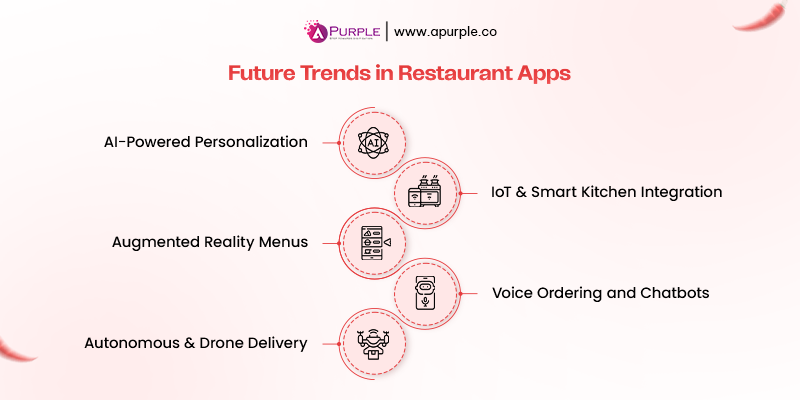
As technology evolves in some tremendous way, the restaurant industry is no exception. Now, the restaurant apps are not limited to just ordering and delivering food; they are serving more than that. Below, we have outlined the top mobile app development trends for the restaurant industry expected in 2026 and beyond.
1. AI-Powered Personalization
As Artificial Intelligence continues to redefine industries, restaurant apps are embracing this. AI will enable the apps to analyze customer preferences, order patterns, and dining preferences to deliver personalized recommendations.
With these operations, AI is set to make food ordering and dining experiences more intuitive.
2. IoT & Smart Kitchen Integration
With advancements in technology, restaurant apps will increasingly integrate with IoT-enabled kitchen equipment and inventory systems to automate cooking, order tracking, and stock management.
This automation will reduce errors, minimize food waste, and increase operational efficiency.
3. Augmented Reality Menus
The implementation of AR technology in restaurant apps enables customers to visualize dishes in 3D before ordering, explore virtual menus, and view nutritional information for the dishes.
This will increase user engagement and make dining and food ordering more interactive.
4. Voice Ordering and Chatbots
Nowadays, customers often don’t have the time to place food orders or make reservations manually through searching and typing. With AI chatbots and voice-enabled features, users can easily order food or book tables through natural conversation.
It speeds up service, improves accessibility, and offers a hands-free experience that customers expect.
5. Autonomous and Drone Delivery
With the growing focus on contactless services and automation, the integration of drone and robot deliveries in the future in restaurant apps will change the last-minute delivery.
This technology will allow faster, safer, and more efficient order fulfillment, reducing delivery time and cost.
Restaurant Apps Created by aPurple
At aPurple, we’ve worked with restaurant startups and enterprises across Brazil, Hong Kong, and New Zealand, helping them turn their app ideas into innovative digital solutions. From a seamless food delivery app to restaurant finder and restaurant chain software, we’ve highlighted a few success stories that showcase our innovation and expertise in building custom restaurant apps that blend technology, usability, and scalability.


Wrapping Up!
Restaurant app development is not just about an ordinary digital upgrade; undoubtedly, it has become a strategic business move for restaurants and food startups. Investing in custom restaurant app development leads to growth, control, and long-term sustainability.
You can say that the restaurant app is an accurate business solution that helps you own customer relationships, improve margins, streamline operations, and scale without depending entirely on third-party platforms.
At aPurple, we stand out as a trusted mobile app development company for restaurant businesses and food-tech startups. From MVP development to full-scale platforms, our team helps food brands launch faster, validate smarter, and compete confidently with their product. Let’s connect to make your dream of a restaurant app a reality.
Frequently Asked Questions
- Step 1: Conduct Market Research
- Step 2: Hire an App Development Company
- Step 3: Business Analysis and Define Features
- Step 4: Select Monetization Model
- Step 5: Choose the Right Tech Stack
- Step 6: Design Restaurant App UI/UX
- Step 7: MVP Development
- Step 8: Full-fledged Development + QA & Testing
- Step 9: Launch and Continuous Improvement
- Commission-Based Model
- Subscription or SaaS Model
- Delivery Fee or Surge Pricing
- Featured Listings for Restaurants