Updated Date: May 29, 2026
Tech startups fail not because the idea was wrong but because the execution never had a structure to stand on. Founders like you come with deep technical knowledge and often skip the business plan entirely, assuming the product will speak for itself. Well, it rarely does.
A solid business plan is not a formality or a document you write for investors to attract. It is the operational backbone that connects your technology vision to real-world decisions, such as where the money goes, who you hire first, which market you enter, and how fast you can scale. For tech founders and startup teams, it’s the difference between building a startup that scales sustainably and one that loses momentum after the initial sprint. Stay tuned to avoid the latter…
What is the Technology Startup Business Plan?
A tech startup’s business plan is a fresh, budding business document containing strategies and tactics of a tech business roadmap in a summarized format. It will make the business set to enter the market with unique technical products or services.
It has been designed to harness the efficiency of the technology tailored to accomplish the business goal. Making a high-end tech startup with a future-ready business plan helps you to work smarter and prevent emerging roadblocks. Therefore, a technology startup plan enables you to represent your idea clearly to the investors and bankers for them to know what you need and how you can further excel your tech business.
Aside from this, you can also ascertain the concept of creating a business plan by validating the following reasons…
Why Does a Tech Startup Need a Business Plan?
For any tech startup, having a foolproof business plan is the major navigator of the whole ideation, validation, creation, and execution. Regarding the technology startup business plan, it amplifies your first impression for investors, partners, banks, and potential employees. Well, a few compelling reasons insist you have a look at the further steps:
- Strategic Roadmapping
- Secure Funding Source
- Risk Reduction Solutions
- Set Realistic Goals
- Market Viability
How to Create a Business Plan for a Tech Startup – Proven Steps
The most sought-after way to start a startup with a clear vision and mission is to create a business plan. You can refer to the tech startup business plan example, but there is a proper set of steps to build your startup plan from scratch.
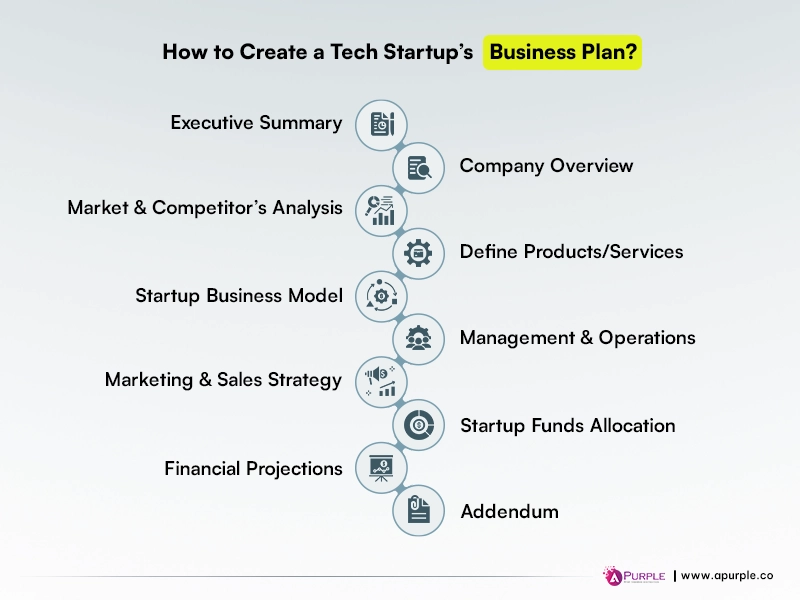
1. Executive Summary
A strong executive summary clearly explains the business opportunity, the problem being solved, the target market, the business model, and the company’s goals. Moreover, it should also mention any funding requirements or strategic objectives. The summary should be concise, professional, and compelling, usually ranging from half a page to two pages in length.
The executive summary could be longer if it involves complex financial transactions; however, it should not exceed one page. Provide a summary of your tech startup’s business within the space. The main components of the executive summary should be…
- Business Concept
- Financial Highlights
- Funds & Revenue Sources
- Verified Information
- Customers & Market type
2. Company Overview
The company overview should be a well-structured and clear summary that makes deeper sense. You must provide a more detailed explanation than the executive summary to make a better company description. Additionally, it defines your key elements like
- Company name and legal structure
- Headquarters and operational locations
- Founding date
- Founder and leadership background
- Mission & Vision statement
- Day-to-day operations
- Core business objectives
- Business philosophy & values
So, this section should also explain the startup’s positioning within the technology ecosystem and define its intended impact on the industry. This will help you clearly showcase how you will add value to your customers and how your company’s strengths and weaknesses will be addressed.
Read More: Startup Business Checklist
3. Market & Competitor’s Analysis
No matter how strong and efficient your business plan has been, you must perform thorough market as well as competitor research. It comes under the SWOT analysis [strengths, weaknesses, opportunities, and threats] for your startup business. With detailed analysis, you can demonstrate a clear understanding of the following aspects.
- Market landscape
- Customer behavior
- Industry trends
- Competitive environment
Moreover, this enables investors to expect startups to validate market demand through research and realistic analysis. However, the areas of research and analysis in both market and competitor analyses are as per the given table.
| Market Analysis | Competitor Analysis |
|---|---|
| Industry overview | Direct/Indirect Competitors |
| Current market trends | Product Comparison |
| Market size & growth rate | Marketing Strategies Evaluation |
| Customer demographics | Unique Value Proposition |
| Pain points & Unestimated needs | Primary Revenue Sources |
| Technology Adoption Trends | Competitor’s Successful Campaign |
| Regional & global opportunities | Social Media Presence |
4. Define Products/Services
Describing the products or services for your tech business has been a tedious task. A technology startup plan requires you to research, analyze, and navigate through the market trends and future scope. For the tech businesses, it is really important to have clarity on what exactly you are striving for, the tech stack requirements, the product type, and the overall business requirements.
From cost and compliance to product-market fit, your business plan revolves around the end goal. The following table will outline the depth of this step seamlessly.
| Section | Details |
|---|---|
| Products/Services Offered | Clearly define the products or services provided by the business and their key features. |
| Customer Needs Addressed | Explain the problems, challenges, or requirements of the target market that the offerings will solve. |
| Value Proposition | Highlight how the products/services provide benefits such as quality, affordability, convenience, innovation, or efficiency. |
| Target Market | Describe the specific customer group, industry, or audience the business intends to serve. |
| Revenue Potential | Demonstrate why customers will be willing to pay for the product/service and the expected market demand. |
| Product Lifecycle | Explain the stages of the product/service from development and launch to growth, maturity, and future improvements or upgrades. |
| Customer Retention Strategy | Describe how the business will maintain customer satisfaction and encourage repeat purchases or subscriptions. |
| Service Subscription Model | If applicable, explain why customers would subscribe to ongoing services and the benefits they will receive. |
| Research & Development (R&D) | Outline ongoing or future development activities such as website creation, software integration, app development, or process improvements. |
| Technology & Innovation | Mention the use of digital platforms, business software, mobile applications, or innovative tools to enhance operations and customer experience. |
| Intellectual Property Plans | Include plans for copyrights, trademarks, patents, or proprietary technologies to protect business assets and innovations. |
| Future Expansion Opportunities | Describe potential future product lines, service enhancements, or market expansion plans. |
5. Startup Business Model
A company’s business model describes how it creates and extracts value. Income and operational sustainability are critical for startups. Here are the critical components of a business model:-
- Identifies target customers’ needs
- Describes value propositions and unique selling points
- Determines revenue streams and cost structures
Pro Tip: Having a well-defined startup business model prevents roadblocks in your startup business development ahead. You can refer to our guide on popular startup business models to choose the ideal one!
6. Management & Operations
No doubt, the business idea you have is solely yours, but you need people to make it a successful business. Who are those people, and what role do they have? You have to mention it in your tech startup business plan, showcasing your team’s strengths and experiences in the particular field. It will help investors and bankers decide if your business idea is achievable or not. So, you will get concerned with the following components under this stage.
- Organizational Structure
- Operations Plan
- Staffing Requirements
- Production & Suppliers
7. Marketing & Sales Strategy
You cannot guarantee the success of your tech startup to investors and bankers unless you develop well-researched marketing strategies and a sales plan. In this section, you should clearly state your marketing plan. The strategy should clearly define how you intend to attract and retain customers. Answer this question accurately.
- What is your marketing strategy?
- What are your strategies for specific marketing channels, and how will they help your technology startup?
- What is your sales funnel and specific audience?
- What are the changing customer behaviors?
- How to quickly adapt to the recent market trends to retain customers?
As you have answered them all, you can have a smooth process going forward. It will mention and give you an idea of the marketing channels you intend to use to promote your product and attract customers. You can avoid demonstrating a single approach to a marketing strategy because there isn’t one. Moreover, evolving marketing strategies will align with the changing needs of your target market. Your marketing strategies should include key points for conversion strategies.
8. Startup Funds Allocation
A funded startup with a full engineering team, compliance requirements, and a go-to-market motion typically requires USD 20,000 – 200,000+ to reach a meaningful MVP cost. Moreover, the biggest cost drivers are talent, infrastructure, and time-to-market, not the idea itself. So, you have to strategically allocate funds with the given sources.
- Bootstrapping
- Angel Investors
- Crowdfunding
- Venture Capital
So, these are effective ways to sort your budgeting aspects for the early-stage requirements of business. Ensure they are mentioned clearly in your business plan structure.
9. Financial Projections
Financial projections are estimates of future economic outcomes for your technology startup. It is the most important part of convincing your angel investors and lenders. As a result, it should be convincing enough to demonstrate the stability of your business. Therefore, it will help investors determine whether the money they invest will be repaid.
If your technology startup business is already operational, please attach balance sheets, income statements, cash flow statements, and any other relevant documents. So, these documents will help you persuade lenders.
Furthermore, you can attach business forecasts and data gathered during market research. With monthly and quarterly financial projections, you should reflect the future financial outlook for the business.
10. Addendum [Evidence locker]
An Addendum (appendix) is an optional but highly recommended final section of a business plan that contains large supporting documents, charts, and raw information. By including detailed evidence here, you can keep the main body clear and scannable while providing investors with easy access to proof of your claims. This file includes—
- Legal & Official Documents
- Market & Product Details
- Social Proof
- Recorded Financials
Moreover, it is better to refer to the details at an early stage to avoid any bottlenecks. You must draft this one clearly while maintaining the transparency of the proofs. Accordingly, it helps startups to redefine the overall document requests for a particular audience.
Get Started Right Away!
Building a successful tech startup requires more than just a great idea; it demands a clear vision, a scalable business model, and a well-structured execution strategy. A strong business plan helps founders validate their market opportunity, attract investors, define growth strategies, and build a sustainable competitive advantage.
As a technology-focused company, we also specialize in developing scalable web and mobile applications tailored for startups and emerging businesses. Whether you are building an MVP, SaaS platform, AI-driven solution, or enterprise application, our experts can help you launch faster, optimize operations, and bring your product to market efficiently. Connect with us to discuss your startup vision and explore how we can support your journey from idea to execution.
FAQs
- Freemium
- Advertising
- Licensing
- SaaS Subscription
- AI-Driven Development
- Integrating ML Models
- Lack of Market Need
- Legal and Regulatory Hurdles
- Financial Constraints & Funding
- Software Development (SaaS & AI)
- Fintech
- Cybersecurity
- IoT
- E-commerce
- Healthtech & Edtech