Updated Date: Mar 26, 2026

Quick Overview: Starting a car rental business is not as simple as a go-getter thing. This requires a detailed strategy and adhering to the righteous steps. As car rental app development is a breakthrough approach, you will necessarily need to understand the car rental business idea, costs, processes, revenue models, and more. Stay on the page to ride through the insight!
A car rental business is where you offer vehicles for rent to individuals or corporations for a definite period. Popular car rental apps like Turo and Hertz have been widely known solutions for years. Car rentals are an automotive solution for customers looking for a short-term car, typically ranging from hours to weeks.
They have to pay the rent or fees for the time they have rented the car. It is actually booming in the marketplace. People rent a car for different purposes, such as travelling intercity, weddings, family picnics, etc. Read further to begin your business with the right strategy.
How to Start A Car Rental Business – Actual Process
Starting a successful car rental business has several key steps. Breaking down the process into different parts helps business owners understand all the necessary components.
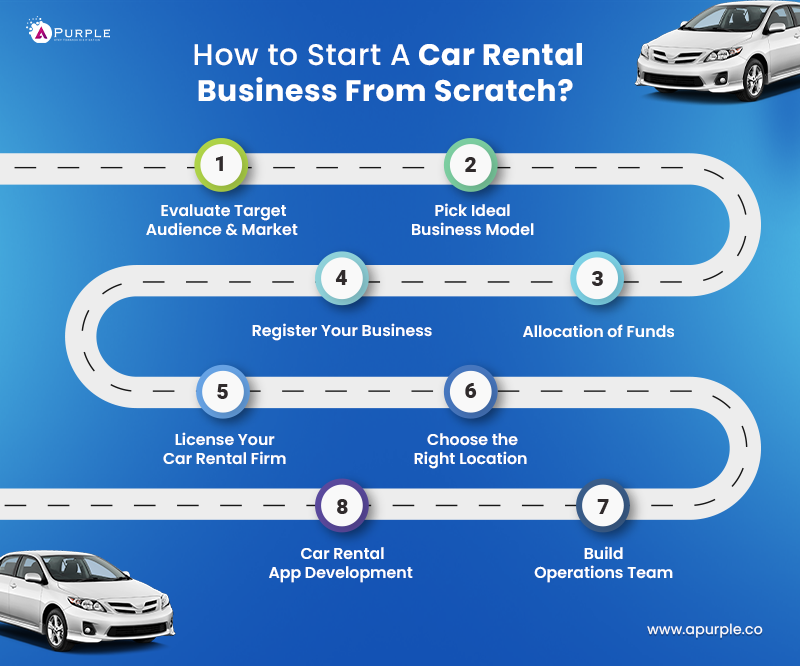
Step 1 – Evaluate Your Target Audience & Market
Determining the target audience and market is the first step toward building your car rental business. So, you will have to start with asking the following question to yourself;
- What do you need to start a car rental business?
- Who is your target audience?
- What are the pain points of your target audience?
- Who are the potential competitors?
In the past, many startups tried to copy Uber’s business model or other apps but failed miserably.
Challenge: Being the first step of the car rental business, it is important to have a clear idea of the related factors of your business.
Step 2 – Business Model of Car Rental Business
There are some proficient car rental business models available for your business. Here is the proper explanation of each below.
| Type of Business Model | Their Purpose |
|---|---|
| Franchise | A franchise car rental business is low-risk by providing ready-to-use resources like reservation systems, technology, and bulk purchasing. So, it furnishes smoother operations and profitability. |
| Dealership | The dealership business model involves a partnership between a car rental business and a dealership. |
| Self-Made | You can independently start your business by buying and renting a car for fleet or logistics purposes for the target audience. |
| Acquisition of Existing Business | Lastly, you can also acquire the existing car or vehicle business for your |
Read Also: Ready to enter the high-end automotive market? Our guide on starting a luxury car rental business addresses frequent challenges and solutions.
Step 3 – Get Your Finances
When starting a car rental business, you must finalize your finances, including the source of funding and operational budget. The process begins with calculating the cost of vehicle procurement or leasing, location setup, insurance, licenses, permits, staffing, and other operational costs. The next step is to find the source of funding. So, the types of funding that you can use for your car rental startups are –
- Personal Savings
- Crowdfunding
- Friends & Family
- Bank Loans
- Venture capital investments
Challenge: Raising funds is difficult; it’s really crucial to get your pitch and ideation ready well in advance.
Step 4 – Register Your Business
In this step, you have to optimize the business’s structure. This includes sole proprietorship, partnership, corporation, or limited liability company (LLC). After choosing the business structure, the next step is to register your business name. Furthermore, getting Federal and State Tax ID numbers is vital to zoning laws.
Challenge: This step demands that you be well-informed about the registration law and process. It even requires a cost of legal formalities, which you need to discuss and pay to register your business.
Step 5 – License the Car Rental Business
The licensing part comes into play after you register your car rental business. The license you get can help you operate legally within city limits, state, and industry regulations. You need to acquire the Car Rental Agent Listing site for registration. When applying for a permit, you must ensure that you deal with insurance companies to protect your car, drivers, and customers.
Challenge: The main limitation comes from navigating complex and varying licensing requirements. As it differs and narrows down across city and state regulations, this can delay approval.
Step 6 – Choose the Right Location for a Car Rental Business
Choosing the right location is the most challenging part of any business. So, select the area that is visible to your potential customers. Some factors to consider while choosing your car rental business location include the property size of 3/4 acre, and accessibility within 2.5 miles to major roads, airports, or other crucial landmarks.
For example, if your target customers are corporate employees who don’t have their private vehicles but would rent a car, you can choose a location among office spaces. So if you are operating in New York, Midtown Manhattan is the location to choose.
The benefits of opting for the correct location include;
- Tapping into a new market
- Improving employee productivity
- Creating a competitive edge
Challenge: The location of the car rental business for pickup and drop-off is really important. You can make a real-time impact on the team.
Step 7 – Build Your Operations Team
Managing a car rental business alone is challenging; you should seek professional help. For various challenging activities where you may need the help of professionals, it is important to establish the right team to manage the different facets of your rental business.
Challenge: The people you connect with make or break your business. Be careful who you include in your team.
Step 8 – Develop a Car Rental App
In the car rental business, it is beneficial to launch the business as an online car rental since it allows customers to interact with the services efficiently. Further offering digital platforms for users to avail your services also opens new avenues of conversions. Going for the car rental app development services is the most profitable way to enter the market. The procedure to develop and deploy an app for your business is as follows:
| Car Rental Application Development Process | |
|---|---|
| Plan for Your App | Developing your car rental business app demands planning your roadmap. It must include functionality, design, and features to attract your target and potential customers |
| Create an Engaging Design | You need a visually appealing UI/UX design for an app, with engaging wireframes of the app. Our team curates the custom UI/UX for app development, which captures users’ interest. |
| Build Your Car Rental App | Building your car rental business app with programming languages, frameworks, and tools like Java, Swift, Flutter, and React Native. |
| Conduct Rigorous Testing | You must rigorously quality-assure the app to ensure that the application runs efficiently and has no bugs or errors. |
| Deployment Your App | As the app has been developed and tested with proper metrics, you need to deploy them further to the app platforms. |
| Post-Launch Support | Next, you have to keep on upgrading app feature switches, changing scenarios, and offering customer support. |
Challenge: This is a core technical aspect of the business. Ensure to hire app developers with hands-on experience.
How much does it cost to start a car rental business?
The typical cost range to start a car rental business is $10,000 to $50,000. As you have to make an impact on the online car rental business. You can even make it with MVP development for early launch and further upgrade it to the market requirement. It will be as follows;
| Stage | Price |
|---|---|
| MVP App Cost | USD 10,000 to 12,000 |
| UI/UX Design | USD 2,000 to 4,000 |
| Developement | USD 10,000 to 20,000 |
| Integrations & Testing | USD 3,000 to 5,000 |
| Deployment & Maintenance | USD 2,000 to 3,000 |
Moreover, the prices may vary depending on your car rental business requirements. Now, you need to gain insight into the features of the car rental app to transform it into a profitable rental business idea.
What are the Features of a Car Rental Website/App?
We have curated a list of the most vital features and functionality to help you get an edge over competitors. There are 2 main car rental app panel features you need to consider.
Must-Have Features for Customer Panel
| Features | Description |
|---|---|
| User Registration | They can create a profile by signing up & managing their booking |
| Renter Verification | For safety purposes, you must look for their identity, license information, email, and more |
| Location-Based Rental | User must be able to search for a nearby location and hire a car through the app |
| Booking Options | Users can book a car through prior or instant booking options |
| Cancellation Option | For some last-minute plans or changes, the rider or renter can cancel the booking as well |
| Payment Gateway | The user can easily make a payment on the app based on the duration they have rented the car for |
Major Features For Admin Panel
| Features | Description |
|---|---|
| Users Management | It allows for monitoring user activity, booking history, and account status to handle user requests |
| Fleet Management | Tracking vehicle status, maintenance schedules, and location for better utilization. |
| Analytics & Reporting | Generating reports on revenue, booking trends, and user behavior. |
| Revenue Management | Dashboard has the total earnings on a daily/weekly/monthly basis, with tracking of payments and transactions |
| Booking Management | Oversee the car booking status, availability, cancellation, and track the car. |
How Does a Car Rental Business Make Money?
For the car rental business, it is necessary to decide how to launch your car rental business or which features to integrate. It would be best to be sensible about earning money from this business. So, here is an answer to your curiosity about the revenue model of the car rental business.
1. Rental Fees
It is the most fundamental component of the revenue model in car rental startups. Rental fees are the prime source of revenue generation by leasing cars to customers for a specific period. Customers pay on a daily, weekly, or monthly basis.
2. Surcharges
Surcharges are the extra fees you charge your customers. The charges can be divided into;
- Insurance Surcharges: Insurance surcharges are the extra cost or risk of collision damage waivers (CDW) and liability insurance. These insurance options come with additional fees that are charged as surcharges.
- Fuel surcharges: The biggest problem is fuel. Sometimes customers return the rental car with an empty tank. If the customer does not return the vehicle with a full fuel tank, you can charge a fuel surcharge to cover refueling the car.
- Child seat surcharges: Those traveling with their children constantly need a child seat in the car, so you can charge for providing the child seats or booster seats for an extra charge.
3. Late Fees
If a customer cannot return the rented car on time, you can charge them late fees. Charges may vary depending on the delay period and the type of car rented. So, the exact charges depend on the rental company, time, and the type of car. Thus, you can ensure a clear return policy for late returns and extra charges. It eliminates user disputes and encourages seamless interaction.
Get Started With Your Car Rental Business!
The car rental business can be challenging if you don’t plan it well. Everything needs to be well planned, from the business model you choose to revenue streams and strategic digitization. What features you include and how well you execute the business plan to align it with your business goals. It serves as the foundation for building the custom car rental app. So, you can ensure higher conversions and profits for your business. aPurple can make things easier, especially for a newbie. Consult with the Experts team now!
FAQs
- Asset Damage and Theft
- Fraudulent Rentals
- Liability-related concerns
- Compliance & Regulatory Risk
However, with proper management and business setup, you can avoid them seamlessly.
- User Registration
- Renter Verification
- Location-Based Rental
- Booking Management
- Cancellation Option
- Fleet Management
- Payment Gateway
- Analytics & Reporting