Updated Date: Apr 23, 2026
Quick Overview: For the longest time, Grubhub’s business model has been the topic of discussion in the online food delivery industry. Grubhub’s profit margins have been on a rollercoaster ride since its inception. As the on-demand food delivery app, Grubhub has always paved the new ways of enhancing the business for all stakeholders and profitability. Read through the journey of Grubhub, with its business model, revenue streams, and value propositions!
The startup businesses planning their mega launch this year, you have really been a sport to make it happen. While doing so, it’s good to have a checklist of your dos and don’ts. It is effective to know what your business is driven by. But at the same time, you have to avoid the common startup mistakes and address them beforehand. Well, this is the sign of a strategic business model.
Grubhub’s business model stands as a great inspiration to learn how to survive in the competitive market and turn the tables. For founders exploring a similar on-demand food delivery marketplace, understanding how Grubhub operates, its revenue streams, and service ecosystem is necessary. It can provide practical insights for building a sustainable business. Before diving into its business model, let’s take a quick look at Grubhub’s journey so far.
Grubhub – Online Food Delivery Platform Maestro
Foundation Year: 2004
Established By: Mike Evans & Matt Maloney
CEO: Howard Migdal
Headquarters: Chicago, Illinois
Business Type: Subsidiary
Purpose: To connect the customers with local restaurants through online mode for food and grocery delivery
Parent Company: Wonder Group [Acquired in late 2024]
Industry: Online Food Delivery
Target Market: Majorly operates in the USA with over 415,000 merchants across 4,000 U.S. Cities
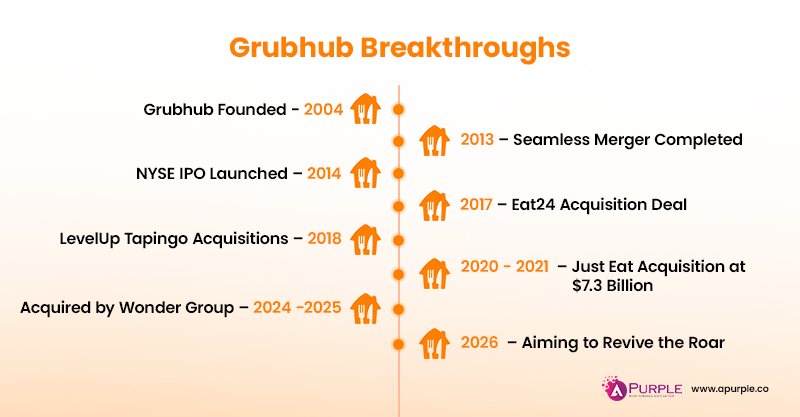
Despite being a popular and potential food delivery partner, Grubhub’s profit has been shaken during 2020-2021. The major reasons could be the high operating costs and cutthroat competition. To make it simpler, the image below shows the timeline journey of Grubhub.
Now, answering the simple question. It will help in redesigning your startup’s business model quite strategically.
What is the Grubhub Business Model?
Grubhub has a hybrid business model. It implies that Grubhub operates as both the marketplace aggregator and a logistics or delivery provider. So, it has opened the opportunity to optimize the restaurant partnerships and local drivers’ network. In other words, it provides a list of restaurants that have their own delivery and even allows drivers who don’t have their own.
A bit confusing! Let me take you through its recent growth-driven moves.
Recent Trends in Grubhub Market Growth
1. Expansion into Grocery Delivery
Grubhub partnered with Instacart to add grocery delivery within the Grubhub app. Accordingly, it allows users access to groceries from diverse retailers with free delivery services on orders above $25. So, Instacart’s fulfillment network has even helped Grubhub to expand beyond restaurant and food delivery.
2. Zero Delivery Fees on Orders $50+
Grubhub has wiped out the delivery and service fees for restaurant orders above $50. As a result, it has encouraged the larger orders and reduced the checkout abandonment rates visibly.
3. Amazon Prime Members Benefits
Millions of Amazon Prime members receive free access to Grubhub+, which offers benefits such as $0 delivery fees and rewards on pickup orders to increase user engagement and repeat orders.
4. First Robot Delivery Experience
Grubhub has launched its first-ever autonomous delivery for fulfillment solutions. It works efficiently in autonomous tracking of orders and delivers beforehand.
Moving to the workability of the Grubhub business model. It will clear your doubts on how the online food delivery business manages the workflow.
How Does Grubhub Work?
Grubhub is a platform-based business model that works as a third-party food delivery solution. It partners with local restaurants and connects with diners to facilitate food ordering and delivery services. So, the delivery is managed by the registered Grubhub drivers. Now, you see, the Grubhub performs as the centralized platform to manage the three different panels for each user, i.e.;
- Restaurants
- Customers
- Drivers
So customers can use the Grubhub website or app to browse the restaurant’s menu and place a food order, and restaurants receive the orders and begin preparing and packing them. Further, the delivery partner or driver arrives at the restaurant to collect the food parcel and then heads to the customer’s location.
In the meantime, customers can track the delivery status on their digital devices. Now, to segment the process for each individual, here’s the breakdown on how Grubhub works;
A. For Customers
- Customers or users download the Grubhub app or open it in a web browser, then create their user profile.
- Further, users navigate and browse through the restaurants and food menus to look for their meal.
- They can add their favorites to the cart and place an order.
B. For Restaurants
- As the customers place the order, the local restaurants can receive it in their system and be notified about the order.
- Next, the restaurant gives the tentative time for its delivery and starts with the preparation of the food order.
- As they finish preparing the order, it will be packed and handed to the delivery personnel or driver.
C. For Drivers
- Drivers or delivery personnel get the notifications and alerts on their app panel about the order.
- As it is in the nearby locality, they can confirm the order by accepting the request.
- Once the order is accepted, the driver has to reach the restaurant and collect the food parcel within the given time or as per their convenience.
- As soon as the driver has the food order, he has to update the order status.
- It will be seen on the customer’s screen that their order is on the way, with the driver’s location and time duration.
- Accordingly, the driver can contact the customers to ask for directions or if there is any delay. A further driver arrives at the customer’s location and hands over the order.
- If the customer wants to tip the driver, they can collect.
Thus, Grubhub is a reliable food delivery service provider and the classic player in the industry. However, it is successful due to several major drivers.
Why is Grubhub So Successful?
The Grubhub business model and services have been flexible through their journey so far. It has some of the key success drivers, which are as follows;
- Diverse Network & Early adopter of the technical upgrades
- Partnership with Amazon Prime gives it a steady source of users
- Engaging and genuine reward programs like Grubhub points and Grubhub+ attract users’ interest
- Higher value to restaurants as Grubhub drives online visibility and positions them as a popular brand
- User-Friendly app design and layout make it efficiently compatible for multiple devices
All these key points have really worked out only because of the robust and strategic business model of Grubhub. So, it’s important to have more depth on it as follows.
Grubhub Business Model Canvas [BMC]
Grubhub’s business model analysis is the breakdown of its different activities, resources, value propositions, and revenue sources. This is the clear picture representing each aspect of the Grubhub business plan.
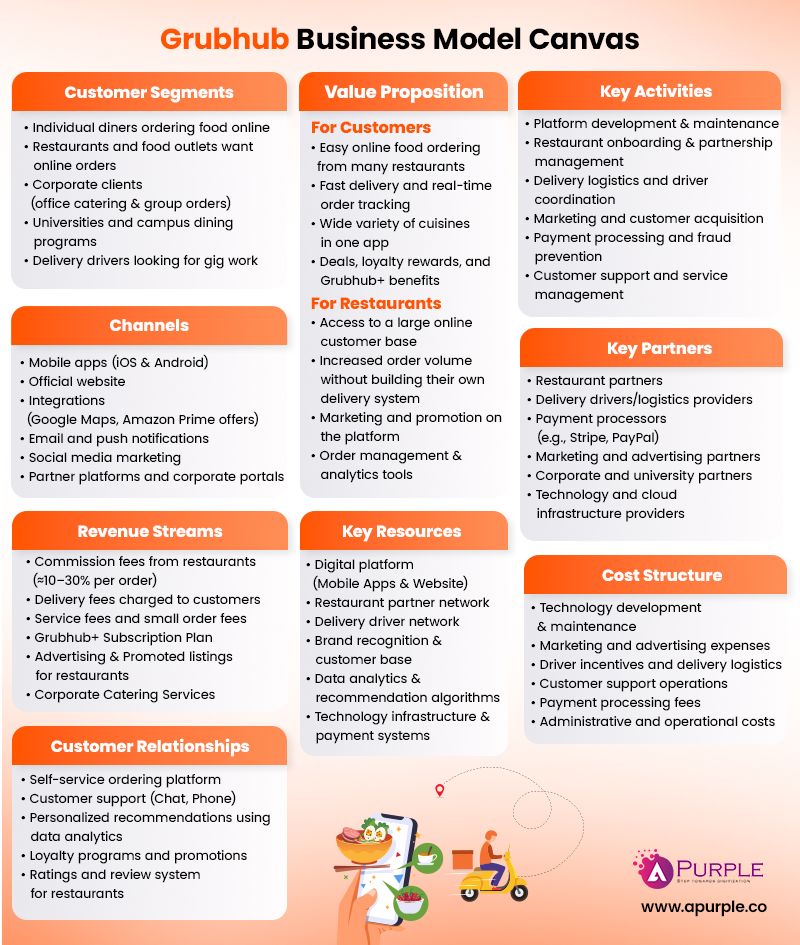
Grubhub Revenue Model: How Does Grubhub Make Money?
As you can see in the above image, Grubhub has a variety of revenue streams that really show as an effective ROI magnet. The revenue model below has made it happen.
-
Commission Fees
The restaurants pay a commission on each order, generally ranging from 5% to 20%. It is for listing them on the Gurbhub platform. Let me take you through the official pricing plan of Grubhub.
| Grubhub Pricing Plan | ||
|---|---|---|
| Plan Type | Marketing Commission | Main Purpose |
| Basic | 5% | Grabbing the New Customers |
| Plus | 15% | Extending the reach among high-value diners |
| All-Access | 20% | Retaining & Offering Optimal Support & Deals |
-
Delivery & Service Fees
The delivery or service fees are charged to customers on each order they place. It covers the cost of delivery and platform usage for their orders.
-
Advertising & Sponsorship Programs
For running the ad campaigns, restaurants pay extra fees (sometimes an additional 2.5%–17.5%) to appear higher in search results. It promotes their brand name and boosts visibility.
-
Grubhub+ Subscription
The monthly subscription of $9.99/month for customers to unlock the premium services is a continuous earnings source for Grubhub. So, it provides unlimited free delivery on eligible orders.
-
Corporate & Group Orders
It has specialized services for businesses and dining for the corporate campus. So, the bulk food orders from the corporate companies are another great source of income.
Thus, Grubhub operates as a significant food ordering platform and has wider revenue streams, which keep it profitable.
Grubhub Value Propositions for All Users
Being a three-sided online marketplace, Grubhub provides value to its customers, restaurant partners, and Grubhub drivers. It has been very consistent and captivating to each user. Let’s understand the Grubhub business model evaluation with each user’s value propositions.
What is the Value Proposition of Grubhub for Customers?
Grubhub gives an easy and effective way for customers to browse food items, check reviews, and place orders for their favorite meals. The following details show how customers can order and get rewards programs as well.
- Customers can browse across the 415,000 merchants on the platform. It is highly seamless to schedule and plan their food or grocery orders.
- The exclusive offers and efficiency of the Grubhub+ enable customers to unlock the benefits of free delivery.
- Alongside, Grubhub has officially made free delivery on orders valued at USD 50+. So, it appeals to customers to place a small order without the worry of the fees.
- One of the unique and notable value-driving solutions of Grubhub is its catering and delivery service for corporate companies. Thus, it has a food delivery company that provides delivery to the company team or the whole office on special orders.
- Grubhub’s 24/7 support services to customers ensure that order-related queries are addressed in real time.
- Customers also have options for purchasing and giving Gift cards (eGift and Digital card) for birthdays, anniversaries, or any other special occasion.
- On the pickup option, customers can earn the 5% Pickup Credit, which they can use for their future purchases.
How Grubhub Provides Value to Restaurants?
Restaurant partners are the most crucial part of the Grubhub business model and the services it provides. In return, restaurants get the value in the following ways;
- It provides marketing tools to help restaurants to promote their business. The owners can make a free restaurant website for better traction of their business.
- The restaurant partners became accessible to millions of online users on the Grubhub online space. It enables them to serve a vast pool of users/customers.
- Gets the high-order volume, which helps to drive better revenue and profitability.
- Reaping the benefits of Grubhub’s delivery platform and it gives customers a unique food experience digitally.
- The dedicated restaurant panel designed for easy and smooth order management eliminates the hassle for the restaurants. So, it gives insights into their daily sales and income.
- It also helps restaurants in providing effective customer service by integrating tools to manage menus, hours, and, in many cases, access to a dedicated delivery fleet.
- Recently, it has begun by helping the restaurants to boost traffic by using the diner acquisition technology. Therefore, the restaurants can offer an exclusive cashback claim service to customers that attracts and retains users.
How Grubhub Provides Value to Drivers?
Grubhub drivers are an important pillar of its Grubhub business model. So, the company has carried out an effective framework for those who want to join and those who have already registered.
- Grubhub allows car or bike owners to earn extra money by registering themselves on the platform as drivers.
- Drivers are free to choose their suitable delivery hours as they work as independent contractors for Grubhub. Hence, it offers flexibility to drivers.
- Grubhub’s driver panel app has the required features for the users through which drivers can start getting orders and delivering them.
- Apart from the decided commission on the order, drivers even get a tip from customers.
- Grubhub allows drivers to get instant cashout with no wait.
- It offers the drivers support and safety in any emergencies.
Lastly, the final Grubhub business model analysis can be determined by comparing it to the other big competitors. These are the top food delivery apps today.
Grubhub Vs Uber Eats Vs DoorDash Business Model
| Food Delivery Platforms | Business Model Type | Areas Serving | Commission Charges & Fees | Best for |
|---|---|---|---|---|
| Grubhub | Connecting the diners and restaurants to generate revenue through restaurant commissions, delivery fees, advertising tools, and the Grubhub+ subscription | ~4,000+ US cities, strong presence on campuses and in urban areas |
|
Restaurants wanting marketplace visibility and access to office/campus diners |
| DoorDash | The large-scale on-demand delivery platform combining marketplace ordering with white-label logistics (DoorDash Drive) | 40+ countries, including the USA, Canada, Australia, Japan, Germany, and more | The commission charged between 15% – 30% including the delivery fees. | Users who look for a variety of local restaurant options |
| Uber Eats | An integrated food delivery solution on the Uber platform. It makes money through the Uber One subscription program and commission. | Global coverage across 6,000+ cities across 45 countries, such as the USA, Canada, the UK, France, Germany, Italy, the Netherlands, etc. | Commission falls between 15% – 30% inclusive of delivery fees | Reliable & Rapid delivery for a range of food items |
You can even explore the guide on DoorDash Vs Grubhub for their detailed comparisons. However, for any newbie business dreaming of making it like the Grubhub platform, this guide is the right reference. Yet the execution steps ahead demand that you consult with the required technical team. Get a 40 min FREE Discussion on your business idea and learn the possible opportunities!
FAQs
- Delivery & Service Fees
- Commission from Restaurants
- Subscription model for premium users
- Advertisements
- Campus dining orders
- DoorDash
- UberEats
- Postmates [Under Uber]