Updated Date: Apr 23, 2026
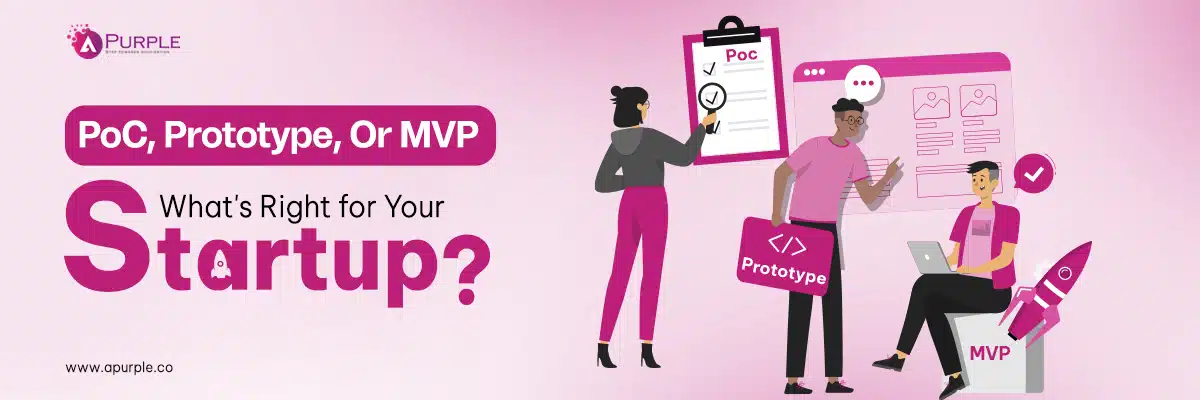
A startup founder starts with a product idea that looks promising, and the next step is to start building. Within days, the team runs into a common startup question: Should we go for a prototype, an MVP, or something else entirely?
This confusion begins in early-stage teams, who struggle with poc vs prototype vs. MVP as each stage serves a different purpose. Without clarity, founders risk building features too early, burning cost, and delaying validation.
If you are looking for how to validate a startup idea fast? Or confusion between POC, MVP, and prototype?
This blog explains the difference between poc, MVP, and prototype, and helps founders move from idea to product faster. Also, when to build each stage and how startups test ideas before scaling development.
What are PoC, MVP, & Prototype: Short Definitions?
Before diving into the details, let’s quickly define each term so you can go through what it means.
1. Proof of Concept (PoC): A PoC is an initial model or a demo version built to verify whether the concept is ready to go or not. Simply, a PoC demonstrates if the core functionality of the product will work or not.
2. Prototype: A prototype is a working model that shows the final product’s functionality and appearance. A prototype usually has limited features, but it provides a tangible representation, allowing for testing, feedback, and maintenance iteration.
3. MVP (Minimum Viable Product): An MVP is a basic version of the product that includes the must-have features. MVP aims to launch fast, gather feedback, and improve the product with real-world data.
Now that we understand these terms, let’s dive deeper into their differences, similarities, and specific use cases.
PoC vs MVP vs Prototype: Quick Comparison for You
| Aspect | Proof of Concept (PoC) | Prototype | Minimum Viable Product (MVP) |
|---|---|---|---|
| Definition | Demonstrates the feasibility of an idea. | Early working model to test design. | Simplified product with core features. |
| Purpose | Validate technical feasibility. | Test product design and user flow. | Gather feedback to validate the product-market fit. |
| Complexity | Low complexity. | High complexity. | High complexity. |
| Functionality | Mostly non-functional. | It has some functionality. | Fully functional with key features only. |
| Features | Typically, no or minimal features. | Not fully functional but has a few key features to represent the design & flow. | Includes only the most essential features necessary for early users. |
| Target Audience | Internal teams, stakeholders. | Designers, developers, and testers. | Early adopters, users, and customers. |
| Time to Develop | Short (a few weeks or months). | Moderate (a few months). | Longer (several months). |
| Cost | Low to moderate cost. | Moderate cost due to design and iteration. | Higher cost, but focused on essentials. |
| Outcome | Decision on feasibility. | Validation of design and user experience. | Market validation and data-driven insights. |
PoC vs Prototype vs MVP: What They Are, How They Differ, and When to Use Each
1. Proof of Concept (PoC): The Feasibility Check
A PoC is often the first step in the product development process. Entrepreneurs can identify whether an idea, technology, or concept can be developed or solved. Simply, it majorly focused on workability rather than user experience. For more clarity, let’s see the possible questions involved in PoC.
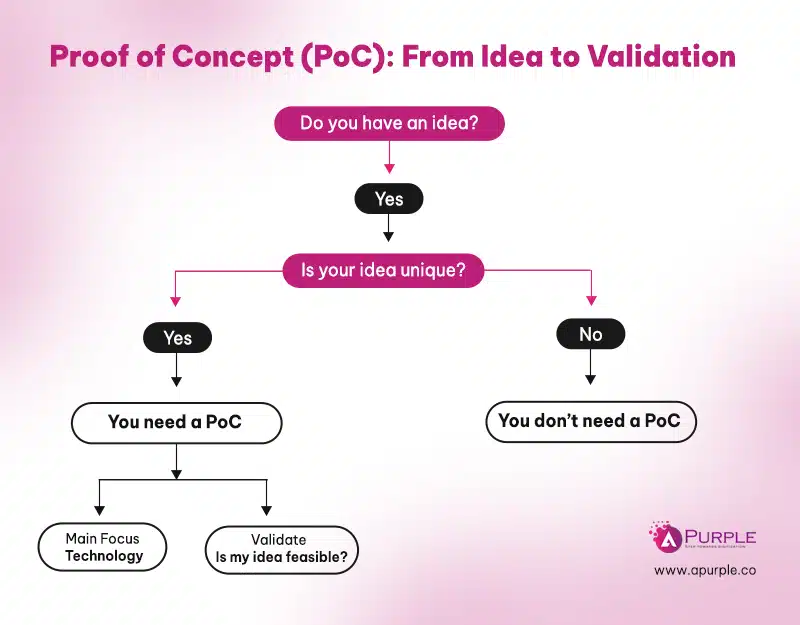
Questions That Can Be Asked Under PoC
- Is the underlying idea or technology practical to build?
- Is my product idea “good to have” or “must-have” for the customer?
- Will this technology or technologies be a good fit for our needs?
- What is the minimum level of functionality required to finalize whether the idea is feasible?
- Will this idea prove the business case?
- How will we measure the success or failure of the PoC?
- Can we get enough ROI with this product?
Key Features of PoC
By learning features, you can also understand the difference between Proof of Concept, Prototype, and MVP. Check here:
- Technical Validation: As the term justifies, PoCs are meant to validate the technical concept or idea, making sure it’s practically possible to build before proceeding.
- No User Interface (UI): PoCs are all about ensuring the reality of ideas, so they are mostly basic models. Sometimes with no interface at all.
- Small Scale: The scale of a PoC is usually small and doesn’t involve complete product development.
Example
If you are interested in grocery delivery app development, before proceeding, you must validate key technology components such as ordering, payment, and delivery during the PoC phase. Once the PoC gives a green signal on core concepts, you can move on to more complex stages, like Prototype and, eventually, MVP development.
When Should You Use a PoC?
- Exploring the feasibility of a new technology.
- Proving the technical viability of your concept.
- Convincing stakeholders or investors of the potential.
PoC Best Practices for Startups
Keep the following points in mind to successfully work on PoC:
- Have proper clarity on purpose.
- Set defined parameters.
- Gather the right team of experts.
- Document everything.
- Gather feedback from stakeholders.
Read Also – How to develop software for your startup?
2. Prototype: The Early Model
A Prototype is a more refined version of a product. While a PoC is primarily concerned with feasibility, a prototype is developed to present a visible representation of the product.
It focuses on creating how the product looks, feels, and behaves with respect to user interactions. Prototypes mostly contain some functional features, but they are not fully optimized as market-ready.
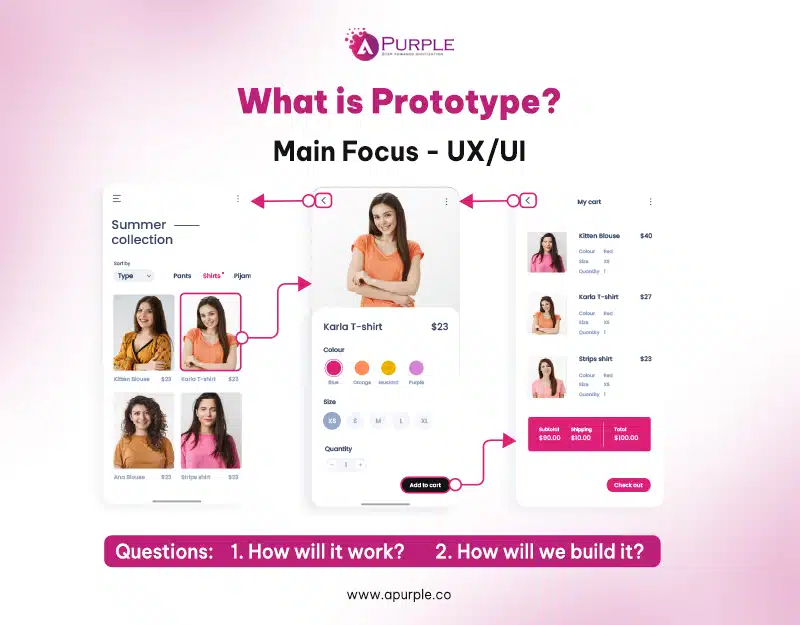
Questions That Can Be Asked Under Prototype
- What are the specific aspects that we need to test in product design and UI?
- Who will be the target audience for feedback on the prototype: the internal team, users, or testers?
- What are the features you should include in the prototype to test user flows?
- How to gather and analyze feedback from users’ interactions with the prototype?
- What are the undecided parts of the product, and how can they be resolved?
- How much functionality should be tested for effective visibility?
- What is the ideal timeline for creating and testing the prototype?
- Should we focus on how it looks good or functionality in the prototype stage?
Key Features of Prototype:
- User Interaction Testing: Prototypes allow businesses to test user flows and interaction design.
- Visual Representation: Unlike PoCs, prototypes display a visual layout. It includes early user interfaces (UI) to get clarity on product design.
- Iterative Feedback: Prototypes generally collect user feedback and update the product before final development.
Example
Understand this with a scenario of creating a prototype of a fitness app development. The prototype might include basic functionalities like setting fitness goals, tracking fitness progress, or viewing daily steps. However, it may not yet include advanced features such as detailed analytics or multi-device syncing.
When Should You Use a Prototype?
- Testing product design and functionality.
- Gathering feedback on user experience (UX).
- Exploring market reaction to a visual concept.
Prototype Best Practices for Startups
With the following best practices, as a business owner, you can avoid the pitfalls of failing prototypes.
- Focus on core functionality & user experience.
- Try to build an interactive model.
- Only create the essential functions.
- Get the right users for testing.
- Get feedback from all team members.
- Test on real devices.
- Refine the model as per the feedback.
There are many industry experts who help startups with prototype development, simplifying their business models from the beginning. As an experienced IT consultant, aPurple has guided numerous businesses to success with their innovative ideas. You can also elevate your business by leveraging insights and iterations from expert teams like aPurple.
3. Minimum Viable Product (MVP): Ready-to-Launch Product
A Minimum Viable Product (MVP) is a product that covers basic features to fulfill early users’ requirements and provide feedback. The main purpose of MVP development is to validate the idea in the market. MVP helps entrepreneurs to collect real-world data. This refines the product based on actual user interactions.
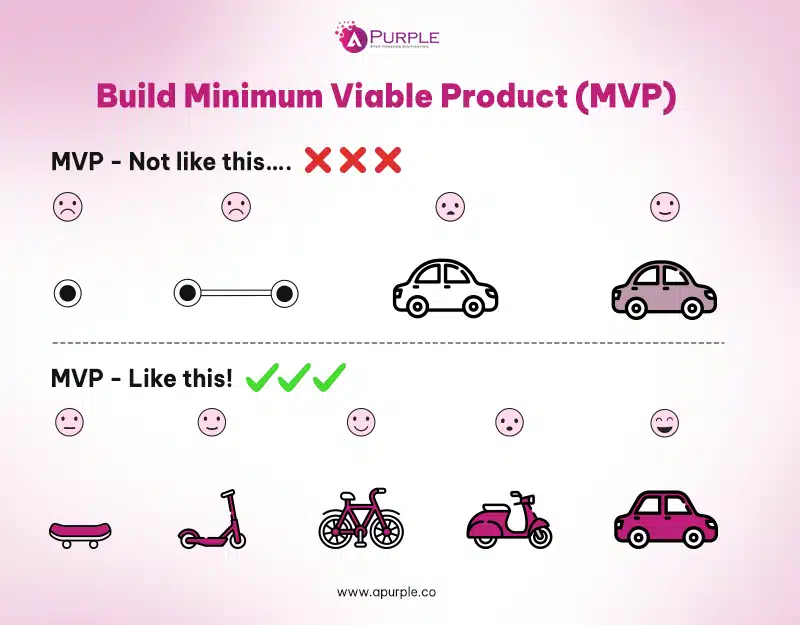
Questions That Can Be Asked Under MVP
- What are the must-have features to address the main problems?
- How to build a product that is easy to use and solves problems effectively?
- What expertise should be prioritized while hiring a developer to build an MVP?
- Who are the initial users, and how do you engage them with the MVP?
- How to quickly launch the MVP while ensuring it remains functional?
- What are the fewest features required to consider an MVP usable?
- How to collect and analyze user feedback?
- How to handle scaling after validating the MVP?
- Which key metrics help to validate the MVP’s success?
Key Features of MVP
- Core Functionality: An MVP is known for including only the required features that solve the core problem.
- User Feedback: The MVP gathers data and improves the product. This cycle runs for future requirements.
- Ready for Launch: Unlike prototypes or PoCs, MVPs are ready-to-launch products.
Example
A basic version that covers must-have features like user registration, account login, and basic functionality is known as an MVP in mobile app development. This MVP helps you to validate the core idea with real users. You get the real feedback and improve the existing app.
When Should You Use an MVP?
- Test market demand for your product.
- Collect feedback for future product iterations.
- Validating your business idea before scaling.
Best MVP Practices for Startups
- Focused core feature development.
- Define the scope.
- Emphasize usability.
- Utilize agile app development methodology.
- Manage early user expectations.
- Engage users early.
- Define success metrics.
- Iterate based on feedback.
You may now understand all the aspects that differentiate the PoC, Prototype vs. MVP. However, despite the distinctions, there are some similarities between them.
Let’s decode similarities too.
Similarities Between PoC, Prototype, and MVP
| Similar Aspect | PoC | Prototype | MVP |
|---|---|---|---|
| Part of Product Development | Yes | Yes | Yes |
| Used in Early Product Stages | Yes | Yes | Yes |
| Goal is Validation | Yes | Yes | Yes |
| Helps Reduce Product Risk | Yes | Yes | Yes |
| Supports Iterative Development | Yes | Yes | Yes |
| Helps Communicate Product Idea | Yes | Yes | Yes |
| Used Before Full Product Development | Yes | Yes | Yes |
| Can Be Improved Based on Feedback | Yes | Yes | Yes |
| Helps Stakeholders Understand the Product | Yes | Yes | Yes |
| Saves Time and Development Cost | Yes | Yes | Yes |
All three exist to test ideas early and reduce risk. Simply, you can understand this as:
- PoC used to prove the idea is technically possible.
- Prototype shows how the product will look & work.
- MVP is the first version that is usable for real users.
Conclusion
The decision of choosing the best approach between PoC, Prototype, or MVP largely depends on the stage of your product development cycle. Where are you in your cycle, and what do you hope to achieve?
- PoC is ideal if you’re still in the concept validation phase and need to prove the feasibility of your idea or technology.
- A prototype is best suited for when you need to test user interface design and user interaction before building out the full product.
- MVP is perfect for startups looking to test the market with a ready-to-launch product that solves real user problems.
For most startups, beginning with a PoC to validate the core concept, followed by a prototype for design testing, and finally, an MVP to test real-world market fit, is the most logical sequence. However, the approach depends on the stage of product development and the specific goals you aim to achieve.
If you are looking for a reliable consultant who can guide you from the concept to the reality of your business idea. Then undoubtedly, aPurple is the perfect mentor for you. Whether you’re just starting with an idea, refining your user experience, or ready to launch your product to the market, our expert team is here to support you. We don’t work just as consultants; our experts put in efforts as partners. Let’s bring your vision to life efficiently and effectively together.
Have a Successful Business Building!!
Frequently Asked Questions (FAQs)