Updated Date: May 12, 2026
Still thinking of entering the pizza delivery market, but unsure how to stand out?
From century-old delivery practices to today’s instant-ordering culture, the game has completely changed, and players like Domino’s Pizza didn’t win just with speed but with smart digital experiences.
Today, customers expect seamless ordering, real-time tracking, and personalized offers, all powered by mobile apps. If you’re a startup aiming to launch a food delivery app, building a feature-rich and latest-driven one isn’t an option anymore. Well, it’s your fastest route to capturing demand, competing with big brands, and scaling profitably.
Let’s explore how a pizza delivery app can turn your idea into a revenue-generating business.
What is a Pizza Delivery App Development?
Pizza delivery app development is the process of developing a mobile application (iOS/Android) that allows customers to browse menus, customize orders, make secure payments, and track deliveries in real-time.
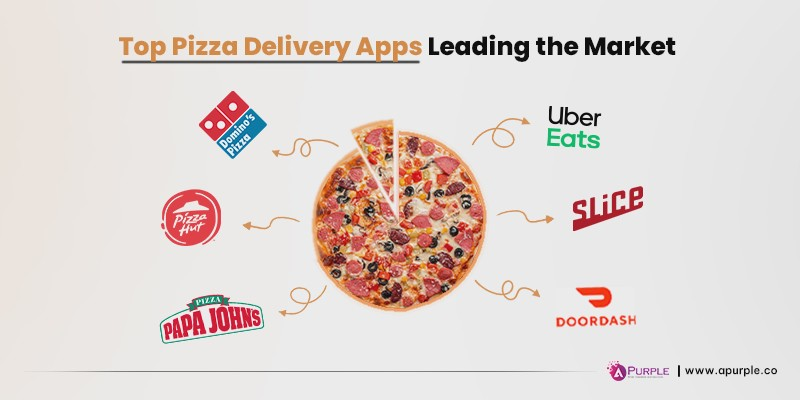
Although it gives restaurant owners a backend to manage orders, drivers, and operations from a single platform or through an aggregator platform. So, it turns a traditional pizza business into a digital-first brand that is accessible, scalable, and built to drive repeat orders. Just like the following brands have been doing for years…
Pizza Delivery Services Market Scope!
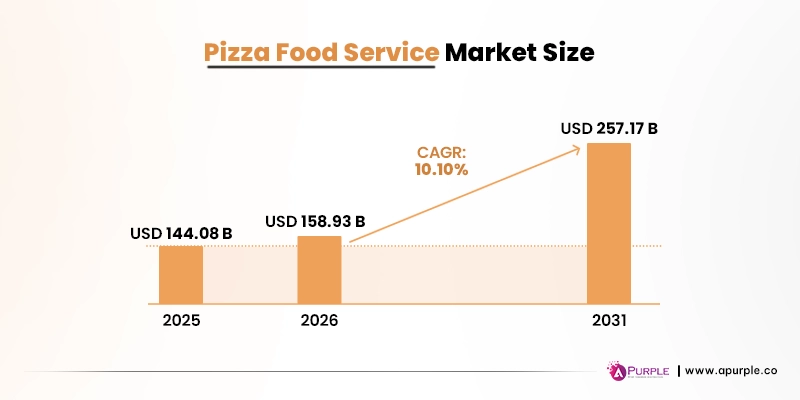
When it comes to building a pizza delivery app, your choice narrows down to the customer demand and market size. Although it’s expanding, at what scale? So, there is a recent report that burst your doubtful bubbles.
The market size of pizza foodservice by 2031 will reach USD 257.17 billion. It’s a pretty great increasing trend in the online and delivery industries. So, you can grab the opportunity in your favor by launching your pizza startup business right away!
What are the Features of a Pizza Delivery App?
Well, the essential features of the pizza delivery app are profile creation, pizza options and customization, real-time order tracking, push notifications, etc. For a single restaurant owner, a pizza restaurant aggregator, or a startup, the features of a pizza delivery app must align for all the stakeholders. So, your pizzeria must enhance its exclusive features to stand out in the market.
1. Customer-Side Features
The customer panel features of the pizza ordering app are tailored to attract and retain customers. It will make their navigation easy for them.
| Feature | Description |
|---|---|
| Nearby Restaurant Discovery | Helps users find nearby pizza outlets or chains using real-time GPS location tracking. |
| Menu Browsing | Displays pizzas with HD images, descriptions, and pricing to enhance user decision-making. |
| Customization (Toppings) | Allows users to add, remove, or customize toppings based on their preferences. |
| Order History | Saves previous orders so users can quickly reorder their favorite pizzas. |
| Discounts & Loyalty Programs | Offers promo codes, cashback, rewards, and loyalty benefits to increase retention. |
| Multiple Payment Options | Supports UPI, cards, wallets, net banking, and Cash on Delivery for seamless payments. |
| Real-Time Order Tracking | Enables users to track order status from preparation to delivery in real time. |
2. Driver’s Panel Features
For the drivers’ features, it’s equally important to have a few non-negotiable features in the app.
| Feature | Description |
|---|---|
| Driver Registration | Allows drivers to sign up using a mobile number, email, or social login. |
| In-App Communication | Enables communication with customers and restaurant staff for smooth coordination. |
| Order Management | Displays assigned deliveries, pickup details, and delivery instructions. |
| GPS Navigation | Provides optimized routes using real-time navigation for faster deliveries. |
| Delivery Status Updates | Allows drivers to update statuses like picked up, delivered, or canceled. |
| Delivery History | Tracks completed orders, working hours, and performance metrics. |
3. Restaurant Panel Features
Well, the side of the restaurant or store features for the Pizza ordering app development are equally important. As part of professional app development for restaurant businesses, it will enhance profits and improve customer support.
| Feature | Description |
|---|---|
| Profile Management | Enables restaurants to manage single or multiple outlet profiles from one dashboard. |
| Menu Management | Allows adding, updating, or removing pizzas with images, pricing, and descriptions. |
| Push Notifications | Sends alerts about offers, discounts, and updates directly to customers. |
| Offer & Discount Management | Helps create and manage promotional campaigns and bulk orders efficiently. |
| Order & Payment Management | Tracks incoming orders, updates statuses, and manages payments seamlessly. |
| Feedback & Review Management | Collects and analyzes customer feedback to improve service quality. |
4. Admin Panel Features
To manage the administrative and store-level operations, the pizza delivery app has admin features. It puts the features in a centralized manner to handle and update the data on a real-time basis.
| Feature | Description |
|---|---|
| Store Management | Allows admin to add, update, or remove restaurant chains and locations. |
| Commission Management | Enables setting commission rates for vendors in aggregator models. |
| Analytics & Reporting | Provides insights into revenue, expenses, orders, and overall performance. |
5. Advanced AI Features
With having AI functionality, you can stand out as a great food business idea in the industry. So, here are the ones that are a one-time investment for prolonging returns.
| AI Feature | Description | Why It Matters |
|---|---|---|
| AI-Based Recommendations | Suggests pizzas, combos, and add-ons based on user behavior, past orders, and preferences. | It increases average order value and drives repeat purchases. |
| Smart Delivery Route Optimization | Uses AI to find the fastest delivery routes in real time based on traffic and distance. | It reduces delivery time and improves customer satisfaction. |
| Predictive Demand Analytics | Forecasts peak order times and demand using historical and real-time data. | It helps optimize staff and inventory and reduces delays during rush hours. |
You may also like: Uber eats vs Doordash
How to Build a Pizza Delivery App? — Proven Steps
For your on-demand pizza delivery app development, you have to go through a phase-by-phase breakdown from idea to launch. It will help you to plan the overall strategy for the app development.
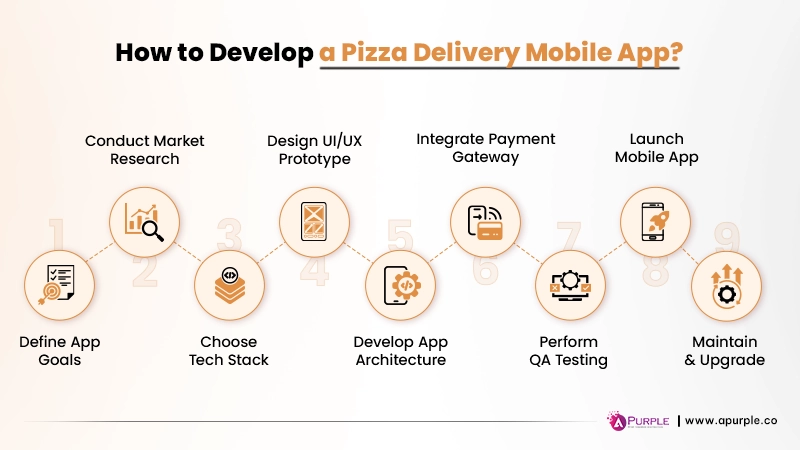
1. Define Your Business Model & Goals
Decide upfront whether you’re building a B2C app (own delivery, like Domino’s) or a P2C aggregator (third-party platform, like DoorDash). Define your target market, core user personas, revenue model, and success KPIs before a single line of code is written. This decision shapes every subsequent step. So, you just have to state the following aspects clearly in your mind.
- Business model selection
- Target market research
- Competitor analysis
- KPI definition
2. Market Research & Requirement Gathering
Study your local market, existing competitors, and customer behavior. Identify gaps: delivery speed, pricing, menu variety, and UX issues that your app can solve better. Document functional requirements (what the app must do) and non-functional requirements (performance, security, scalability).
- User interviews
- Competitor benchmarking
- Feature prioritization
- SRS documentation
3. Choose Your Tech Stack & Platform
Decide whether to build for iOS, Android, or both (cross-platform via Flutter or React Native). Select your backend framework (Node.js, Django), database (PostgreSQL, MongoDB), real-time tracking solution (Google Maps API), and payment gateway (Stripe, Braintree). Your stack directly impacts cost, speed, and scalability.
- Flutter / React Native
- Node.js / Django
- Google Maps API
- Stripe / Braintree
- Firebase
4. UI/UX Design & Prototyping
Create wireframes and interactive prototypes before development begins. Focus on intuitive navigation, fast checkout flow, and visual menu presentation; these directly impact order conversion rates. Thus, run usability tests on prototypes with real users to validate flows before handoff to developers.
- Wireframing
- Interactive prototypes
- Usability testing
- Design system creation
- Figma / Adobe XD
5. Frontend & Backend Development
Development typically runs in two parallel tracks. Frontend builds the customer-facing app (order placement, tracking, payment). Backend builds the server, database, APIs, admin panel, and delivery management system. Core features include user authentication, menu management, real-time GPS tracking, push notifications, and order history.
- Customer app
- Delivery driver app
- Restaurant admin panel
- API Integrations
- Real-time tracking
- Push notifications
6. Payment Gateway Integration
Integrate payment gateway for multi-method payment system; credit/debit cards, digital wallets (Apple Pay, Google Pay), and cash on delivery, where applicable. Ensure PCI-DSS compliance to protect customer payment data. Also, integrate promo code, loyalty points, and referral discount logic at this stage.
- Stripe / PayPal
- Apple Pay / Google Pay
- PCI-DSS compliance
- Promo & loyalty logic
7. Testing & Quality Assurance
Run functional, performance, security, and usability testing across all app panels, customer, driver, and admin. You must test on multiple devices, OS versions, and network conditions. Identify and fix bugs before launch. Moreover, load testing is critical; your app must handle peak order volumes (lunch, dinner rush) without crashing.
- Functional testing
- Load & stress testing
- Security testing
- Cross-device testing
- UAT
8. App Store Submission & Launch
Submit your app to the Apple App Store and Google Play Store, following their guidelines for review. Set up app store optimisation (ASO); keywords, screenshots, description, to drive organic downloads from day one. Plan a phased rollout: soft launch in one city, gather feedback, fix issues, then scale.
- App Store review
- Google Play submission
- ASO optimization
- Phased rollout
- Beta testing
9. Post-Launch Maintenance & Upgrades
Launch is not the finish line. Monitor app performance, crash reports, and user feedback continuously. Release regular updates to fix bugs, improve features, and add new functionality based on real user data. So, you can track metrics like order completion rate, average delivery time, cart abandonment, and customer retention to guide your roadmap.
- Crash monitoring
- User feedback loops
- Feature iteration
- Performance analytics
- Regular updates
Read Further: How to Start a Food Delivery Business
Pizza Ordering Apps’ Business Models: Which One to Choose?
Pizza chains dominate the food industry, but the emergence of on-demand pizza delivery companies is carefully trying to pick up. There are certainly two pizza delivery services and two models for any pizza ordering app development.
1. Business-to-Consumer [B2C]
2. Platform-to-Consumer [P2C]
1. Business to Consumer [B2C] – Pizza Chains
The pizza brand owns its entire delivery operation; no third-party platforms are involved. They manage their own delivery staff, app, and customer relationship end-to-end. Therefore, the higher control, higher investment, but 100% of revenue stays in-house.
Examples: Domino’s, Pizza Hut, Papa John’s
2. Platform to Consumer [P2C] – Food Aggregators
A third-party platform acts as the bridge between customers and restaurants. The aggregator handles ordering, payment, and delivery, and the restaurant just fulfils the order. So, the faster to market, but it comes with commission fees and less brand control.
Examples: Grubhub, DoorDash, Uber Eats
What is the Cost to Build a Pizza Delivery App?
The cost of developing a pizza delivery app ranges from $15,000 to $300,000+. Moreover, it depends on the complexity, design requirements, platform choice, and engagement model. However, the cost of a pizza delivery app will vary based on the following factors.
-
Complexity of App
How complex or straightforward your app is can be a determining factor in estimating the cost of developing a pizza delivery app. If you create a simple pizza delivery application, the price will be between $40,000 and $70,000.
| App Type | Estimated App Development Cost | Total Time of Development |
|---|---|---|
| Simple app | $15,000 to $50,000 | 3-6 Months |
| Complex app | $60,000 to $300,000 | More than 9 Months |
-
Design Requirements
The UI/UX design of a pizza delivery app is a crucial aspect of the entire process, and it significantly impacts the cost of developing an app.
If your pizza delivery app design needs complex visual elements for the design part, it can lead to increased costs. Thus, adding interactive features, intuitive navigation, and graphics can increase costs.
-
Choice of Platform
Whether you choose Android, iOS, or a cross-platform platform for your pizza delivery app will impact its cost. Each platform has specific requirements, including dealing with native environments and configurations.
Catering to platform-specific requirements can be complex and require top talent. So, you need to hire experts with experience, which costs more.
-
Engagement Model
Choosing the right engagement model can impact the total cost of ownership (TCO) of a pizza app development project. A fixed-cost model means lower TCO but limited scope and budget. An hourly/monthly/annual model has limitations, and hiring a dedicated team is the most optimal solution, as it provides flexibility and affordability.
What are the Revenue Streams of Pizza Delivery Apps?
Pizza delivery app development encourages the reaping of high-potential revenue sources. They are as follows;
1. Restaurant Commissions (15-30%):
This is the primary revenue source of the pizza ordering app. It takes the percentage of every order placed at the restaurants.
2. Delivery Fees:
As the app, you must charge customers to pay for the delivery services.
3. In-App Advertising:
With growth in the market, the Restaurants pay for premium placement to appear at the top of search results.
4. Subscription Models:
As the food aggregator, you can charge the monthly subscription fees. It provides subscribed users with free delivery or discounts.
5. Service Fees:
The additional charges (up to 15%) added by the platform on top of the delivery fee are to maximize profit. It is usually a service fee to be added to the platform for featuring your services.
Kickstart Your Pizza Delivery App Solution!
Planning your pizza delivery app development the right way can significantly accelerate the growth of your pizza business. A well-designed delivery app helps streamline daily operations, improve order management, and reach more customers without operational complexity.
If you have an idea and are searching for the right partner to build your pizza delivery app, your search ends here. As an experienced pizza delivery app development company, aPurple has the expertise and resources to transform your vision into a scalable digital solution.
FAQs
- Customer Loyalty
- Location-Based Marketing
- Better Customer Data
- Delivery Services