Updated Date: Mar 2, 2026
Starting a transportation business sounds very exciting, with an average annual profit margin of 10%-30%. However, when you, as a founder, dive deep into this business, you need to figure out fleet costs, licensing, permits, compliance regulations, and insurance.
Now, if you’re good enough to figure this out, the bigger challenge is the barrier to entry posed by giants like Uber, FedEx, and DHL, which have already captured major market share. You need to compete against these big names while also managing your cash flow and profitability.
However, among these challenges, many startup founders have been successful. They’re not the ones who had massive capital upfront, but the ones who have focused on building lean, moving fast, and using the latest technology from day one.
Therefore, knowing how to start a transportation business the right way separates founders who can scale their businesses from those who may fail midway. This guide covers everything about the transportation business – fleet cost, business models, compliance basics, and mistakes to avoid – so they can move from idea to operational business within 6-12 months.
What is a Transportation Business?
A transportation business comprises moving passengers, goods, or materials from one location to another using vehicles such as trains, ships, planes, or trucks. Transportation is a very critical logistics sector that involves courier services, freight, and public or private passenger transport. So, running this business requires you to know about equipment, permits, licences, and a solid fleet management strategy.
However, if you’re figuring out how to run a transport business in 2026, you should definitely care about AI, automation, and smart tech to incorporate features like AI-powered dispatch, real-time tracking, and route optimization.
What are the Key Benefits of Starting a Transportation Business?
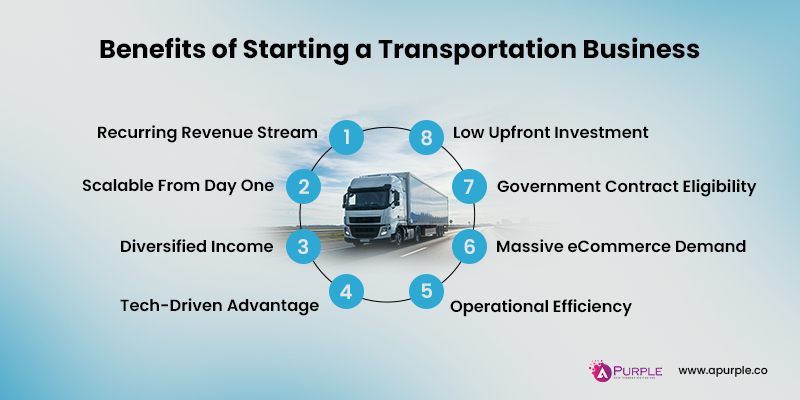
The transportation industry is growing faster than ever before, and therefore, it’s the right time to use that to your advantage. Here is a list of reasons why you should invest in a transportation business:
| Key Benefit | Description |
|---|---|
| Recession-Proof Revenue Stream | Even during an economic slowdown or a pandemic, you still need to move goods to meet people’s essential needs. That’s why the transportation business offers you a predictable and recurring revenue stream. |
| Scalable From Day One | You don’t require a massive fleet from day one to start the transportation business. You can learn how to start a transportation business with one van, validate the demand, and then expand that to more vehicles. |
| Diversified Income Potential | You have many options in the transportation business, including medical transport, last-mile delivery, freight, and ride-hailing. So, you can pick a niche that suits your business needs and establish various revenue streams. |
| Tech-Driven Competitive Advantage | In the age of smart tech, AI, and automation, you can opt for logistics app development to reduce fuel costs, optimize routes, and automate dispatch, thereby standing out from competitors using legacy systems. |
| Low Upfront Investment | If you compare the transportation business with other industries, you will find that it doesn’t require a massive upfront investment. A single vehicle, a solid business plan, and scalable software can get you started. |
| Government Contract Eligibility | Central, state, and local governments are always seeking reliable transportation vendors to move goods. If you can avail yourself of one government contract to help stabilize your cash flow. |
| Massive eCommerce Demand | Online shopping has become a daily ritual for millennials and Gen-Z users. So, last-mile delivery will never stop, and eCommerce platforms are seeking small-scale transportation operators to avoid massive delivery costs. |
| Data-Driven Operational Efficiency | Today, the transportation industry uses smart technologies such as AI, IoT, and machine learning. So, every trip you take generates a lot of data that you can use for demand forecasting, reducing downtime, and optimizing your operations. |
What are the Various Types of Transportation Businesses?
After reviewing the business benefits, you may be interested in knowing how to start a logistics business. For that purpose, you should first decide on the transportation model. It’s the transportation model that determines your costs, tech stack, profit margins, and scalability.
Here are the various types of transportation models you can choose from:
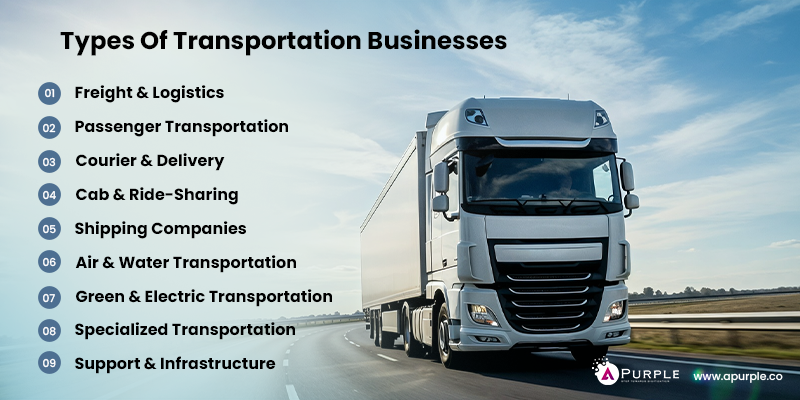
| Types of Transportation Business | Description | USPs | Best For |
|---|---|---|---|
| Freight & Logistics Services | Here, you move goods locally, interstate, or internationally via trucks, rail, or waterways. For this purpose, you can use AI in logistics to optimize the day-to-day operations. | Scalable fleet model, high revenue, and recurring contracts. | Founders who know a thing or two about supply chain and want to build an asset-heavy business. |
| Passenger Transportation Services | It’s a transportation business model in which people are scheduled to move via bus, shuttle, or corporate caravan. | Plenty of government contracts available, predictable riders, and a strong presence in underserved corridors. | Founders who are aiming for municipality-level contracts or corporate accounts. |
| Courier & Delivery Services | Here, you focus on last-mile or same-day delivery for local businesses, eCommerce, and retail. | Faster time-to-market, possible to start with minimal assets, and amazing partnership opportunities. | First-time founders who have limited capital and want to validate market demand. |
| Cab & Ride-Sharing Services | It’s a model focused on on-demand passenger rides, and suitable for starting a transportation business with a consumer-facing product. | Recurring revenue via surge pricing and a strong brand-building opportunity. | Tech-savvy new venture owners who want to compete in a ride-sharing niche. |
| Shipping Companies | You need to handle freight and logistics for importers, exporters, and manufacturers via rail, water, or a multimodal network. | If you choose this model, you can access global trade routes and secure high-margin contracts. | If you’re an emerging business owner with experience in international trade, choose this option. |
| Air & Water Transportation Services | If you choose this model, you have to manage charter flight logistics, cargo air freight, ferry services, etc. | There’s very little competition, and you get premium pricing. | New business owners who want to target clients in the luxury, pharma, and energy sectors and have substantial capital should choose this option. |
| Specialized Transport Businesses | It’s a model that focuses on specific areas such as load hauling, medical transport, and temperature-controlled freight. | You get a premium rate for this type of transportation model. | If you’re a founder who is an expert in a particular industry and want to use that experience in transportation, choose this model. |
| Support & Infrastructure Services | It focuses on supporting transportation-related activities, such as dispatch software, fleet maintenance, fuel management, and driver training. | There’s very little compliance burden, and you can establish a recurring revenue stream. | It’s the best option for founders who don’t want to own a fleet but still want to work in the transportation sector. |
How to Start Your Own Transportation Business? Key Steps to Follow
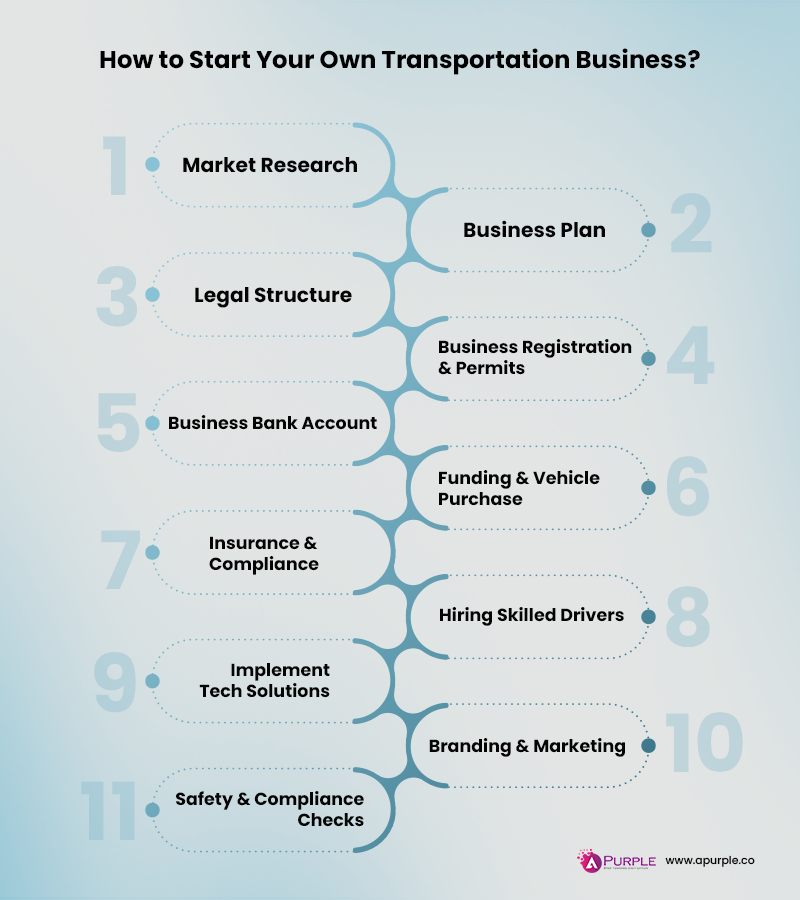
Starting a transportation business in 2026 is not only about buying trucks and hitting the roads. It’s about building a scalable, secure solution that helps you create a sustainable business model and compete with giants. Here’s how you can proceed in a step-by-step manner:
- Step 1: Conduct Market Research & Select Your Niche
- Step 2: Develop a Solid Business Plan
- Step 3: Choose & Set Up a Legal Business Structure
- Step 4: Register Your Business and Apply For Permits
- Step 5: Set Up a Business Bank Account
- Step 6: Secure Funding and Purchase Your Vehicles
- Step 7: Get Business Insurance and Ensure Compliance
- Step 8: Hire Skilled and Licensed Drivers
- Step 9: Implement Technology Solutions
- Step 10: Build Your Brand and Marketing Strategy
- Step 11: Carry Out Safety & Compliance Checks
Step 1: Conduct Market Research and Select Your Niche
The transportation industry comprises niches such as last-mile delivery, ride-hailing, medical transportation, and freight. Each of these niches has different profit margins, customer expectations, needs, and compliance. Therefore, knowing your ideal niche before starting the business is essential.
- You can know the current demand for transportation in your locality by reviewing Google Trends data, census data, or sources like IBISWorld.
- Study competitors in your target niche and identify gaps that can become your business opportunities.
- You should identify your ideal customers as early as possible, i.e., B2C delivery partners or B2B freight contracts.
- Lastly, you should validate your niche with the pre-sales team before investing any capital.
Step 2: Develop a Solid Business Plan
One of the biggest startup mistakes is not having a business plan ready before moving to the technical or operational part. Many founders understand that the transportation business plan is a document to attract investors. However, that’s not true at all. In fact, it’s your roadmap that helps you know whether your business is working as desired.
- You should clearly define your revenue model, i.e., subscription-based, per-mile, or on-demand pricing.
- You should determine your 12-month cash flow for each of the three scenarios: low, medium, and high budgets.
- Focus on documenting your fleet acquisition tactic for both cases, i.e, buying or leasing fleets.
- You should define your success metrics (KPIs) from the beginning, such as cost per delivery, customer acquisition rate, utilization rate, and so on.
Step 3: Choose & Set Up A Legal Business Structure
Your business’s legal structure directly affects your taxes, liabilities, scalability, and eligibility for funding. Most transportation business owners opt for an LLC (Limited Liability Company) or an S-Corp (Small Business Corporation).
- If you choose an LLC, your business will have liability protection with pass-through taxation.
- If you choose an S-Corp, you can reduce self-employment taxes once your revenue crosses $50K/year.
- Before finalizing your legal structure, always consult a CPA (Chartered Public Accountant), as a mistake here can cost you significantly.
- To fasten up the legal process, you can use platforms like LegalZoom or Stripe Atlas.
Step 4: Register Your Business and Apply For Permits
The transportation company registration process is layered and involves local, state, and federal laws. Missing any of these permits can halt your business even before it starts generating revenue.
- You should register your transportation business with the state’s Secretary of State and obtain an EIN (Employer Identification Number) from the IRS (Internal Revenue Service).
- Now, if you’re planning to run a commercial freight across the state, you should apply for a USDOT number and an MC number.
- You should know the transport business license requirements according to your vehicle class and service type.
- Lastly, research the operating requirements of local bodies in the city or state where you want to operate.
Step 5: Set Up a Business Bank Account
One mistake founders make is mixing their personal and business finances. You should separate them from day one for your transportation business requirements.
- You should open a dedicated business account – Chase Business, Mercury, and Relay are some of the finest options for early-stage business owners.
- Set up your business credit card, as it helps you to build your company’s credit score from day one.
- You should always integrate your bank account with accounting software like QuickBooks or Pilot.
- You should keep a separate payroll account if you’re onboarding drivers or operations staff.
Step 6: Secure Funding and Purchase Your Vehicles
Capital is the biggest challenge for any transportation founder. Understanding the transport business’s ROI before you approach any lender or investor can help you secure the funding you need.
- Calculate your Total Cost of Operations (TCO), which comprises software costs, payroll costs, vehicle leasing or buying costs, insurance costs, fuel reserve costs, etc.
- You should research Small Business Administration (SBA) loans, fleet leasing, and equipment financing.
- If you’re building a tech-enabled transportation business from day one, contact angel investors or logistics-focused VCs for funding.
- In the initial stage, you should consider leasing the vehicles, as it helps you save the capital required for day-to-day operations.
Step 7: Get Business Insurance and Ensure Compliance
Insurance is not optional in the transportation business. You need it from day one, and the insurance coverage also varies by cargo, vehicle type, and where your fleet operates.
- You should always take cargo insurance, as it protects your business if your freight is damaged or lost in transit.
- You should also not miss out on commercial vehicle insurance for any of your fleets.
- Take the assistance of a general liability insurance and umbrella policies for wider risk coverage.
- You should always check FMCSA compliance guidelines if you’re operating across various states.
Step 8: Hire Skilled and Licensed Drivers
Your drivers are your asset, and therefore hiring the right drivers matters most, as it directly affects your brand reputation, liability, and profit margins.
- Check whether the driver has a valid CDL (Commercial Driver’s License) and a clean MVR (Motor Vehicle Record) before hiring them.
- You should always do detailed background checks and drug verification for each driver.
- Establish an SOP for onboarding new drivers that includes route training and following safety procedures.
- You should offer strong, performance-based incentives to retain drivers.
Step 9: Implement Technology Solutions
Technology is what separates the traditional transportation business from modern-day logistics. If you have an idea for which smart technology you should integrate into your transportation ecosystem, you can increase efficiency without increasing overhead.
- You should integrate a Transportation Management System (TMS) such as Samsara or Onfleet to manage route optimization, delivery tracking, and dispatch from a single platform.
- Use GPS-based fleet tracking to continuously monitor vehicle usage, driver behavior, and current location in real time.
- You should also incorporate AI-powered route optimization to increase delivery volume while reducing fuel consumption.
- Use AI-based predictive maintenance to identify issues before they cause a vehicle breakdown, reducing maintenance costs.
Step 10: Build Your Brand and Marketing Strategy
In the transportation business, trust is your biggest brand builder. So, you need to position your business so customers and shippers feel you’re available 24*7.
- Always try to build a clean, easy-to-navigate, and conversion-focused website or app, with strong landing pages, compelling CTAs, and social proof.
- You should leverage LinkedIn’s reach to connect with B2B logistics buyers and build long-term relationships.
- Claim and optimize your Google My Business (GMB) profile to increase local visibility and reach.
- You should collect reviews and testimonials from your previous clients and publish them as a case study by highlighting key metrics.
Step 11: Carry Out Safety and Compliance Checks
Safety is not a checkbox; it could become a massive differentiator for your transportation business. If your business follows all the safety protocols and complies with industry regulations, you can win more contracts, convert big clients, and reduce insurance premiums.
- You should always conduct DOT inspections at regular intervals and maintain your vehicle logs up to date.
- Focus on running Hours of Service (HOS) compliance checks for all drivers regularly.
- You should conduct safety training sessions quarterly and brief your drivers about the latest regulations.
- Always track your FMCSA Safety Measurement System (SMS) score and act on its red flags.
What are the Common Mistakes to Avoid While Starting a Transportation Business?
If you’re figuring out what you need to start a transportation business, knowing common mistakes to avoid is a critical component. Here are the mistakes you should avoid:
| Common Mistake | Description |
|---|---|
| Skipping Market Research | Without knowing whether your transportation business idea has a niche market and target audience, your chances of success drastically reduce. |
| Understanding Costs | Knowing the factors that add up to the total cost is essential, like fuel, insurance, maintenance, permits, and driver salaries. |
| Ignoring Compliance Early On | You need to comply with federal, state, and local regulations. Also, getting DOT numbers and related permits before starting your operation is essential. |
| Choosing the Wrong Business Model | Not every business model is suitable for your business. To become the best transportation business to start in the next few years, you need to choose the business model that aligns with your capital, bandwidth, and network. |
| Delaying Tech Adoption | Today’s transportation industry runs on smart technologies such as AI, data analytics, IoT, and automation. So, if you’re not integrating those into your transportation ecosystem, you will fall behind your competitors. |
| No Financial Buffer | In the transportation business, not every client will pay you the charges as soon as you complete the work. They take 30-60 days to complete the payment. So, maintain a 3-month cash buffer to keep your business running without incurring losses. |
How Much Does it Cost to Start a Transportation Business?
Here’s a detailed transportation startup cost breakdown according to various factors:
| Factor | Low-Budget Startup | Mid-Budget Startup |
|---|---|---|
| Vehicle (Lease/Purchase) | USD 5,000 – USD 20,000 | USD 25,000 – USD 80,000 |
| Licenses & Permits | USD 500 – USD 2,000 | USD 2,000 – USD 5,000 |
| Insurance | USD 3,000 – USD 8,000/year | USD 10,000 – USD 20,000/year |
| Fleet Management Software | USD 50 – USD 200/month | USD 300 – USD 800/month |
| Fuel & Maintenance | USD 2,000 – USD 5,000 | USD 6,000 – USD 15,000 |
| Marketing & Branding | USD 500 – USD 2,000 | USD 3,000 – USD 8,000 |
| Total | USD 10,000 – USD 35,000 | USD 50,000 – USD 150,000 |
Once your transportation business has sufficient funds, you will likely integrate smart technology and build a custom application to manage your daily operations efficiently.
Now, here’s a detailed cost breakdown of the custom transportation app according to traditional development and AI-assisted development:
| App Complexity | What’s Included | Traditional Development | AI-Assisted Development |
|---|---|---|---|
| MVP/Basic App | GPS tracking, booking, driver/rider profiles, and basic dispatch | USD 13,000 – USD 30,000 | USD 8,000 – USD 15,000 |
| Mid-Range App | Real-time tracking, payments, push notifications, and route optimization | USD 25,000 – USD 60,000 | USD 18,000 – USD 35,000 |
| Complex App | AI-driven dispatch, demand forecasting, predictive maintenance, and multi-fleet management | USD 75,000 – USD 150,000 | USD 45,000 – USD 80,000 |
Summing Up
So far, you’ve already got a roadmap for starting a transportation business. However, if you’re someone who has already been in the transportation sector for a while and wants to modernize your business with smart technologies like AI, IoT, machine learning, etc., or if you’ve completed all the prerequisites for the transportation business but are looking for a partner to handle your tech and funding, connect with aPurple right now.
Frequently Asked Questions