Updated Date: Apr 23, 2026

Saas is the next big business vertical in the online space. CTOs and CEOs swear by it as the dominating software solution type in the near future. Consequently, new ventures and startups are eyeing the SaaS business idea right now. Having better potential in the market with low investment and better margin expectancy, the SaaS startup business is widely appreciated among founders. This blog has the complete list of top SaaS ideas to start your business!
17 Profitable SaaS Business Ideas To Invest
Here are some of the best SaaS business ideas for startups and founders to introduce their tech business. The list is curated based on the present and future SaaS demand.
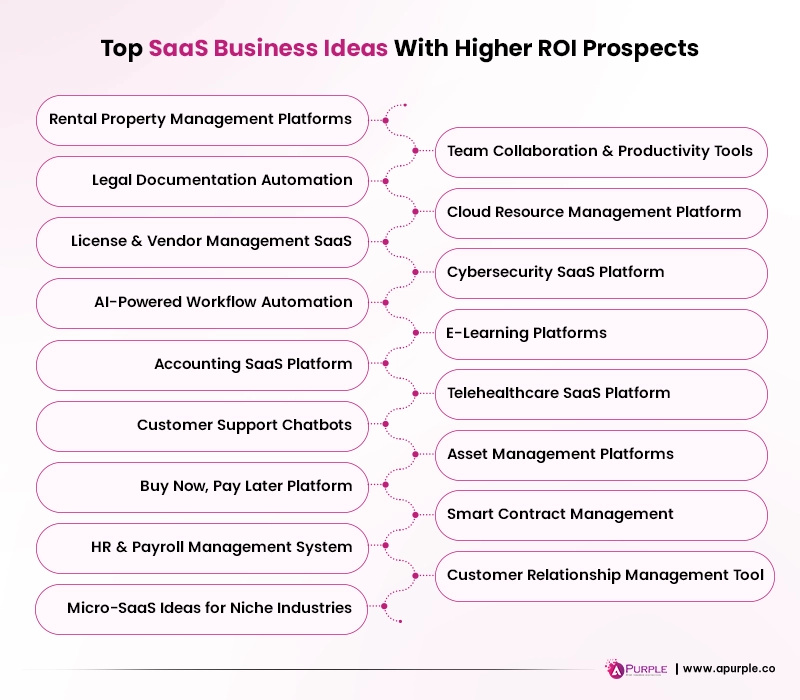
- 1. Rental Property Management Platforms
- 2. Team Collaboration & Productivity Tools
- 3. Legal Documentation Automation
- 4. Cloud Resource Management Platform
- 5. License & Vendor Management SaaS
- 6. Cybersecurity SaaS Platform
- 7. AI-Powered Workflow Automation
- 8. E-Learning Platforms
- 9. Accounting SaaS Platform
- 10. Telehealthcare SaaS Platform
- 11. Customer Support Chatbots
- 12. Asset Management Platforms
- 13. Buy Now, Pay Later Platform
- 14. HR & Payroll Management Systems
- 15. Customer Relationship Management (CRM) Tools
- 16. Smart Contract Management
- 17. Micro SaaS For Niche Industries
1. Rental Property Management Platforms
The ever-increasing urbanization and investments in rental properties have led to a surge in demand for rental property bookings. Additionally, the rental property management firms face legal compliance, tenant screening, and lease agreement complications.
If you are an entrepreneur, building a platform that can eliminate the challenges of rental property processes, this SaaS application idea is for you. Here are the major reasons why it is one of the good SaaS ideas to consider.
- Market Potential – The Global property management software market is projected to reach a revenue of USD 5,888.7 million by 2033.
- Target Audience – This SaaS business’s target audience will be landlords, property managers, and real estate agencies.
- Revenue Model – Charge the subscription (per property/unit), percentage of total rent collected, Tenant screening fees, and Payment processing (optional)
- Key Competitors – Buildium, AppFolio, and Rentec Direct
Must-have features of rental property management SaaS are;
- Online rent collection & automated invoicing
- Tenant and lease management
- Document storage and management
- AI-powered chatbots and support
- Automated tenant screening
What is the Impact of AI in Rental Property Management?
Custom AI models can accelerate tenant screening, set rental prices, and provide predictive maintenance features. Hence, you can automate communication between property owners and tenants without any hiccups.
2. Team Collaboration & Productivity Tools
As the shift towards a hybrid work culture has accelerated, the need for real-time productivity-tracking tools is high. You can also offer seamless cross-functional communication for driving team collaboration and productivity platforms. Some modern organizations face limitations of the traditional project management system.
A SaaS-based team collaboration tool can empower businesses to overcome these hurdles, automate workflows, and enhance operational capability. Here are the crucial reasons why this is a top SaaS business idea opportunity to consider.
- Market Potential – The global team collaboration software market is projected to reach USD 68.20 billion by 2034, growing at a CAGR of 10.1% between 2026 and 2034.
- Target Audience – The primary users for such a Saas platform idea are SMBs, large enterprises, project managers, and distributed remote teams.
- Revenue Model – Freemium or tiered subscription model based on team size and Enterprise licensing.
- Key Competitors – Slack, Microsoft Teams, & Asana
Key features of team collaboration and productivity SaaS are:
- Real-time messaging and video conferencing
- Task and project management
- File sharing and document collaboration
- Automated workflow management
- Advanced reporting and analytics
- Customizable notifications and reminders
How does the AI-Driven Productivity & Collaboration Tool Excel?
AI improves team productivity by automatically assigning tasks, summarizing meetings, and forecasting project delays. It also involves manual coordination through intelligent workflows. However, designing workflows requires strategic planning, which consists of avoiding common startup mistakes, such as rushing the design.
3. Legal Documentation Automation
The old-school approach of legal documentation is lagging behind the Law firms, corporate legal departments, and government agencies’ processes. It struggles to keep up with regulatory compliance, contract management, and high-volume document processing. As a result, this kind of legal document software helps these organizations streamline their operations, reduce errors, and boost productivity. Here’s the brief on this amazing Saas startup idea’s scope ahead.
- Market Potential – The global legal document automation software market is estimated at USD 4272.91 Million in 2033, which is a CAGR of 13.34% between 2025 and 2033.
- Target Audience – Such a SaaS application idea captivates the law firms and in-house legal departments.
- Revenue Model – Major income sources are subscription per use, Pay-per-document generation, and overall compliance packages
- Key Competitors – Formstack, Clio & Templafy
Key features of legal documentation platforms are,
- Automated document drafting
- AI-powered clause suggestions & contract analysis
- E-signature integration
- Template management
- Cloud-based collaboration
- Integration with CLM systems
How AI Automates Legal Documentation?
AI automates contract drafting, clause analysis, and compliance checks. This significantly reduces legal review time and ensures error-free document workflows.
4. Cloud Resource Management Platform
Cloud resources are at the core of operations across industries. From logistics to healthcare, cloud resources enable businesses to scale their operations effortlessly. The speedy adoption of AI is also driving demand for cloud resource management.
With an effective cloud resource platform, companies can easily manage their resources and optimize costs. Therefore, you can emerge as the leading saas startup idea today. So, you can gain the market potential of this business as follows.
- Market Potential – The cloud management platform market is set to reach $55.33 billion in 2030, which expands at a CAGR of 20.8%.
- Target Audience – Your target audience will be small and medium-sized enterprises looking to overcome the challenges of fragmented resource management, escalating costs, and the need for unified oversight and security.
- Revenue Model – Charge companies a recurring fee for access to specific features, with tiered pricing for the platform.
- Key Competitors – AWS, IBM Cloud, & Azure Arc
Key features of cloud management platforms are;
- Resource provisioning and management
- Cost management and optimization
- Performance monitoring and observability
- Automation and orchestration
- Security and compliance management
How AI Helps Manage Cloud Resources Optimally?
AI optimizes cloud usage by predicting demand, minimizing costs, and proactively identifying security anomalies. However, integrating the AI and cloud migration can be complex.
5. License & Vendor Management SaaS
The evidently boosting growth of cloud-based applications has made licensing and vendor management complex. Companies must track software licenses from various vendors, ensure compliance, optimize costs, and reduce risks.
A SaaS-based license and vendor management platform provides centralized oversight and enhances operational efficiency. It is also one of the best B2B SaaS startup ideas that entrepreneurs can leverage to offer managed licensing services. Here are the key reasons to consider.
- Market Potential – The global license management market is projected to reach USD 4.62 billion by 2034, growing at a CAGR of CAGR of 12.44% from 2026 to 2034.
- Target Audience – The target audience will likely be the large enterprises, SMEs, IT departments, procurement teams, and managed service providers.
- Revenue Model – You can use a tiered subscription model based on the number of managed licenses, vendors, users, and advanced features.
- Key Competitors – SAP Ariba, Coupa, and ManageEngine
Key features of license and vendor management platforms are;
- License Inventory Management
- Usage Tracking and Metering
- Compliance Monitoring
- Automated Alerts and Renewals
- Vendor Management
- Workflow Automation
- Scalability and Customization
- Payment and Contract Management
How AI Helps Manage Vendors And Licences?
AI tracks software usage, flags underutilized licenses, predicts upcoming renewals, and assesses vendor risks. It can help companies reduce costs and ensure compliance with regulations.
6. Cybersecurity SaaS Platform
Cybercrime is increasing as the online marketplace expands, driving the demand for SaaS platforms to mitigate these risks. It is also one of the software-as-a-service business ideas to help organizations overcome security threats.
Such a platform provides data protection for sensitive information and against threats like ransomware, phishing, and data breaches. Creating such a platform can also be a profitable opportunity for entrepreneurs. However, you need to consider the following aspects.
- Market Potential – The global Security-as-a-Service market has been extensively increasing in usage over a long time, and it has a better future scope.
- Target Audience – Your target audience will be enterprises, SMEs, government agencies, and managed security service providers.
- Revenue Model – Subscription (per endpoint/user), Tiered pricing, Usage-based for API security, cloud security
- Key Competitors – Cisco Systems, McAfee & Symantec
Key features of cybersecurity SaaS platforms are,
- Identity and Access Management (IAM)
- Threat Detection and Response
- Security Information & Event Management (SIEM)
- Cloud Access Security Broker (CASB)
- Endpoint Detection and Response (EDR)
- Vulnerability Management
- Compliance Management
- Backup and Disaster Recovery
What is the Impact of AI On Cybersecurity Management?
AI detects threats in real-time, predicts vulnerabilities, and automates incident response, making enterprise cybersecurity faster, more innovative, and more scalable.
7. AI-Powered Workflow Automation
The rapid digital transformation across industries has driven demand for seamless workflow automation software. Organizations face challenges such as isolated processes and manual task dependencies. Developing an AI-driven workflow automation is a highly potent SaaS platform. You can seek a huge number of clients from the corporate sector. So, it has the efficiency to transform the online marketplace.
- Market Potential – The global workflow automation market is projected to grow at a CAGR of 10.09% and is expected to reach $48.31 billion in revenue by 2032. [Source: SnSInsider]
- Target Audience – Your primary target audience includes IT departments, operations teams, HR, finance, and customer support divisions.
- Revenue Model – Subscription + usage (per task / API call), AI premium pricing, and Automation credits model
- Key Competitors – Zapier, Workato, & Microsoft Power Automate
Key features of the Workflow Automation SaaS Platform;
- Drag-And-Drop Workflow Builder
- AI-driven Process Optimization
- Integration With Third-Party Applications
- Automated Notifications and Escalations to ensure timely task completion
- Role-Based Access Controls (RBAC)
- Intelligent Document Processing
How aPurple helped the AI SaaS project to Automate Workflow?
It’s been our privilege to get hands-on expertise with AI-powered automation as an add-on to enterprise software. It easily maps the intelligent business approach, automates repetitive tasks, and leads to continuous improvement. So, we can bet on this SaaS business idea as the most successful one.
8. E-Learning Platforms
The demand for e-learning platforms has increased in tandem with the rise in internet usage and the growing popularity of online education. It has been driven by the need for flexible, scalable, and interactive solutions for students and users. So, they can upskill and reskill, and deliver knowledge efficiently. Building a robust e-learning platform that addresses the needs of modern learners is one of the key profitable SaaS ideas. Let’s have a look at its details.
- Market Potential – The global e-learning market is projected to reach over $1515.97 billion by 2033, with a CAGR exceeding 17.35% between 2024 and 2030. [Source: Finance Yahoo]
- Target Audience – The main audience base of this business is educational institutions (such as schools, colleges, and universities), corporate Learning and Development (L&D) teams, training providers, and individual learners seeking self-paced courses
- Revenue Model – Subscription (B2C or B2B), Course marketplace commission, and Enterprise training licensing
- Key Competitors – Coursera, Duolingo, & Teachable
Main features of an e-learning SaaS platform are:
- Course Creation and Management
- Learning Paths and Progress Tracking
- Live and On-Demand Sessions
- Assessment & Certification
- Collaboration Tools
- AI-Powered Personalization
- Integration Capabilities
- Mobile Accessibility
How does AI in Learning platforms offer personalization?
AI personalizes learning paths, automates grading, and identifies at-risk learners. Thus, it enhances the engagement and learning outcomes across all user types.
9. Accounting SaaS Platform
A centralized accounting SaaS platform manages the manual bookkeeping, complex compliance rules, and scattered financial data. It is the need of the slow administrative task management system. In addition to that, the accounting SaaS platform solves these challenges by making accounting simple, automated, and accessible from anywhere.
For a startup founder looking for a SaaS idea, building an accounting platform is an evergreen solution. So, here’s navigating you through this top SaaS startup idea opportunity for you:
- Market Potential – The global accounting software market will reach $31.25 billion in revenue by 2030, growing steadily at a CAGR of 8.4%. [Source: Grandviewresearch]
- Target Audience – Your target audience will be small businesses, accountants, and financial institutions. It can be integrated with those who want to automate tasks, reduce errors, and get instant financial insights.
- Revenue Model – Monthly subscription, Add-ons like Payroll & Tax filing, also earn through Financial services upsell
- Key Competitors – QuickBooks Online, Xero, & FreshBooks
Must-have features for your accounting SaaS platform:
- Automated Bookkeeping And Invoicing
- Real-time Expense Tracking
- Instant Financial Dashboards
- Tax Compliance Tools
- Multi-Currency & Global Tax Support
- AI-Powered Fraud Detection
How AI Automates Accounting?
Entering with an AI-powered solution will automate the bookkeeping, flag anomalies, and predict cash flow. So, it will reduce manual errors and enhance financial clarity.
10. Telehealthcare SaaS Platform
Telehealth SaaS platform offers a cloud-based solution for healthcare providers to offer remote consultations and patient care. Using a telehealth platform, patients can access virtual care, remote monitoring, and real-time consultations on their terms. So, it reduces long wait times for patients, addresses a shortage of specialists, and alleviates the burdens of in-person visits.
Having the telehealthcare platforms is also one of the best SaaS business ideas. It caters to a massive market, which you can capitalize on by consulting with startup experts. Some of the key aspects of this SaaS business idea are;
- Market Potential – The global telehealth market is projected to grow to billions in numbers, with higher profitability opportunities.
- Target Audience – This software-as-a-service business idea targets healthcare providers, clinics, hospitals, and medical institutions
- Revenue Model – Commissions on per-consultation fees and premium add-ons, such as AI diagnostics or integration with wearable devices.
- Key Competitors – Teladoc Health, Amwell, and Zocdoc
Key features of the telehealth or medical platform:
- Video Consultations
- Remote Patient Monitoring
- AI-Driven Diagnostic
- Appointment Scheduling
- EHR Integration
- HIPAA & GDPR Compliance
How can AI transform this Healthcare business idea?
AI assists with symptom tracking, automates medical transcription, predicts patient health outcomes, and powers 24/7 virtual healthcare experiences.
Read More: Healthcare Business Ideas
11. Customer Support Chatbots
By utilizing the natural language processing capabilities of AI chatbots, SaaS-based software can manage support services. It became increasingly efficient through more personalized customer interactions for your business.
AI-based chatbots are addressing key challenges faced by customer-facing businesses. Startups can offer customized chatbots that companies can integrate into their existing systems for personalized communication. Some of the key aspects of this SaaS business idea that you must know are;
- Market Potential – The AI chatbot market is set to reach $66.6 billion in revenue by 2033, growing at a CAGR of 26.4%. [Source: Market.us]
- Target Audience – Your target audience will primarily consist of e-commerce brands, SaaS companies, banks, telecoms, and any business with a digital presence that seeks to automate customer support.
- Revenue Model – Charges based on per conversation session or API usage, and Subscription tiers
- Key Competitors – Zendesk, Intercom, & Drift
Key features of the customer support chatbots:
- AI-Powered Conversations
- 24/7 Automated Support
- Seamless Handoff To Human Agents
- CRM, eCommerce, and Helpdesk Integration
- Multilingual And Omnichannel Support
- Customizable Conversation Flows
- Data Analytics Dashboard
How AI-driven Customer Chat Support Harnesses Your Business?
AI delivers smart, multilingual chat support, automatically resolves common queries, and escalates complex issues with full context for fast and efficient service.
12. Asset Management Platforms
Asset management platforms are SaaS-based digital tools that help organizations track, manage, and optimize their assets, which can be physical or digital in nature. These assets include equipment, machinery, and other physical items, as well as software licenses, computers, and servers.
So, you can leverage SaaS application development services to build a scalable and agile platform for asset management. Here are some key considerations if you choose this SaaS application idea.
- Market Potential – The Asset management platform market scope is optimally fortunate. As the shift from spreadsheets to cloud tools is accelerating, you can reap the benefits.
- Target Audience – Your target audience for this SaaS business idea will be enterprises, SMBs, healthcare, logistics, retail, manufacturing, and IT teams.
- Revenue Model – Subscription-driven by per asset tracked, Enterprise licensing, and Analytics add-ons
- Key Competitors – IBM Maximo, SAP EAM & Asset Panda
Key features of the Asset Management Platforms:
- Real-Time Asset Tracking With IoT, RFID, or GPS
- Automated Maintenance Scheduling
- Asset Lifecycle Management
- Predictive Analytics For Repairs
- ERP & CRM Integrations
- Compliance And Regulatory Reporting Tools
How AI Helps Manage Assets?
AI provides real-time tracking, predicts maintenance needs, and optimizes asset lifecycles. This lowers downtime and enhances operational planning.
13. Buy Now, Pay Later Platform
Buy now, pay later [BNPL] is the main form of SaaS platform. It offers instant credit to users when they want to make a purchase. However, BNPL works as a faster and more reliable option to manage credit payments. As the traditional credit options are slow and intimidating, BNPL is highly preferred by both eCommerce stores and retail shops.
Therefore, you can boost your business brand to make better transaction management and increase the average order value. For the startup founders eyeing the fintech space, building a BNPL platform is a high-growth SaaS solution with global appeal. Here’s showing you why this is a top SaaS startup opportunity;
- Market Potential – The global BNPL platforms market is projected to reach $911.8 billion by the end of 2030, growing at a CAGR of 10.2%. [Source: Globenewswire]
- Target Audience – Ideal customers for your SaaS business idea of building a BNPL platform. Accordingly, it will be eCommerce retailers, D2C brands, marketplaces, and even offline merchants.
- Revenue Model – Merchant fees, Interest/late fees, and Interchange fees
- Key Competitors – Klarna, Afterpay, & Affirm
Must-have features for your BNPL SaaS platform are:
- Instant Credit Scoring
- Real-Time Credit Approval
- Flexible Installment Scheduling
- AI-powered Fraud Detection
- Automated Reminders & Late Fee Management
- Merchant Dashboards With Data Analytics
- Customizable UX To Match Merchant Branding
- Regulatory Compliance (PCI DSS, GDPR, local lending laws)
How AI Enables Smart BNPL?
AI conducts instant credit scoring, personalizes repayment options, and detects fraud, enabling safer and faster buy-now-pay-later experiences.
14. HR & Payroll Management Systems
As corporate organizations are broadly managing the huge employee database, they look for payroll and HR tools to automate the tasks. From timely salary transactions, tax compliance, to administrative work, your HR Saas tool can amplify the process without any error.
- Market Potential – The HR management software market is expected to grow to USD 31.89 billion by 2031 at 10.29% CAGR over 2026-2031
- Target Audience – SMBs, mid-sized enterprises, large corporations, staffing agencies, and global companies managing distributed teams.
- Revenue Model – Tiered pricing (HR only or full payroll suite), Add-ons (benefits, compliance, tax filing) & Implementation/setup fees
- Key Competitors – ADP, Workday, & Gusto
Must-Have Features of HR & Payroll Software
- Payroll Processing & Tax Automation
- Employee Self-Service Portal
- Attendance & Leave Management
- Benefits Administration
- Compliance & Labor Law Management
- Multi-country payroll support
How can AI be used in payroll?
Using AI can offer a data-driven strategy to HRs and management on overall cost and bifurcation of the gross salary. It even helps to handle the tax payment and process the repetitive tasks daily.
15. Customer Relationship Management (CRM) Tools
Customer Relationship Management (CRM) tools are widely used software for managing customer data at a centralized platform, structuring the interactions, and automating further marketing and sales funnels.
- Market Potential – The Customer Relationship Management (CRM) market size is USD 87.96 billion in 2026 and is estimated to rise to USD 128.86 billion by 2031.
- Target Audience – Sales teams, marketing teams, customer support teams, SMBs, enterprises, SaaS companies, and service-based businesses
- Revenue Model – Subscription (per user/month), Tiered plans (basic, advanced automation), Add-ons (marketing automation, analytics, integrations) & Enterprise licensing
- Key Competitors – Salesforce, Microsoft Dynamics 365, & HubSpot
Key Features for CRM SaaS Platform;
- Contact & Lead Management
- Sales Pipeline Tracking
- Email & Communication Integration
- Marketing Automation
- Reporting & Forecasting Dashboards
- API & Third-party Integrations
How does AI-optimized CRM have a better future?
The AI-optimized CRM systems provide a better future by transforming the passive data repositories into active, autonomous agents. So, it will drive revenue and efficiency for your business.
16. Smart Contract Management
Smart contract management platforms are key SaaS application examples that help businesses manage the entire contract lifecycle. They bring up the smart contracts to manage the execution of key organizational contracts decentralized through Blockchain.
Using this SaaS business idea as an entrepreneur, you can build a platform that automates the execution of contracts across operations. Here are some key considerations for this SaaS startup idea,
- Market Potential – The worldwide smart contracts market is USD 16.31 billion by 2034. It has great scope to captivate the diverse business types.
- Target Audience – Legal departments, procurement teams, real estate operators, logistics firms, and enterprises that deploy blockchain-based workflows.
- Revenue Model – Tiered subscription model based on contract volume, number of users, or advanced automation features
- Key Competitors – PandaDoc, Agrello, and Juro
Essential features of a smart contract management SaaS platform:
- Automated Smart Contract Creation
- Digital & Cryptographic Signatures
- Contract Lifecycle Management
- Audit Trail And Version Control
- Automated Execution And Orchestration
How AI Helps Manage Smart Contracts?
The AI-based solution reviews smart contracts for logic errors, automates execution, and monitors compliance. So, it reduces the legal and transactional risks at scale.
17. Micro SaaS For Niche Industries
Unlike the above big SaaS app development solutions, Micro SaaS focuses on the specified and smaller target customers’ problems. So, it works by narrowing down the pain point of the particular user. It is a high-margin and famous saas business idea of the year.
As a niche-focused business type, micro business sales ideas are low-cost businesses seamlessly efficient for startups like yours to enter. Moreover, there is a variety of micro Saas ideas available to pick from. Based on the detailed research, I am showing you the best one from each niche. So, here you go…
| Industry | Micro Saas Idea | Details |
|---|---|---|
| eCommerce | Visual Content Generation APIs | This is the most enticing and high-demand type, automating the designing, editing, and drafting of marketing visual content. Thus, it is widely popular for generating on-brand images effectively. |
| Fintech | Invoice Reconciliation Tool | Being an automated invoice reconciliation software, it optimizes the process of managing a high volume of transactions smoothly. Moreover, it handles duplicate invoices and even boosts accuracy throughout. |
| AI-Driven | RFP (Request for Proposal) Auto-Responder | Performs the automated task for preparing and sending proposals or questionnaires to the client. It helps the sales team to manage bulk proposal requests in less turnaround time. |
| Healthcare | Private Practice Waitlist | The online doctor’s appointment booking application needs a private practice waitlist solution to manage the busy schedules. So, it will fill the gap and optimize the patient appointment list. |
| Automotive | SMB Fleet Maintenance Tracker | For keeping up with the vehicle’s health and repair needs, this software idea works as an alert for maintenance or regular servicing accordingly. It is the underlying Saas idea with great profitability. Check out our work on smart vehicle tracking software. |
| Education | IEP Generator | An Individualized Education Program (IEP) generator is an advanced and streamlined solution for special education regulations on automating goal setting for teachers. It helps them maintain the documentation of weekly progress. |
Well, the list is a bit overwhelming, I know, it might have led you into a dilemma of choosing the best one. Don’t worry, you can make that decision in the following ways.
How to Finalize the Right SaaS Business Idea?
Questions like which idea should you pick, how to validate your SaaS idea, etc., are flowing through your mind. You can get the one-stop solution for the idea with the following steps.
- Define Your Niche & Audience
First, it’s critical to identify a specific target audience of yours and their pain points. It is important to know the idea and the further SaaS development process accordingly.
- Validate the User’s POV
Now, you have to conduct a few of the interviews and discussions either online or in-person with potential users. Understand their experience with existing platforms and what they look for. It will help to validate your plan and make necessary changes beforehand.
- Analyze Competition and Gaps
Evaluating the competitors and researching existing information about their next move through social media and other platforms is necessary. Ensure to look for common complaints that your product can solve better.
- Check Search Intent & Visibility Scope
As you at the initial stage, it’s significant to use the keyword intent in the landing page and examine with tools, if people are searching for solutions to the problem. So, you can study the user and search intent seamlessly.
- Develop a Lean MVP
Building a minimal viable product (MVP) strengthens your functional basis of the Saas product idea. It helps to solve the core problem of having the required features only. So, it easily suits a startup SaaS founder to begin with.
Turn Your SaaS Application Idea Into Reality!
The above provides SaaS application ideas that you can leverage as a founder to build a successful startup. You need an end-to-end SaaS development company for strategic roadmap design and development of such platforms. Partnering with aPurple as your customized solutions for compelling SaaS products opens higher profit-earning opportunities. Finalize your idea! Connect with us to build a SaaS application.
FAQs
- AI-powered workflow automation
- Remote patient monitoring platforms
- Project Management & collaboration tools
- Visual Content Generator
So, these Micro Saas ideas can uplift your business to an industry-level solution rapidly.