Updated Date: May 5, 2026
As the market is more “AI-first,” it is no longer a choice but a survival tactic. Now, your choice of tech stack makes a real impact. It is about coding language, frameworks, and tools that are the foundation of your future valuation. We’ve moved past the era of simply building apps; now it’s more about building intelligent systems that scale, adapt, and think.
If you’re planning for a startup project, you don’t just need a language that works. You need a stack that is fast, cost-effective, and proficient. Many startups move quickly to build an MVP. Accordingly, they end up only to face performance issues, rising costs, or expensive rewrites due to poor tech stack decisions. Founders often struggle to balance speed, cost, and scalability while making choices that will hold up in the long run.
Keep reading further to the most commonly used programming languages, that has turned out to be the topmost solution for startup projects.
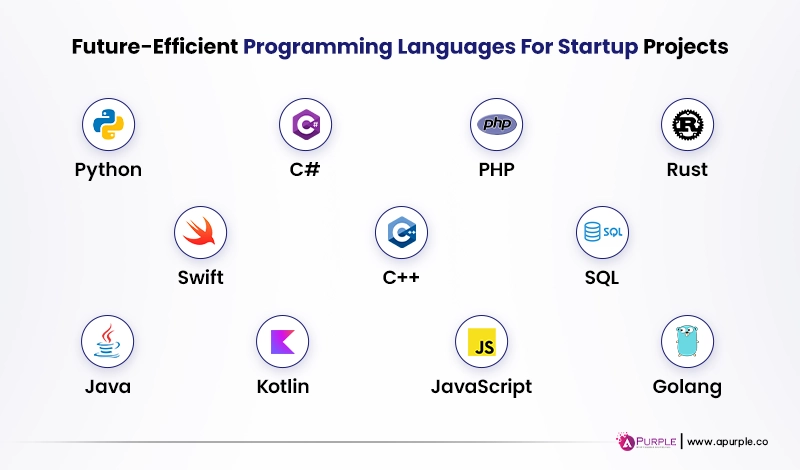
Top Programming Languages For Startup Projects
There are the top 10 programming languages that meet today’s requirements with efficacy and reliability factors. However, I have added one more to amplify the list tailored for startup development projects. So, you can consider the ideal one from the best programming languages today and in the coming years.
- Python — Startup World’s Favorite All-Rounder
- C# — Microsoft’s Powerhouse for Enterprise-Grade Apps
- C++ — Raw Power for Performance-Critical Products
- PHP — Quiet Engine Behind Half the Web
- Rust — Future-Proof Language Built for Safety & Speed
- Java — Battle-Tested Language That Scales with You
- Kotlin — Modern Way to Build Android Apps
- Swift — Native Language Seamless for iOS Apps
- JavaScript — Full-Stack Language That Runs Everywhere
- Golang — Google’s Gift to Backend Developers
- SQL — Language Every Data-Driven Startup Needs
1. Python
Python is a general-purpose programming language, one of the easiest technologies with simpler syntax. It is developed to manage small to large enterprise projects. Python has topped the TIOBE Index as the best programming language to choose to develop new software. Additionally, Python’s strong integration with AI frameworks and machine learning libraries makes it especially noteworthy.
That’s why it’s the best programming language to start with for your AI startup business. You can have Python best used with…
Key Frameworks
- Django
- Flask
- FastAPI
- TensorFlow (AI/ML)
- PyTorch (AI/ML)
Why Startups Should Choose This:
Python has sort of dominated coding languages for AI, automation, and other modern-age app solutions. Its simplicity and wide ecosystem allow startup projects to be developed and delivered beforehand with efficiency.
Use Cases:
- AI & Machine Learning (predictive models, chatbots)
- Data Analytics & Visualization
- Web Development (backend APIs, SaaS platforms)
- SaaS platforms
Examples:
- Stripe
2. JavaScript
Next is the common and popular one of all, JavaScript. It has been the widely used language for web and mobile app development. JavaScript is an efficient and trusted technology. Being a robust frontend web development solution, it is highly preferable for startup as well as enterprise projects. Moreover, you can combine JavaScript with any backend technologies.
It delivers dynamic website content as a powerful client-side coding solution. The best part is its versatility to adapt to different frameworks. Alongside that, there is impressive tech under its umbrella: TypeScript, a JS syntax with types.
Key Frameworks:
- React.Js
- Angular
- Vue.Js
- Node.js
- Express.js
Why Startups Should Choose This:
JavaScript continues to power the custom web apps. TypeScript adds scalability and structure to it. Moreover, together, they enable full-stack development with a single language.
Use Cases:
- Frontend development
- Backend (Node.js)
- Real-time applications
- SaaS platforms
Examples:
- Netflix
- Airbnb
3. Java
Java is used as the primary Android app development language. It is an object-oriented technology, a reliable solution for startup app development. You can get a native mobile app solution with the proficiency of Android and ChromeOS devices’ performance. Moreover, it has been a great pair with the following frameworks.
Main Frameworks:
- Spring Boot
- Hibernate
- Struts
- Micronaut
Why Startups Should Choose This:
Java remains a strong choice for building secure, scalable, and enterprise-grade applications, especially in regulated industries.
Use Cases:
- Enterprise applications
- Large-scale backend systems
- Android development
Examples:
- Uber
4. C#
Next is C#, which is an increasingly strong choice for new ventures due to its evolution into a modern, open-source, and cross-platform ecosystem. Well, historically, it has been considered the “enterprise-only” language for Windows. So, the advent of .NET enables startups to build high-performance applications that run on Linux, macOS, and even on Docker.
Key Frameworks:
- ASP.NET Core
- Blazor
- .NET MAUI
- Unity
Why Startups Should Choose This:
C# is a strong player in enterprise and Microsoft ecosystems. You can adopt its growing cloud solutions.
Use Cases:
- Enterprise software
- Web apps (.NET)
- Game development
Examples:
- Stack Overflow
- Unity Technologies
5. C++
C++ is a go-to choice for startups building performance-critical products. It has low-level memory management that enables faster execution and efficient hardware interaction. For deep-tech startups working on autonomous vehicles or robotics, C++ provides the precision and performance needed to operate at scale with minimal latency.
Primary Frameworks:
- Qt
- Boost
- Cinder
- Unreal Engine
Why Startups Should Choose This:
The popular programming languages, i.e., C++, have been critical for low-latency systems and hardware-level efficiency. It’s widely used in deep-tech domains like AI infrastructure, gaming engines, and real-time systems.
Use Cases:
- Game development
- Computer vision & AI infrastructure
- Embedded systems & robotics
Examples:
- Tesla
- Epic Games
6. Go [Golang]
For modern software environments, Golang serves as a potential language. Startup software development can amplify the usage with the viability of Go (Golang). It is the popular choice for startup projects due to its scalability and fast development-to-deployment cycles. Therefore, it has been used as a well-suited solution for tech-edge projects.
Main Frameworks:
- Gin
- Echo
- Revel
Why Startups Should Choose This:
Go is highly used to build speed and scalable solutions in cloud-native environments.
Use Cases:
- Microservices
- Cloud infrastructure
- Backend systems
Examples:
- Dropbox
- Uber
7. Rust
There is a question that pops up generally: Do startups use Rust? Well, it does fit as the near-native performance technology. You can utilize the robustness of the technology to reduce the cloud infrastructure costs for backend systems. In addition to that, Rust has been an impressive pick for the custom startup software project.
Key Frameworks:
- Rocket
- Actix Web
Why Startups Should Choose This:
This is a high-performance language with memory safety and is ideal for critical systems.
Use Cases:
- System programming
- Blockchain
- High-performance apps
Examples:
- Cloudflare
- Discord
8. SQL
SQL is a critical, on-demand language with an innovative impact for database management solutions. This can be used for the database setting in backend development, analytics, and even data-driven applications. For your project, it is used to query, manipulate, and retrieve data for the application.
Key Framework:
- MySQL
- PostgreSQL
- Microsoft SQL Server
- SQLite
Note: SQL itself doesn’t have frameworks, but works with these systems/tools
Why Startups Should Choose This:
It is the core language for managing structured databases and processing.
Use Cases:
- Databases Management
- Analytics & Reporting
Examples:
- Amazon
9. Kotlin
An object-oriented language, Kotlin was created and first used in 2011. Kotlin, in simple terms, is a high-end programming language. It helps in creating cross-platform mobile applications using a simple syntax. Moreover, it offers multi-platform development solutions. It leads to saving time and money by compiling the Java code for app development.
Key Framework:
- Ktor
- Android Jetpack
Why Startups Should Choose This:
Modern, concise language primarily used for Android and backend systems.
Use Cases:
- Android apps
- Backend services
Examples:
- Trello
10. Swift
Being an open-source language, Swift has been the preferred pick for iPhone app development. macOS, iOS, and other Apple devices, using Swift is the righteous solution. It’s a high-level language to make startup apps run on the platform to make an early entry. Therefore, you will have improved memory management and even support cross-platform capability.
Main Frameworks:
- SwiftUI
- UIKit
- Combine
Why Startups Should Choose This:
Swift has been the primary choice as Apple’s programming language, with alignment to the reliable frameworks.
Use Cases:
- iOS apps
- macOS apps
Examples:
- Lyft
- Airbnb
11. PHP
Last, but most amazing of all, PHP. The classic open-source and server-side programming language. It is a best-in-class language to run on a web server, empowering dynamic websites and backend systems. So, you can make a powerful and performance-rich application with PHP and its frameworks.
Key Frameworks:
- Laravel
- Symfony
- CodeIgniter
- CakePHP
Why Startups Should Choose This:
Java remains a strong choice for building secure, scalable, and enterprise-grade applications, especially in regulated industries.
Use Cases:
- Web apps
- CMS
- E-commerce
Examples:
- Facebook (originally developed using PHP)
- WordPress
Underrated Programming Languages For Custom Development
The above list is undoubtedly the top-notch programming languages, yet there are a few other options as well. You can explore them as well. So, here you go…
| Language | Domain | Startup Use Cases | Key Purpose |
|---|---|---|---|
| HTML | Web | Landing pages, email templates, UI prototypes, SEO structure | Defines the structure of every web page; essential for any startup with a web or SaaS product. |
| Ruby | Backend | MVPs via Rails, SaaS APIs, e-commerce (Shopify), admin tools | Let small teams ship full-featured web apps fast. Ideal for validating ideas before scaling. |
| Visual Basic | Scripting | Excel automation, internal ops tools, legacy enterprise integrations | Automates Office workflows. Valuable for B2B startups working with enterprise clients. |
| R | Data | A/B testing, investor data visuals, health/finance analytics, market research | Gold standard for statistical analysis. Builds credibility with data-driven stakeholders. |
| Perl | Scripting | Log parsing, bioinformatics pipelines, data migration, sysadmin scripts | Powerful text and regex processing. Still relevant in biotech, cybersecurity, and legacy data work. |
| Dart | Mobile | Cross-platform apps via Flutter (iOS + Android + web from a single codebase) | Let’s lean teams build native-quality apps for all platforms; it cuts dev costs significantly. |
How to Pick the Ideal Programming Language for a Startup Tech Stack?
Well, the best way out would be to combine the technology and get the best out of it. Because the choice is highly aligned with your startup project industry, size, technicality, and feature set. So, you can easily pick the combination from below.
| Technology Combination | Best For | Startup Fit |
|---|---|---|
| Python + FastAPI / Django | AI-powered apps, SaaS platforms, data-driven products | MVP → Growth |
| JavaScript + React + Node.js | Full-stack web apps, SaaS, real-time platforms | MVP → Scale |
| Go / Rust | Scalable backend systems, microservices, cloud-native apps | Growth → Scale |
| Swift / Kotlin + Dart (Flutter) | Cross-platform mobile apps (iOS + Android) | MVP → Growth |
For a new business, it is advisable to consult a startup business development team. Choosing any technology carelessly might cost you big bucks later. You can ask for assistance from aPurple. We have experts in all the above technologies with industry experience. Connect now!
FAQs
Python — ML frameworks, LLMs, data pipelines, research
R — statistical modelling, academic AI research
C++ – Low-level AI inference engines and edge AI
- JavaScript
- Python
- PHP
- HTML
- Go
- Rust adoption rising — It is replacing C/C++ for memory-safe systems programming; now used in Linux, Windows, and Android kernels
- Python dominance in AI — Python’s lead will grow further as LLMs and generative AI become core to software products
- AI-assisted coding — There are tools like GitHub Copilot and Claude Code that are reducing the barrier of language choice
- WebAssembly (Wasm) — It is enabling languages like Rust and Go to run in browsers, expanding web capabilities.