Updated Date: Apr 22, 2026
Healthcare software product development isn’t just about building an app. It’s about navigating strict regulations, ensuring data security, and integrating complex systems without compromising patient care. For many startups, this becomes the biggest roadblock: high development costs, compliance challenges like HIPAA, and the pressure to deliver reliable solutions.
At the same time, industry leaders are rapidly adopting AI-driven diagnostics, remote patient monitoring, and cloud-based platforms. This has been raising the bar for innovation and shrinking the gap for startups to enter.
But here’s the catch to this: the rise of SaaS in healthcare is making it easier to build and grow. Delivering centralized, scalable, and compliant solutions can connect patients and providers efficiently. Well, it’s expanding prosperously. Recent data shows that the healthcare SaaS market will reach USD 82.37 billion by 2031. The following image will define the high jump of the market size…
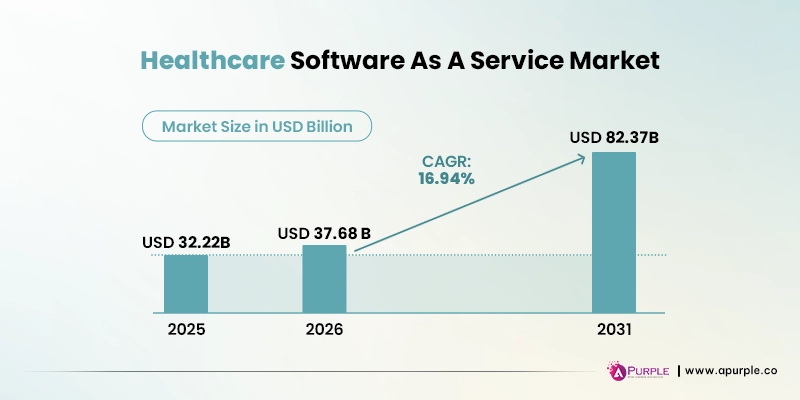
Explore the details on how healthcare software products are redefining how the ecosystem functions.
What is a Healthcare Software Product?
Healthcare Software Products are the digital solution, which can be a SaaS platform, application, or system. They are used for different purposes of healthcare processes, i.e., streamlining the workflow, handling patient data and diagnosis, and enhancing clinical results. In addition, the healthcare software products comply with industry regulatory requirements.
For building a seamless healthcare product solution, it is essential to have a clear idea of the purpose for which the product will be used. Creation of such an incredible product is called healthcare software product development.
From managing clinical operations to specialty tools for diagnosis, there are diverse types of healthcare software products startups can choose from. Got you covered with the best healthcare product types; these are the popular ones with optimal prospects.
What are the Types of Healthcare Software Products?
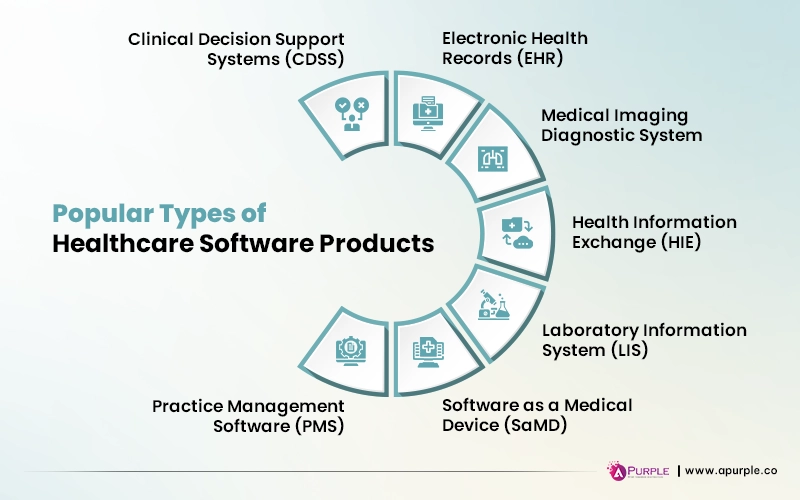
From managing clinical operations to specialty tools for diagnosis, there are diverse types of healthcare software products startups can choose from. Got you covered with the best healthcare product types; these are the popular ones with optimal prospects.
-
Clinical Decision Support Systems (CDSS)
CDSS is a brilliant example of a healthcare software-driven product widely used in medical firms. Being a reliable solution, it works to recommend and support clinical decisions. Healthcare providers can analyze the data as the product works with an advanced model for predictive analysis from the software. Accordingly, it helps to make the right decisions by eliminating errors.
Example: IBM Watson Health
-
Electronic Health Records (EHR)
This is the most classic form of product, making strides in the electronic health records for a long time now. EHR or EMR [Electronic medical record] is the primary aspect in healthcare institutions. It keeps up with the database on patients’ history, treatment, and test reports. So, EHR has been a simplified and scalable software product with well-structured health and medical records of patients.
Example: Epic Systems
-
Medical Imaging Diagnostic System
Next up, you can start with medical imaging and diagnostic systems. They are the go-to products for diagnosing the core of disease or health concerns by visualizing internal organs. X-Ray, CT scan, MRI, and Ultrasound are performed to gather data to monitor and diagnose the root cause. Therefore, it is one of the great ways to enter the medical field with a solid tool.
Example: Aidoc
-
Health Information Exchange (HIE)
Using the Health Information Exchange (HIE) allows smooth, secure, electronic sharing of health information. It is transmitting information between multiple stakeholders through medical systems. As a result, HIE is encouraging the smooth exchange of data without any prejudice.
Example: eHealth Exchange
-
Laboratory Information System (LIS)
Moving to another super product type, LIS, which is the mainstay solution used in the labs and hospitals to manage patient data on samples and track the specimens. Moreover, these tools enable pathologists and lab technicians to handle the patients’ samples and result reporting.
Example: LabWare LIMS
-
Software as a Medical Device (SaMD)
SaMD has been the most promising software product to emerge as the best substitute for hardware-driven devices. It works independently for different purposes of the clinical operations and hospital workflows. Furthermore, it scales your medical and health purposes efficiently without reliance on hardware. It is primarily defined and described by the International Medical Device Regulators Forum (IMDRF).
Example: Apple Health
-
Practice Management Software (PMS)
Lastly, PMS systems are utilized by healthcare organizations to keep track of appointments, billing, reporting, and analytics. These solutions coordinate with legacy systems and other software to efficiently manage the healthcare ecosystems.
Example: AdvancedMD
Regulatory Compliance Healthcare Software Product Startup Should Integrate
No matter the type of healthcare software product development you pick, adhering to rules and regulations is non-negotiable. You have been banking on the big project, so investing in security law & regulation gains the trust of healthcare firms. Have a look at the most essential ones.
| Regulation / Standard | Type | Region | Key Purpose |
|---|---|---|---|
| HIPAA [Health Insurance Portability and Accountability Act] | Privacy & Security Law | USA | Most important healthcare law compliant as Protecting Patient Data (PHI) |
| FDA [Food and Drug Administration | Regulatory Authority | USA | Approves/controls medical software such as Software as a Medical Device (SaMD) |
| GDPR [General Data Protection Regulation] | Privacy Law | EU (Global impact) | Effective in protecting personal data |
| Australian Register of Therapeutic Goods (ARTG) | Legal Compliance | Australia | Ensure the compliant to be reviewed and assessed under safety standards |
| HITECH [Health Information Technology for Economic and Clinical Health Act] | Health IT Law | USA | Strengthens your data security & EHR |
| SFDA (Saudi Food and Drug Authority) & SDAIA (Saudi Data and AI Authority) | Regulatory Bodies | Saudi Arabia | Oversee the Protection of food, drugs, medical devices, and data with AI adoption |
| HL7 [Health Level Seven International] | Interoperability Standard | Global | Seamlessly handles the data exchange standards |
| FHIR [Fast Healthcare Interoperability Resources] | API/Data Standard | Global | Works as the modern Healthcare Interoperability Resource |
| FDA 21 CFR Part 11 | Compliance Regulation | USA | Title 21 Code of Federal Regulations Part 11 validates the electronic records/signatures |
| EU Cybersecurity Act [European Union Cybersecurity Act] | Cybersecurity Law | EU | Protection and Security certification |
| EU AI Act [European Union Artificial Intelligence Act] | AI Regulation | EU | Using safe and transparent AI solutions |
| ISO 13485 [International Organization for Standardization 13485] | Quality Standard | Global | Quality Management System (QMS) for medical devices |
Undertaking the legal practices and laws for your healthcare software product amplifies your venture’s trust. You can also consult the software product developers for more details!
What are the Main Features of the Healthcare Software Products?
The feature set of healthcare software product development must qualify for the 3-user panel, i.e.,
- Patient Panel (User-Facing Experience)
- Healthcare Provider Panel (Clinical & Hospital Experience)
- Administration Panel (Management & Governance)
Let’s begin with…
1. Patient Panel Features
| Features Name | Capabilities |
|---|---|
| Onboarding & Identity Management | Registration, OTP/biometric login, consent management |
| Appointment Scheduling & Telemedicine | Book/reschedule/cancel appointments, video consultations |
| Health Records Access | View lab reports, prescriptions, and medical history seamlessly |
| Remote Monitoring & IoMT [Internet of Medical Things] | Integration with wearables, real-time vitals tracking |
| Notifications & Engagement | Manages to give medication reminders, alerts, and wellness tips |
2. Healthcare Provider Panel Features
| Features Name | Capabilities |
|---|---|
| EHR / EMR Systems | Essential to collect patient records, history, prescriptions, and documentation |
| Clinical Decision Support (CDSS) | AI-driven alerts, diagnostics support, treatment suggestions |
| Collaboration Tools | Secure messaging, shared dashboards, and team coordination |
| Analytics & Reporting | Real-time updates on patient trends, clinical outcomes, and performance metrics |
| Compliance-Ready Data Handling | Necessary to manage the encryption, audit logs, and consent tracking |
3. Administration Panel Features
| Features Name | Capabilities |
|---|---|
| User & Role Management | Role-based access, permissions, and audit tracking |
| Revenue Cycle & Billing | Claims processing, billing automation, insurance integration |
| Performance Dashboards | KPIs like occupancy, wait times, and utilization rates |
| Data Governance & Compliance | Audit trails, encryption, and security monitoring |
| Scalability & Integration | Cloud deployment, API integrations, multi-location support |
You can top up with other advanced features by integrating AI/ML at different layers during the development process. Let’s get into it…
How to Develop a Healthcare Software Product?
Steps for the Health software product development must be followed as per the given sequence.
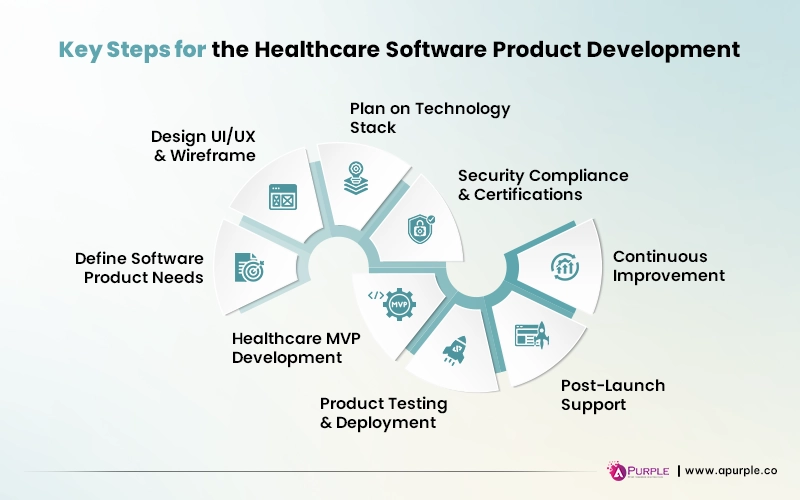
1. Define Software Product Needs
Firstly, you have to begin with researching and brainstorming on the pain point or purpose of your healthcare product. Defining what it will address, narrowing down the target audience and market, AI opportunities, etc. These are the decisive measures that need to be figured out at the early stage. Moreover, it helps in the discovery of your product type and overall features.
2. Design UI/UX & Wireframe
Secondly, the UI/UX design solution of the product. Remember, you are serving two different user panels (Patients + Healthcare Providers). As the features are distinct, so should your design layout be for each user. Prioritizing the simple yet navigational UX is highly recommended. You can get a clear idea of it with mockup designs.
3. Plan on Technology Stack
The technology stack used in creating healthcare software products must be carefully decided. Here’s the tabular form of the best tech stack for a healthcare product as follows;
| Layer | Technologies |
|---|---|
| Frontend | React, Flutter |
| Backend | Node.js, Python (Django/FastAPI) |
| Cloud Infrastructure | Amazon Web Services (AWS), Microsoft Azure |
| Security Layer | Encryption (AES-256, TLS), IAM (OAuth 2.0, RBAC) |
| DevOps & Deployment | Docker, Kubernetes |
| AI/ML Frameworks | TensorFlow, PyTorch |
| Data Processing | Apache Spark, Pandas |
| AI Services (Cloud) | AWS SageMaker, Azure ML |
| NLP (Clinical Text) | SpaCy, Transformers (BERT) |
| MLOps & Monitoring | MLflow, Kubeflow |
4. Security Compliance & Certifications
Next has been emphasized above as well, the rules and certifications for your product. Obviously, you have to follow…
Interoperability Standards
- FHIR
- HL7 messaging standards
Regulatory Guidelines of;
- HIPAA
- HITECH
- GDPR
So, these are very basic and important to be incorporated into your product. It offers Role-based access control (RBAC), performs audit logs & monitoring.
5. Healthcare MVP Development
Develop your minimum viable product for healthcare with main features and agile methodology. It will fasten the process of development. Additionally, you can collect the real-time users’ feedback, as the MVP would be an early launch. Afterwards, you can uplift the product functionality by integrating the AI-driven solution and ML models.
6. Product Testing & Deployment
Assuring your medical software products’ quality and performance prevents post-launch errors. Your product needs to be examined.
- Bugs or coding errors
- Load time concerns
- APIs functionality
- Responsiveness, etc.
Hiring an experienced QA will manage the testing thoroughly. Therefore, you can have an error-free and completely ready-to-deploy product. Moving with the smooth deployment process, aligning with the platform’s guidelines.
7. Post-Launch Support
After the product goes live in the market, monitor the success ratio. You have to look into the user behaviors and market trends. Accordingly, offering support to the healthcare providers, either by using the product or subscription plans. Proper customer support makes your healthcare software product gain credibility and reach.
8. Continuous Improvement
Keeping with the new tech trend, demand, AI-adaptation, and many ongoing upgrades are the ultimate goal. You have to update the product periodically by analyzing the loopholes and competitors in the market.
Well, these are more technical areas, and a trusted product development team will guide you on this. But what you really have to understand is…
What is the Estimated Cost of Healthcare Software Product Development?
The price estimation of healthcare software product development starts from USD 10,000 to USD 1,50,000 depending on the advanced functionality. Moreover, the main price navigator of the project has a strong influence on the size and complexity of the product. Startups that aim to enter the market with a top-quality yet cost-effective product are at a tricky turn.
Some of the factors that impact the healthcare software products development cost are;
- Complication Level
- Technical Integrations
- Security & Regulatory Compliances
- AI-Driven Functionality
- Developers’ Location
The main price differentiators are as follows;
| Hiring Model | Price Range [USD per month] | Suitability to Startup |
|---|---|---|
| In-House Development Team | $50K – $100K+ | High Cost Investment |
| End-to-end Outsourcing | $10K – $50K+ | Fast Launch Solution |
| Dedicated Offshore Team | $15K – $45K+ | Best Value Package |
Pro Tip: For startups’ healthcare software product development cost, outsourcing to an AI-powered health product development team is the ideal pick. It not only minimizes the cost and risk but also offers a faster time to market.
What are the Possible Challenges You Face During Healthcare Software Product Development?
During the healthcare software product creation process, you may come up with bottlenecks. These are some of the limitations you may face; here’s addressing them with workable solutions.
1. Integrating Regulatory Compliance & Standards
As your software product addresses a broader audience, adhering to the regulatory requirements is even more crucial. It becomes difficult to maintain the pace with many security regulatory authorities, having their own set of consent and requirements.
Solution: Get in touch with the regulatory compliance experts from the beginning of the process. You can also acquire the cloud platforms to provide a regulatory environment, but do not rely on them end-to-end.
2. Interoperability & Data Integration
As the hospitals have their legacy software solution, the struggle to integrate the data is problematic. With the isolated and restricted nature of the software, exchanging data with the latest EHRs raised concerns.
Solution: As you start using the standards like FHIR and related APIs integration. It may increase the cost a bit, but it makes more sense in the long run.
3. Adequate Product Budget & Resources
Being an advanced product with full-fledged features such as AI-powered software and ML integrations, this is a high-capital-intensity project. You have to work on our project pitch and raise funds for this one.
Solution: Start with MVP development and lead the product with further upgrades, and transform it. However, this is a unique and one-of-a-kind product solution; accordingly, exclusivity demands a bit of expense.
4. Healthcare Data Privacy & Security
The significance of data in the healthcare industry uplifts the importance of software products. Patient data has a higher demand among hackers, protection against data breaches really increases the need for the security rules implications.
Solution: Integrating the security patches and data protection APIs with end-to-end encryption. Accordingly, it will proficiently save sensitive data throughout the exchange processes.
However, it’s time to move to the vital part, or the misconception of the people. It will burst the bubble on the dissimilarities between healthcare software products and just software development. So, keep reading ahead!
Healthcare Software Development & Healthcare Product Development – How They Are Different?
| Aspect | Healthcare Software Development | Healthcare Software Product Development |
|---|---|---|
| Definition | Building custom health software tailored to the specific needs of a single client or healthcare organization | Creating a healthcare software product as a scalable, market-ready solution for multiple customers across the healthcare industry |
| Target Users | One specific client (hospital, clinic, lab, or medical institute) | Broad market (multiple hospitals, clinics, providers, insurers) |
| Defined Scope | Defined by client requirements and project specifications | Defined by market research, product strategy, and long-term vision |
| Delivery Model | Project-based with a clear start and end | Continuous development with ongoing updates and releases |
| Ownership | Typically transferred to the client after delivery | Retained by the product company |
| Revenue Model | One-time contract, fixed cost, or hourly billing | Subscription (SaaS), licensing, or per-user pricing |
| Customization Level | Highly customized for specific healthcare firm workflows | Core product with configurable features for different industry purposes |
| Scalability | Limited to the client’s environment to automate or handle the tasks | Designed to scale across multiple organizations and regions |
| Maintenance & Updates | Handled via separate contracts or change requests | Continuous updates, patches, and feature enhancements included |
Final Words!
You see, that healthcare software product is not your regular software or app for your business. It has a holistic impact, which led you, as a startup entrepreneur, to accelerate in the ever-growing industry.
aPurple has been a start-up business development company with an edge in multiple industrial projects. No matter which kind of application or SaaS-based product you want to build and deliver, choosing the right partner will help with smooth navigation. You can check out our work on the Telemedicine Application!
FAQs
- Enhanced Patient Care & Outcomes
- Advanced Diagnostic Capabilities
- Harness Data Security & Compliance
- Reduced Costs & Resource Optimization
- Efficient Process Automation
- AI-powered diagnostics
- Remote Patient Monitoring
- Robotic Process Automation (RPA)
- Deep Learning Algorithms
- Align with Nanotechnology
- Extended Reality (XR)